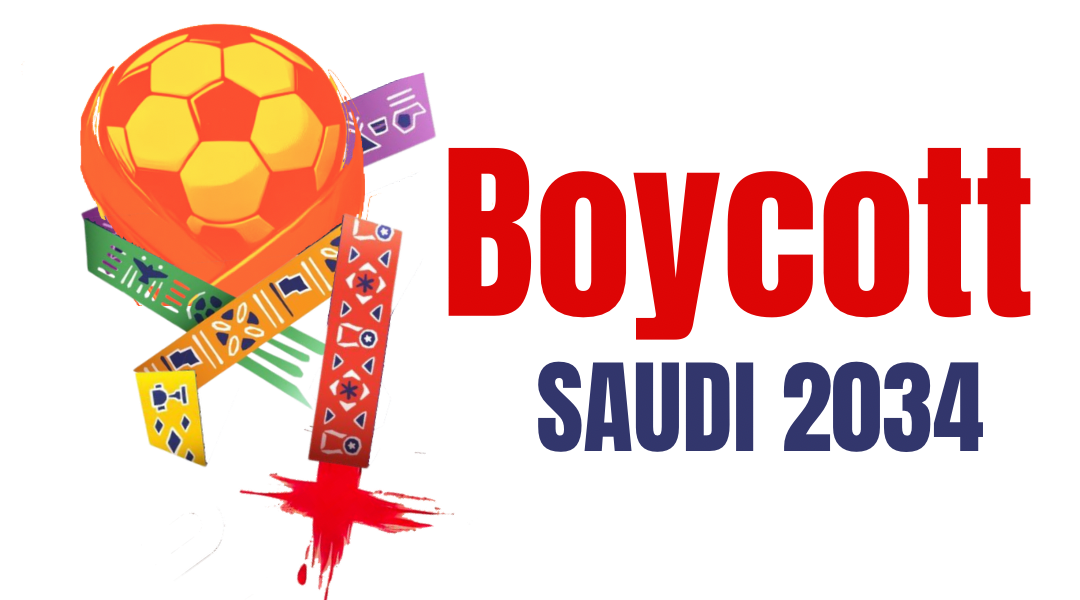
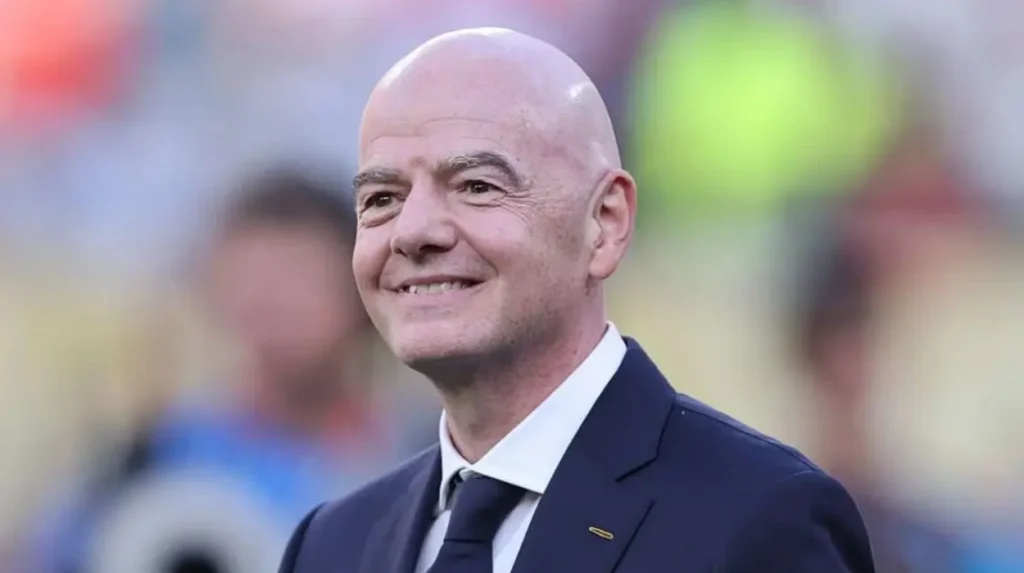
FIFA president Gianni Infantino closed the 2026 World Cup by telling critics to meditate, pray or watch football rather than question his leadership, a response that echoes a pattern stretching back through Qatar 2022 and earlier controversies. As Saudi Arabia’s preparations for 2034 begin in earnest, that pattern raises a governance question bigger than any single tournament: whether FIFA is still capable of engaging seriously with legitimate scrutiny.
FIFA president Gianni Infantino used a 15-slide personal Instagram post, reposted to FIFA’s eight million followers, to tell critics of his leadership, FIFA and the 2026 World Cup to “meditate, pray or watch a football match” rather than continue what he called spreading hate and false rumours, Yahoo Sports reported. The remarks, made as the tournament closed with Spain’s victory over Argentina, drew criticism for dismissing a set of controversies that included a referee denied entry to the United States, a suspension controversy involving President Donald Trump, visa complications for players and fans, and a boycott of the final by a major federation president. With Saudi Arabia now beginning an eight-year run-up to hosting the 2034 tournament, Infantino’s response has reopened a governance question that predates this World Cup by years: whether FIFA is capable of engaging with legitimate scrutiny, or whether it has settled into a posture of dismissing it.
Infantino Tells Critics To “Meditate, Pray Or Watch Football”
Yahoo Sports reported that Infantino’s post addressed what he called
“those behind their pens and papers, behind their screens,”
asserting that while critics were occupied with negativity, FIFA had delivered what he described as the greatest event on earth. He said the tournament had delivered total safety and security, and singled out Iran’s participation, despite the country’s active conflict with co-hosts the United States, as a success story. Infantino also addressed the visa controversies directly, arguing that critics had focused on the small number of people denied entry while overlooking the millions who were approved.
Al Jazeera’s own review of the tournament noted that FIFA is separately investigating an altercation involving Argentina’s players and staff after their final defeat to Spain, as well as allegations of racist abuse directed at an American social media influencer, matters that remained open even as Infantino declared the tournament a triumph.
A Tournament That Delivered Football And Controversy In Equal Measure
Referees Denied Entry Under US Travel Restrictions
Al Jazeera reported that Somali referee Omar Abdulkadir Artan, who would have been the first official from his country to work a World Cup, was denied entry to the United States despite holding a valid visa, under a travel ban that also covered nationals from Haiti, Iran, Senegal and Ivory Coast. An unnamed Trump administration official claimed, without providing evidence, that Artan’s exclusion was linked to associations with suspected terrorist organisations, a claim Al Jazeera noted sat uneasily alongside Artan’s standing as the Confederation of African Football’s men’s official of the year in 2025. FIFA ultimately paid Artan his full assignment fee but, according to Yahoo Sports, president Infantino said only that FIFA does not “control everything” when asked about the decision.
Trump’s Intervention In The Balogun Suspension
The tournament’s most politically charged moment came when United States forward Folarin Balogun received an automatic one-match suspension after a red card, which would have ruled him out of the round of 16 tie against Belgium. Multiple outlets, including Al Jazeera and Pulse Kenya, reported that FIFA suspended the ban after President Trump personally telephoned Infantino to request a review, a decision that drew sustained criticism from across the sport. Trump went further, publicly questioning the competence of the Brazilian referee who issued the card, Raphael Claus, telling reporters he was, in the president’s words, suspect based on his past, without offering further detail. Al Jazeera reported that the Brazilian football federation rejected any suggestion the referee had acted improperly, while FIFA itself stopped short of fully defending its own official.
Visa Bonds, Detentions And Access Problems
Beyond the headline cases, the tournament was marked by a string of access problems. TRT World reported that Iraqi striker Aymen Hussein and members of his delegation faced extensive questioning at a US airport, with a photographer travelling alongside the team ultimately denied entry, while Ghanaian midfielder Thomas Partey was refused a visa to enter Canada and missed his side’s opening match as a result. A short-lived programme requiring fans from several African nations to post financial bonds of as much as $15,000 was suspended for ticket holders after public criticism, according to reporting from Tapmad.
A Federation President Boycotts The Final
Perhaps the clearest sign of institutional strain came from within football’s own governing structures. Pulse Kenya reported that UEFA president Aleksander Ceferin boycotted the World Cup final itself, citing broader disagreements with FIFA that included its handling of the visa and access controversies, a rare public rupture between the leaders of the sport’s two most powerful bodies.
A Familiar Pattern: FIFA’s Response To Criticism Over The Years
Qatar 2022: “Today I Feel Gay, Today I Feel Disabled”
Infantino’s 2026 remarks were not without precedent. On the eve of the 2022 World Cup in Qatar, Infantino delivered an hour-long address in which he said he identified with Qatari, Arab, African, gay, disabled and migrant worker identities in order to argue that criticism of Qatar’s human rights record amounted to hypocrisy, according to Sky Sports and SBS News. <cite index=”30-1″>Infantino accused critics of World Cup host Qatar’s treatment of migrant workers of hypocrisy</cite>, arguing that engagement, not condemnation, was the way to improve conditions. CNN, as reported by Time, described the address as an explosive tirade, and Henry Winter, chief football writer for The Times, told Sky News the remarks were offensive to fans, given that Qatar criminalised homosexuality at the time. Qatar had faced sustained criticism over migrant worker deaths and treatment; the secretary general of Qatar’s own World Cup organising committee had separately estimated migrant worker deaths connected to the tournament in the hundreds.
2017: “FIFA-Bashing Has Become A National Sport”
The pattern extends further back. Addressing FIFA’s Congress in Bahrain in 2017, months after the organisation’s worst corruption crisis, Infantino dismissed ongoing criticism of FIFA as fake news and alternative facts, telling delegates, as reported by Gulf News, that FIFA-bashing had become a national sport in some countries. When a journalist asked him afterwards for a specific example of the fake news he was describing, Infantino replied, according to the Bangkok Post, that it was generally a feeling rather than a documented instance.
Why Independent Scrutiny Matters For Organisations Like FIFA
Global sporting bodies occupy an unusual position: they exercise significant regulatory and commercial power, oversee events involving hundreds of millions of pounds in public infrastructure spending, and yet are accountable to no electorate beyond their own member associations. That structure is precisely why independent journalism, human rights monitoring and governance research play an outsized role in holding organisations like FIFA to account. Distinguishing between bad-faith attacks and legitimate investigative scrutiny matters here: a fabricated claim or conspiracy theory is qualitatively different from a documented complaint, a formal legal filing, or on-the-record criticism from an elected federation president. Grouping all of it together as hate, as Infantino’s 2026 remarks and 2017 remarks both did in different ways, risks collapsing that distinction rather than addressing it.
Saudi Arabia 2034 Was Already Under Scrutiny Before A Ball Is Kicked
An Uncontested Bid And A Compressed Timeline
FIFA combined its host selection processes for the 2030 and 2034 tournaments into a single accelerated timeline, restricting 2034 bids to member associations from Asia and Oceania. Australia explored a rival bid before withdrawing, leaving Saudi Arabia as the sole candidate. NBC News reported that FIFA confirmed the kingdom’s hosting rights by acclamation at an extraordinary Congress in December 2024, with Infantino telling delegates the vote was loud and clear despite the absence of any competing bid.
Human Rights Organisations Sound The Alarm
NBC News reported that a joint statement signed by 21 human rights and labour organisations, including Amnesty International, described FIFA’s decision as a moment of great danger, warning that workers would face exploitation and death without fundamental reform in Saudi Arabia. Human Rights Watch’s director of global initiatives, Minky Worden, said in a statement carried by CBS News that FIFA was choosing to remain wilfully blind to the country’s human rights record, setting up what she described as a decade of potential abuses tied to tournament preparation. Norway’s football federation president, Lisa Klaveness, later told The Guardian, in comments carried by Play the Game, that FIFA had not followed its own governance reforms in reaching the decision.
A Formal Legal Complaint Against FIFA
Scrutiny escalated further in 2025. ESPN reported that lawyers filed a formal 30-page complaint against FIFA over its handling of the Saudi bid, arguing the organisation had failed to take adequate steps to address the kingdom’s record on freedom of expression, arbitrary detention and migrant and women’s rights. Play the Game reported that governance expert Mark Pieth, who was among those who lodged a related complaint over FIFA’s failure to implement its own human rights policy, said he was surprised no FIFA member federation had taken the organisation to a Swiss civil court over the decision, arguing that route could have made a genuine difference.
Infantino’s Personal Ties To Riyadh
Middle East Eye and World Soccer Talk both reported that Infantino’s increasingly visible personal relationship with Saudi Crown Prince Mohammed bin Salman has itself become a subject of scrutiny, with Infantino appearing at Saudi-hosted investment conferences and joining Trump on a state visit to the kingdom in 2025. Play the Game noted that Infantino is expected to present President Trump with FIFA’s newly created peace prize, a move some critics interpret as consistent with a broader pattern of courting heads of state, including leaders with documented human rights records, over the course of his presidency.
What Continued Scrutiny Of Saudi Arabia Is Likely To Focus On
Based on the concerns already raised by rights organisations, football federations and legal experts, several issues are likely to remain under sustained examination through 2034: the treatment of migrant construction workers building tournament infrastructure; press freedom and the treatment of journalists covering preparations; the male guardianship system and women’s rights; freedom of expression and the treatment of domestic dissidents; the safety and legal status of LGBTQ+ fans and players; the transparency of FIFA’s ongoing oversight mechanisms; and the broader question of whether FIFA’s sponsorship and commercial relationships in the region compromise its independence as a regulator.
Is FIFA’s Institutional Posture Becoming More Defensive?
Comparing Qatar 2022, the 2026 tournament and the early stages of Saudi 2034 preparation suggests a consistent institutional reflex rather than an isolated incident. In each case, FIFA’s leadership has responded to structured, often well-documented criticism, ranging from legal complaints to federation-level objections to investigative reporting, with rhetoric that characterises critics broadly as hostile, hypocritical or hateful, rather than engaging point by point with the substance of the claims. That pattern does not, on its own, establish that any individual allegation is true or false. But it does suggest an organisation more practised at managing the optics of criticism than at demonstrating the kind of transparent, responsive governance its own 2017 reform programme promised.
The Central Questions Ahead Of 2034
Several questions remain unresolved as preparations continue. Whether dismissing critics as motivated by hate risks discouraging the kind of legitimate oversight that has already produced formal complaints and federation-level objections. Whether FIFA has the internal capacity, or the institutional will, to distinguish between coordinated misinformation and evidence-based investigative journalism. What level of independent scrutiny is proportionate for a tournament that will draw the attention, and in many cases the direct participation, of billions of people worldwide. And what obligations FIFA carries toward the supporters, players, sponsors and host communities who have no vote in how the organisation is run, but who bear the consequences of its decisions.
Conclusion: Accountability Will Decide Whether 2034 Succeeds
Saudi Arabia’s preparations for 2034 will ultimately be judged on more than stadiums, attendance figures and commercial revenue. They will be judged on whether FIFA, as the tournament’s governing authority, is willing to engage seriously with the human rights, labour, press freedom and governance concerns that have already been documented by federations, lawyers and rights organisations, rather than folding them into the same category as the misinformation and bad-faith attacks Infantino condemned in his closing remarks on 2026. Independent scrutiny is not, in itself, a threat to the World Cup’s success. Left unanswered, the pattern established across three consecutive tournament cycles suggests the opposite may be true: that an unwillingness to engage with legitimate criticism is what ultimately puts the credibility of the event, and of FIFA itself, at risk.