
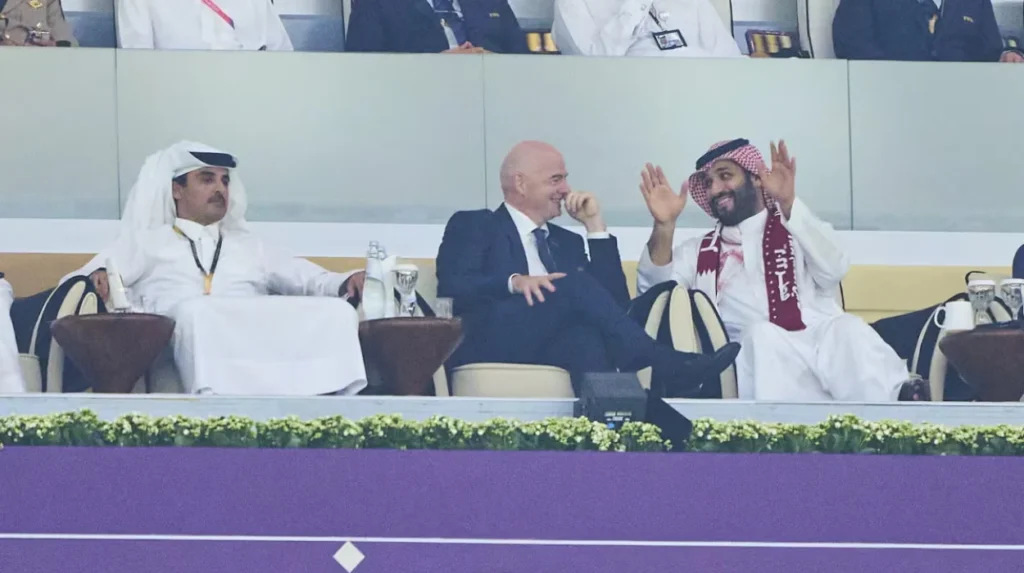
Renewed diplomatic efforts to advance Saudi Arabia–Israel normalisation, reportedly championed by the late US Senator Lindsey Graham, have unfolded alongside continued international scrutiny of the humanitarian crisis in Gaza. These developments raise consequential questions for FIFA’s human-rights commitments and the governance framework surrounding Saudi Arabia’s role as host of the 2034 FIFA World Cup.
Reported Diplomatic Developments
According to Times of Israel, a report indicates that Senator Graham had been preparing a push for Israel-Saudi ties after the Israeli election, believing the regional dynamics created an opening for normalisation. Axios journalist Jonathan Swan reported that Graham saw Saudi-Israel normalisation as the defining prize of a broader postwar settlement and had discussed the initiative with top officials. The Jerusalem Post, citing Axios, noted Graham aimed to reach Israel-Saudi normalization before the end of the year as a prize connected to the wider regional conflict.
The Hill reported that Graham turned focus to possible “historic” Saudi-Israeli ties after Iran strikes, signalling the diplomatic momentum behind the effort. Public TV (India) reported that Graham maintained the success of the initiative hinged on clearing domestic political obstacles, including mobilising sufficient support in both countries. Hindustan Times explained that Graham viewed Saudi-Israel ties normalisation as the biggest achievement in a wider post-war plan for West Asia.
Positions of Key Stakeholders
Saudi Arabia
Saudi Arabia has long signalled that normalisation with Israel would require substantial US security guarantees and progress towards a Palestinian statehood pathway, though precise public conditions have varied over time. The kingdom’s strategic calculus balances regional de-escalation, US alliance management, and domestic and pan-Arab legitimacy concerns, especially amid the Gaza humanitarian crisis.
Israel
Israeli governments have pursued normalisation with Arab states as a strategic priority, with Saudi Arabia representing the most significant potential breakthrough. Domestic political considerations, including coalition dynamics and public opinion shaped by the Gaza war, influence the timing and substance of any agreement.
United States
US administrations have treated Saudi-Israel normalisation as a cornerstone of Middle East stabilisation strategy. According to multiple reports, Graham’s initiative was understood to be Trump-backed, reflecting bipartisan interest in sealing a deal that would reshape regional alignments.
Other Stakeholders
Palestinian leadership and many Arab publics view normalisation without credible Palestinian statehood progress as unacceptable, especially amid high civilian casualties and displacement in Gaza. European governments, UN agencies, and human-rights organisations emphasise compliance with international humanitarian law and accountability for alleged violations as prerequisites for durable regional peace.
Gaza Humanitarian Crisis and International Scrutiny
The humanitarian situation in Gaza continues to attract intense international scrutiny, with UN agencies and human-rights groups documenting widespread civilian harm, displacement, and restrictions on aid. This context shapes the diplomatic environment for any Saudi-Israel deal, as Riyadh faces domestic and regional pressure to link normalisation to tangible improvements for Palestinians.
Human Rights Watch and other organisations have issued joint statements warning that awarding the 2034 World Cup to Saudi Arabia, despite severe known risks, exposes residents, migrant workers and visiting fans to potential abuses. DW reported that Saudi Arabia’s poor human rights, free speech and labour rights record were effectively ignored in the hosting decision.
FIFA’s Human Rights Policy and 2034 Hosting Obligations
FIFA’s Human Rights Policy commits the organisation to respect human rights in line with the UN Guiding Principles on Business and Human Rights (UNGPs), including preventing and mitigating human-rights risks connected to its activities and providing remedy where it has contributed to harm.
Bid and Hosting Requirements
FIFA’s bidding and hosting requirements for the 2034 World Cup include obligations to protect labour rights, ensure non-discrimination, safeguard freedom of expression and assembly, and provide access to justice. However, ALQST, a human-rights organisation, released a briefing arguing that Saudi Arabia’s bid “fails” to meet FIFA’s human rights requirements and creates a direct risk of abuse.
The report critiques the Saudi “Bid Book” for limited focus on human rights, and challenges the independence of the AS&H Clifford Chance “Independent Context Assessment”, which was criticised by eleven civil society organisations as “shockingly poor”. ALQST also argues that the Saudi Arabian Football Federation’s “Human Rights Strategy” presents an “uncritically positive view” based on limited findings.
Beyond Tournament Operations
FIFA’s policy language suggests responsibilities extend beyond tournament-specific operations to broader human-rights and humanitarian considerations where FIFA’s activities may have adverse impacts. Human-rights groups contend that infrastructure construction, land seizures, forced evictions, and restrictions on civil society in host countries fall within FIFA’s due-diligence obligations under the UNGPs.
Governance, Transparency and Reputational Issues
Labour Rights and Migrant Workers
ALQST’s report highlights prevailing labour-rights violations and plans for extensive infrastructure construction as creating “serious risks” for exploitation and death “on a massive scale”. Human Rights Watch has previously contacted Jeddah Central Development Company over allegations of forced displacement linked to tournament venues.
Freedom of Expression and Press Freedom
The criminalisation of human-rights activity and journalism in Saudi Arabia accentuates risks for other thematic areas, including spectator safety, fan expression, and media access during the tournament. International press-freedom standards expected of World Cup host nations include unrestricted media access, protection for journalists, and legal safeguards against arbitrary detention.
Land Seizures and Forced Evictions
Reports indicate “grave abuses” have already taken place at NEOM and Jeddah Central, raising concerns about displacement and lack of effective remedy for affected communities.
Discrimination and Access to Justice
ALQST identifies discrimination based on identity, gender, religion and sexual orientation, alongside a vague legal framework and criminal justice system lacking transparency, as key concerns. FIFA’s non-discrimination obligations and access-to-justice requirements are directly implicated.
Civil Society, Sponsors and Football Stakeholders
Human-rights organisations, trade unions, fans groups and migrant-worker representatives issued a joint statement arguing that FIFA’s human-rights policies have been “exposed as a sham” by the 2034 award process, which lacked competitive bidding and meaningful protections. BBC sports editor Dan Roan explained that FIFA’s evaluation report raised issues about whether the tournament could improve Saudi human rights, reflecting the governance debate.
Sponsors and commercial partners face heightened reputational risk if tournament preparation or delivery is associated with documented abuses. Football stakeholders, including national associations and player unions, may press for binding safeguards, independent monitoring, and enforceable remedy mechanisms.
Sportswashing, State Reputation and Geopolitical Influence
The Saudi-Israel normalisation push intersects with wider debates about sportswashing and state reputation management through mega-events. Critics argue that hosting the World Cup can be used to legitimise repressive rule and deflect attention from human-rights concerns, while proponents contend that engagement and conditional hosting can drive reform.
Geopolitical influence through sport is evident in Saudi Arabia’s strategic use of football investment and event hosting to enhance global standing, diversify its economy, and reshape regional alliances. Ethical hosting, transparency, and accountability remain central to whether such initiatives align with international norms or exacerbate governance deficits.
Implications for FIFA’s Oversight of 2034
The reported diplomatic developments do not, in themselves, establish human-rights violations by FIFA or Saudi authorities. However, they contribute to an environment where FIFA’s commitment to internationally recognised human-rights standards for World Cup hosts is tested.
Key governance issues relevant to FIFA’s ongoing oversight include:
- Ensuring binding labour protections and enforceable remedy for workers involved in tournament infrastructure.
- Safeguarding freedom of expression, assembly and press access before, during and after the tournament.
- Preventing forced evictions and ensuring effective consultation and compensation for affected communities.
- Establishing transparent, independent monitoring of human-rights risks and regular public reporting.
- Clarifying whether FIFA’s Human Rights Policy extends to broader humanitarian considerations linked to host-country conduct where FIFA’s activities may have adverse impacts.
The renewed push for Saudi-Israel normalisation, as reported by multiple outlets, unfolds against a backdrop of persistent humanitarian concerns in Gaza and documented human-rights risks associated with the 2034 World Cup. For FIFA, the question is whether its human-rights commitments and host-country responsibilities will be operationalised through binding safeguards, independent oversight and effective remedy, or remain largely aspirational. International human-rights organisations, civil society groups, football stakeholders and sponsors are likely to interpret these developments through the lens of accountability, ethical hosting and the role of global sporting events in shaping state reputation.