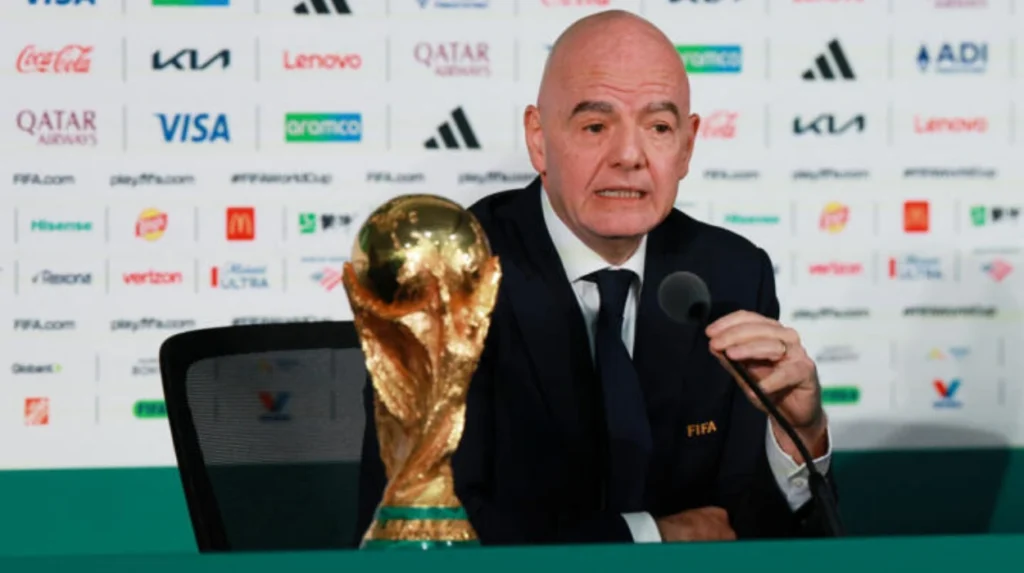
As Gianni Infantino fights to keep his job following the collapse of his World Cup investment plan, analysis of his presidency shows a decade-long pattern of deepening financial ties between FIFA and Saudi Arabia, from a $100 million-a-year Aramco sponsorship to a free World Cup streaming deal linked to a Saudi investment fund. With Morocco and Saudi Arabia now central to the political battle over FIFA’s future, the pattern raises fresh questions about how closely the tournament’s next two hosts are entwined with the man overseeing them.
FIFA’s leadership crisis has placed the Middle East at the centre of a political battle over the future of world football, with upcoming World Cup hosts Morocco and Saudi Arabia playing starring roles as Gianni Infantino fights to keep his job, Al-Monitor reported. The crisis, triggered by Infantino’s now-abandoned plan to sell a 20% stake in a new $20 billion commercial subsidiary to outside investors, has renewed scrutiny of a much longer pattern: a decade of deepening financial ties between FIFA under Infantino and Saudi Arabia, the kingdom set to host the 2034 World Cup.
Middle East Takes Center Stage In FIFA’s Leadership Crisis
Al-Monitor reported that the crisis erupted after the conclusion of the 2026 World Cup, when reports revealed Infantino was pursuing a plan to bring outside investment into FIFA through a new entity, FIFA Forward Enterprise, backed in part by investor Joshua Kushner, whose brother Jared Kushner is a son-in-law of President Trump. UEFA denounced the proposal as an opaque backroom deal, and FIFA shelved the plan within days of its announcement, but the controversy has continued to build, with federation officials calling for Infantino’s resignation and open questions over whether he can secure another term when FIFA members vote in March 2027.
A Decade Of Deepening Saudi Financial Ties
Independent analysis of Infantino’s presidency has traced a consistent pattern of financial relationships between FIFA and Saudi Arabia stretching back years before the current crisis, beginning with Infantino and Crown Prince Mohammed bin Salman sharing a box together at the opening ceremony of the 2022 Qatar World Cup. Three months later, FIFA selected Saudi Arabia to host the 2023 Club World Cup.
The Aramco Sponsorship Deal
In April 2024, FIFA announced a four-year sponsorship agreement with Aramco, the Saudi state-owned oil and chemicals company, covering major rights to both the 2026 World Cup and the 2027 Women’s World Cup. The deal, valued at around $100 million annually, ranks among the most lucrative sponsorship agreements in the sport’s history.
PIF’s Direct Stake In The Club World Cup
Ahead of the inaugural expanded Club World Cup, FIFA confirmed that Saudi Arabia’s Public Investment Fund would join the tournament as an official partner. PIF is also the majority shareholder of Saudi club Al-Hilal, which took part in the same tournament and earned an estimated $10 million for its participation, a detail not highlighted in FIFA’s own announcement of the sponsorship.
The DAZN Free Streaming Deal
In December 2024, FIFA revealed that streaming broadcaster DAZN, which had been operating at a loss, had purchased the rights to show the Club World Cup for free on its platform, in a deal reported to be worth around $1 billion. Less than two months later, Surj Sports, the sports investment arm of Saudi Arabia’s sovereign wealth fund, purchased a minority stake in DAZN for a reported $1 billion, a sequence of transactions that drew scrutiny over how closely FIFA’s broadcast decisions and Saudi investment activity had come to align.
A Pattern That Predates The Current Crisis
The current investment plan is not the first time Infantino has pursued outside capital tied to Saudi Arabia. In 2018, he proposed a secretive $25 billion offer over 12 years with SoftBank of Japan to create new global competitions, seemingly backed by Saudi Arabian money, after SoftBank had received tens of billions of dollars in investment from Saudi Arabia’s sovereign wealth fund. The plan ultimately failed after fierce resistance from UEFA, which saw threats to its own prize assets, the Champions League and the European Championship, a dynamic echoed almost precisely in UEFA’s response to Infantino’s latest plan more than seven years later.
The Kushner Connection Adds A New Layer
The current crisis has added a further dimension to scrutiny of FIFA’s financial relationships in the Gulf. Saudi Arabia’s Public Investment Fund is reported to be the largest investor in Jared Kushner’s private equity fund, Affinity Partners, having committed $2 billion to the fund in 2021, even after PIF’s own investment screening committee recommended against the deal, citing Kushner’s inexperience and what it considered excessive fees. That recommendation was overruled by Crown Prince Mohammed bin Salman, who chairs PIF’s board. Joshua Kushner’s fund, Thrive Eternal, is reported to be the lead investor behind Infantino’s now-abandoned FIFA Forward Enterprise plan, connecting the current controversy to the same web of Saudi-linked capital that has surrounded the Kushner family’s business dealings more broadly.
Saudi Arabia’s Own Calculated Silence
Despite this history of close financial ties, Saudi Arabia has notably declined to publicly back Infantino during the current crisis, according to reporting citing sources close to the situation. Infantino is said to be concerned that he has not received public support from a country previously among his strongest backers, with reports suggesting the kingdom’s own internal football federation elections, due at the end of August, are a significant factor behind its silence rather than any shift in its underlying relationship with Infantino.
Why This Matters For The 2034 World Cup
The scale and duration of FIFA’s financial entanglement with Saudi Arabia, spanning sponsorship deals, broadcast rights, sovereign wealth fund investments and now a reported role in the Kushner-linked investment plan that triggered this crisis, adds significant weight to long-standing criticism that Saudi Arabia’s hosting of the 2034 World Cup was secured through a relationship defined by mutual financial benefit rather than a transparent, independently scrutinised bidding process. A FIFA presidency whose major commercial decisions have repeatedly tracked so closely alongside Saudi financial interests raises direct questions about how independently FIFA can be expected to oversee the kingdom’s hosting preparations over the next eight years.
Broader Debate Over Sportswashing And Accountability
Critics of Saudi Arabia’s growing footprint across global sport, from golf and boxing to Formula One and now football, have long argued that the kingdom’s investment strategy is not gradual mission creep but a calculated geopolitical strategy that Western sporting institutions have been largely willing to accept. The pattern of financial ties documented across Infantino’s presidency, and its direct connection to the investment plan now threatening his leadership, gives that argument considerable additional weight. Neither FIFA nor Infantino has addressed in detail how these financial relationships might affect the transparency of FIFA’s oversight of Saudi Arabia’s 2034 preparations. For federations, rights organisations and fans already questioning FIFA’s governance under Infantino, the full extent of the financial ties now coming to light is likely to remain a central part of that debate as his fight to remain in office continues.