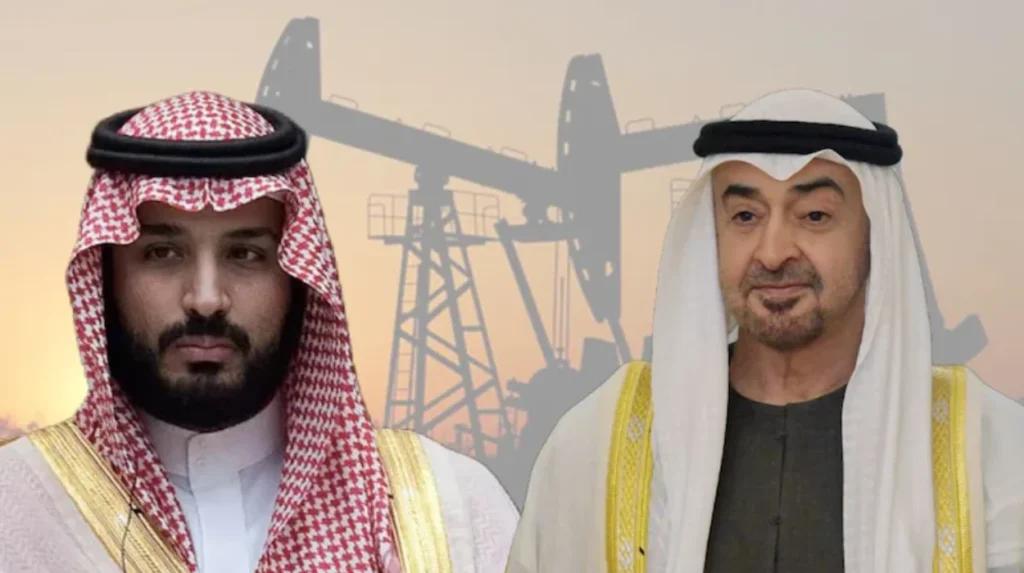
Saudi Arabia’s successful bid to host the FIFA World Cup in 2034 has been framed as a defining milestone in the kingdom’s transformation. Under Crown Prince Mohammed bin Salman’s Vision 2030, the tournament is intended to signal a shift away from oil dependency and toward a diversified, globally integrated economy. Like previous mega-events in the Gulf, it is also a carefully calibrated exercise in image-building: projecting stability, modernity, and openness to international audiences. Yet beneath this narrative lies a more complex and less reassuring reality. Recent tensions within OPEC, culminating in the United Arab Emirates’ decision to exit the alliance, raise questions about Saudi Arabia’s economic trajectory and its capacity to sustain the leadership role it seeks to showcase through global sport.
Vision 2030 and Oil Dependence
Vision 2030 has always rested on an implicit contradiction. On the one hand, it promises to reduce reliance on hydrocarbons through investments in tourism, technology, and infrastructure. On the other, it remains heavily financed by oil revenues, which continue to underpin state spending and sovereign investment vehicles such as the Public Investment Fund. The scale of Saudi Arabia’s ambitions—from futuristic cities like NEOM to high-profile sporting acquisitions—depends on sustained oil income. In this sense, diversification is not a departure from oil but an extension of it. The kingdom’s ability to deliver a successful World Cup, therefore, is closely tied to the same commodity it seeks to move beyond.
OPEC Fractures and the UAE Exit
This tension has become more visible as the cohesion of OPEC has come under strain. The UAE’s exit from the organization, while framed diplomatically, reflects deeper disagreements over production quotas, market strategy, and long-term positioning in a shifting global energy landscape. For decades, Saudi Arabia has acted as OPEC’s de facto leader, leveraging its spare capacity and financial weight to manage supply and stabilize prices. The departure of a key Gulf partner does not in itself dismantle the cartel, but it signals a weakening of the consensus that has traditionally underpinned Saudi influence.
Economic Credibility Under Pressure
The significance of this development lies less in immediate market impact than in what it reveals about regional coordination. The UAE has increasingly pursued an independent economic strategy, prioritizing market share and diversification over collective restraint. This divergence complicates Saudi Arabia’s efforts to maintain price discipline, particularly at a time when global demand forecasts are uncertain and energy transitions are accelerating. If OPEC’s internal cohesion erodes further, Saudi Arabia may find it more difficult to balance its dual objectives of maximizing revenue and preserving long-term market stability.
At the center of this dynamic is the leadership style of Energy Minister Prince Abdulaziz bin Salman, whose approach has been characterized by a high degree of centralization and assertive market management. His public interventions and willingness to enforce production cuts have, at times, reinforced Saudi Arabia’s authority within OPEC+. However, they have also exposed the limits of that authority when confronted with diverging national interests. The UAE’s departure can be read, in part, as a response to a system perceived as increasingly rigid and dominated by Saudi priorities.
Geopolitics and Regional Cohesion
This raises broader questions about the sustainability of Saudi Arabia’s economic model. If oil revenues remain volatile and coordination within OPEC becomes more fragile, the financial foundation of Vision 2030 may face greater uncertainty. Large-scale projects tied to the World Cup—stadiums, transport infrastructure, hospitality networks—require long-term planning and significant capital outlays. While the kingdom possesses substantial reserves, the margin for error narrows in an environment where oil prices are subject to both geopolitical shocks and structural shifts in demand.
The implications extend beyond economics into the realm of geopolitics. Saudi Arabia’s regional leadership has long been anchored in its ability to act as a stabilizing force within the Gulf and the broader Middle East. Yet recent years have seen a more fragmented landscape, with states pursuing increasingly autonomous policies. The UAE’s strategic divergence, alongside evolving relationships with other regional and global powers, suggests a move away from the kind of unified bloc that once amplified Saudi influence. In such a context, the World Cup becomes not only a domestic project but also a test of the kingdom’s capacity to project coherence and authority on the international stage.
Sportswashing Under Strain
Mega-events have often been used by states to consolidate narratives of progress and stability. For Saudi Arabia, the 2034 World Cup is intended to encapsulate the successes of Vision 2030, offering a tangible demonstration of economic transformation and global integration. However, the effectiveness of such narratives depends on their alignment with underlying realities. When economic and geopolitical signals point in a different direction, the risk is that the event becomes a site of scrutiny rather than affirmation.
This is where the notion of “sportswashing under strain” becomes relevant. The term is often used to describe how governments leverage sport to enhance their international image, but it also implies a degree of control over the narrative. In Saudi Arabia’s case, that control may be harder to maintain if external developments—such as OPEC fragmentation or oil market volatility—continue to shape perceptions. Investors, partners, and international audiences are likely to assess the World Cup not in isolation but as part of a broader evaluation of the kingdom’s stability and credibility.
Credibility on the Global Stage
None of this is to suggest that Saudi Arabia is incapable of hosting a successful tournament. The country has demonstrated significant organizational capacity in recent years, and its financial resources remain considerable. Nor does the UAE’s exit from OPEC necessarily herald a systemic breakdown. However, it does introduce an element of uncertainty that complicates the narrative of seamless transformation. A World Cup bid built on the promise of diversification inevitably invites scrutiny of the structures that still underpin the economy.
The question, then, is not whether Saudi Arabia can deliver the infrastructure or logistics required for a global sporting event. It is whether the broader context in which the event takes place supports the image it seeks to project. Can a state navigating internal tensions within its primary economic alliance convincingly present itself as a model of stability and forward-looking governance? Can diversification narratives hold when oil remains both the engine of growth and a source of vulnerability?
These questions are unlikely to be resolved in the immediate term. Vision 2030 is, by design, a long-term project, and its outcomes will unfold over decades rather than years. Yet the timeline of the World Cup compresses these dynamics into a single moment of global attention. By 2034, Saudi Arabia will not only be judged on the success of the tournament itself but also on the trajectory of its economic and geopolitical positioning.
In this sense, the World Cup functions as both a showcase and a stress test. It offers an opportunity to demonstrate progress, but it also exposes the tensions inherent in the kingdom’s current path. The exit of the UAE from OPEC serves as a reminder that regional leadership is neither static nor guaranteed, and that economic transformation cannot be insulated from the structures it seeks to transcend.
Ultimately, the credibility of Saudi Arabia’s World Cup ambitions will depend on the extent to which its narrative of diversification aligns with observable realities. If oil dependency remains pronounced and regional coordination continues to fray, the tournament risks highlighting these contradictions rather than obscuring them. For a project designed to symbolize a new era, that would represent a more complicated legacy—one in which the spectacle of global sport is overshadowed by the unresolved challenges of economic and geopolitical transition.