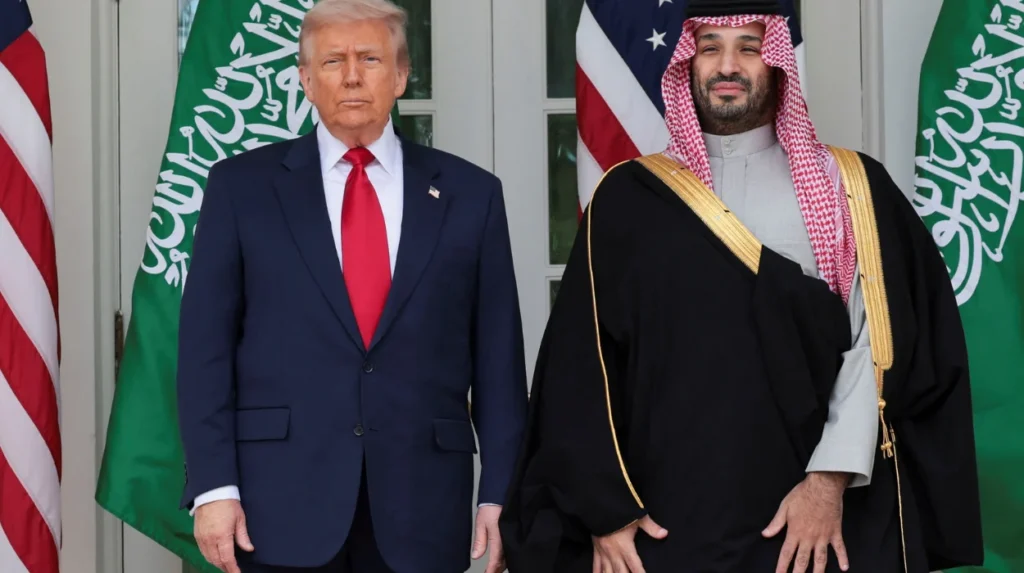
Less than 24 hours after signing a civilian nuclear agreement with Saudi Arabia, President Trump declared on social media that the deal is “totally subject” to the kingdom joining the Abraham Accords, a condition neither government had mentioned at signing. The episode has thrown the agreement into doubt and offered a fresh illustration of how much Gulf diplomacy still depends on the shifting positions of individual leaders, a question with direct relevance to Saudi Arabia’s preparations to host the 2034 World Cup.
President Donald Trump placed a new condition on the newly signed US-Saudi civilian nuclear agreement on Thursday, a day after formally approving it, saying the kingdom must now join the Abraham Accords and normalise relations with Israel, CNN reported. Trump wrote in a social media post that the deal
“will be approved, but is totally subject to Saudi Arabia joining the very respected and successful Abraham Accords,”
while also denying the agreement would allow uranium enrichment, contradicting earlier reporting on its terms. White House press secretary Karoline Leavitt told reporters that if the Saudis do not join, “the deal is off,” according to The Hill, even though neither the US Energy Department nor the Saudi government had mentioned any such condition when the agreement was announced on Wednesday.
A Deal Reversed By Social Media Post
CNN reported that Trump’s Thursday post came without any advance notice to Saudi leadership, and that the president was reportedly already frustrated that Energy Secretary Chris Wright had announced the deal without first informing him. That frustration was compounded, CNN said, by a wave of criticism from nonproliferation experts and conservative commentators after the terms became public. PBS and the Associated Press reported that the agreement could still allow for the construction of a uranium-enrichment facility in Saudi Arabia following a joint study between Washington and Riyadh, and that it does not include the International Atomic Energy Agency’s additional protocol, which would allow for more extensive monitoring and inspections.
White House Says Saudi Arabia Must Join Abraham Accords
NPR reported that White House press secretary Karoline Leavitt said Trump had not spoken with Saudi leadership before posting the new condition, though she said he had previously discussed the importance of joining the Abraham Accords with Gulf and Arab allies. Leavitt said the administration would continue talks with Saudi counterparts in the hope of finalising the deal and seeing the kingdom join the accords “very soon.”
A Longstanding Condition Trump Had Reportedly Dropped
CNN reported that normalisation with Israel had historically been a condition of US nuclear cooperation with Saudi Arabia, an approach that held as recently as the Biden administration, according to a source familiar with the matter. That source told CNN the condition became untenable for Riyadh after Israel’s response to the 7 October 2023 Hamas attack. Separate Reuters reporting had indicated that the Trump administration subsequently moved away from linking the two issues altogether, making Thursday’s reversal a return to a position Washington had reportedly abandoned.
Saudi Arabia Pushes Back Behind The Scenes
The Times of Israel reported that Saudi Arabia’s longstanding position has been that it will not join the Abraham Accords without a clear pathway to Palestinian statehood, a position the current Israeli government rejects. The outlet reported that the Saudi Embassy in Washington did not immediately respond to a request for comment on Trump’s post, but that journalist Laura Rozen quoted an unnamed Saudi source saying the agreement had already been signed and that there was nothing left to renegotiate, adding that social media posts do not overturn signed agreements.
Lawmakers And Experts Question What The Deal Even Means
The Hill reported that Andrea Stricker, deputy director of the nonproliferation programme at the Foundation for Defense of Democracies, said Trump’s comments might inadvertently help delay the agreement, since it had already been signed and Saudi Arabia now had to decide whether it wished to normalise relations with Israel. Democratic congressman Brad Sherman of California told The Hill he could not say with confidence whether the civil nuclear agreement was now void pending Saudi Arabia’s agreement to the Abraham Accords. NPR quoted Steven Cook, a senior fellow for Middle Eastern studies at the Council on Foreign Relations, questioning whether a social media post could supersede a signed diplomatic agreement, and noting the frustration other countries have expressed over similar unpredictability from Washington.
Israel Welcomes The New Condition
NPR reported that Israeli Prime Minister Benjamin Netanyahu’s office welcomed Trump’s condition, describing Saudi Arabia’s potential accession to the Abraham Accords as a historic step forward for regional peace. The reversal followed earlier alarm in Israel over the original, unconditioned version of the deal; former Israeli defence and foreign minister Avigdor Liberman had separately warned, in comments carried by The Times of Israel, that allowing enrichment on Saudi soil would cross a red line and risk setting off a regional nuclear arms race.
Why This Matters For Saudi Arabia’s 2034 World Cup Bid
Saudi Arabia is preparing to host the FIFA World Cup in 2034, a commitment that requires roughly a decade of predictable planning, sustained international cooperation, and a stable diplomatic environment. An agreement of major strategic significance being announced, reversed in substance and thrown into public doubt within a single news cycle illustrates precisely the kind of volatility that critics of the 2034 hosting decision have warned could complicate the tournament’s build-up.
A Pattern Of Policy Decided By Presidential Post
This is not an isolated case of unpredictable Gulf diplomacy. Saudi Arabia has separately clashed with Washington in recent weeks over the use of its bases during the Iran conflict, and continues to navigate an active security threat from Yemen’s Houthi movement along its southern border. Added to that list is now a headline nuclear agreement whose terms appear to have been rewritten by the US president in a single social media post, without consultation with the other government involved.
Gulf Stability Continues To Rest On A Handful Of Individuals
Steven Cook’s question, of whether a social media post can override a signed diplomatic agreement, cuts to the heart of a broader concern relevant to any organisation planning a decade-long commitment in the region: how much of Gulf stability currently depends on the personal, and often unpredictable, decisions of a small number of leaders in Washington, Riyadh and Tel Aviv, rather than durable institutional agreements. For FIFA, national federations and travelling supporters planning around a 2034 tournament, that dependency is difficult to ignore.
Broader Debate Over Accountability And Sportswashing
Saudi Arabia’s critics have long argued that its investment in global sport is intended to project an image of stability and reliability that does not always match its underlying diplomatic and security position. A nuclear agreement unravelling within 24 hours of being signed, tied to an unresolved and politically fraught question over recognition of Israel, adds fresh weight to that argument. Neither FIFA nor the Saudi government has commented publicly on how this episode might affect confidence in Saudi Arabia’s broader international commitments, including its 2034 World Cup preparations. For international stakeholders watching Gulf diplomacy play out in real time on social media, that silence leaves an open question likely to resurface as the tournament draws closer.