
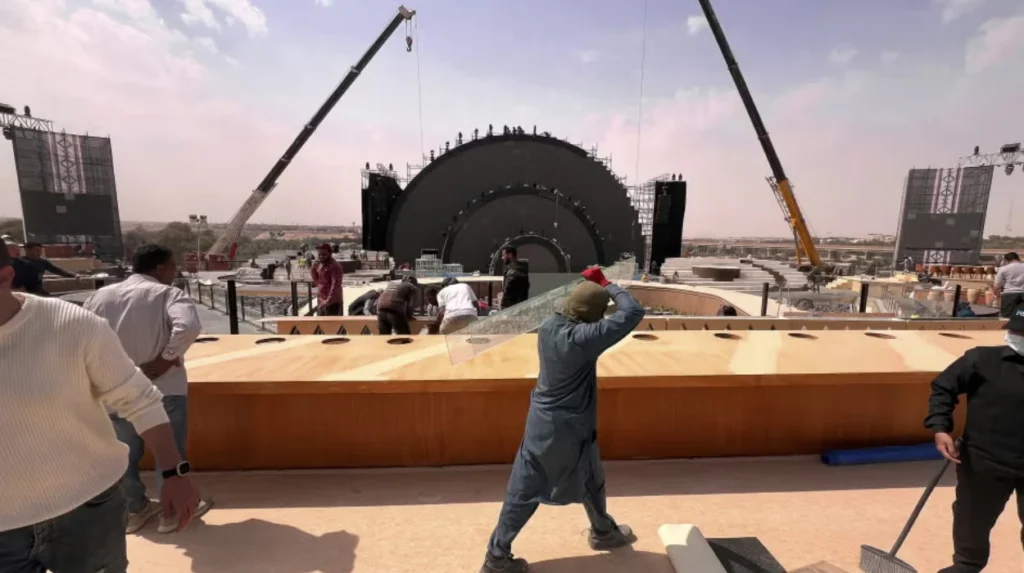
Human Rights Watch’s latest reporting, backed by UN experts, shows that Saudi Arabia’s labor governance problem is no longer just a domestic rights issue; it is now embedded in the country’s sports strategy, infrastructure buildout, and global branding effort. The core concern is familiar but unresolved: reforms have narrowed some formal restrictions, yet the kafala-style dependency system continues to shape migrant workers’ lives in practice, leaving employers with disproportionate control over residency, mobility, and exit from the country. For a state seeking to host megaprojects, stadiums, and eventually the 2034 FIFA World Cup, that gap between policy announcement and workplace reality is the central analytical fault line.
Labor Reform Claims Under Scrutiny
Saudi officials have presented labor reform as evidence of modernization, particularly since the 2021 Labor Reform Initiative, but the evidence assembled by Human Rights Watch and echoed by UN experts suggests that legal change has not translated into reliable protection. The repeated pattern is not subtle: workers remain vulnerable to wage theft, recruitment-fee debt, document retention, job-transfer obstruction, and unsafe conditions, even where the law nominally prohibits such abuses. That matters because labor governance is judged not by the existence of reform text, but by whether workers can actually exercise rights without retaliation.
The UN experts’ warning, issued in the context of Saudi Arabia’s preparations for the 2034 World Cup, is significant because it frames the issue as systemic rather than episodic. Their concern is that Saudi Arabia’s labor model still permits the same power imbalance that has long defined kafala systems across the Gulf: the worker’s legal status depends on the employer, and that dependency suppresses meaningful bargaining. In practical terms, that means a reform can exist on paper while the real labor market remains controlled through sponsor leverage, administrative hurdles, and fear of job loss.
The Legacy of Kafala
The enduring relevance of kafala is that it does not need to remain unchanged in law to retain influence in practice. HRW’s reporting says Saudi Arabia removed the term from its labor law years ago, but did not eliminate the structural dependence that links residency and work authorization to sponsor control. UN experts made the same basic point: unless workers can freely change jobs, leave abusive employment, and access remedies without employer permission, the system remains abusive in substance even if the terminology has changed.
That is why enforcement gaps matter as much as formal statutes. Amnesty International’s recent reporting on Riyadh Metro labor conditions described weak inspections, persistent passport confiscation, and a compliance regime that tends to prioritize documentation and Saudization targets over worker protection. This is a familiar governance pattern in the Gulf labor market: the state can proclaim modernization, but if oversight is designed around labor supply management rather than rights enforcement, the employer remains the real regulator of daily life.
Migrants Build The Boom
Saudi Arabia’s current investment cycle depends heavily on migrant labor, and the scale is large enough to shape the country’s entire development model. HRW says there are 13.4 million migrant workers in the kingdom, and that they are the engine of the construction and service sectors feeding Vision 2030, NEOM, the Red Sea Project, and related giga-projects. That dependence creates a structural contradiction: the state needs large numbers of low-wage foreign workers to deliver its economic transformation, yet the same workers are often denied the labor security that would make the transformation credible under international scrutiny.
The report is especially relevant to sports because Saudi Arabia’s global sporting ambitions are intertwined with massive physical expansion. HRW says FIFA’s 2034 World Cup plans involve 11 new stadiums, four refurbished ones, more than 185,000 hotel rooms, and extensive transport infrastructure. Those are not symbolic projects; they are labor-intensive construction programs that will draw on the same migrant workforce already documented as facing wage theft, overwork, and poor living conditions. In sports reporting terms, the event is not being built on branding alone; it is being built on labor relations.
Sports Branding And Risk
Saudi Arabia has used sport as a diplomatic and commercial amplifier, and that makes labor conditions part of the event’s legitimacy test rather than a peripheral concern. HRW notes that sports promotion sits inside Vision 2030’s larger effort to turn the kingdom into a “global investment powerhouse,” with the Public Investment Fund financing both prestige sports assets and the infrastructure around them. The strategic logic is straightforward: sport helps diversify the economy, attract capital, and reshape the country’s international image.
But the same strategy exposes Saudi Arabia to reputational risk if labor standards remain unresolved. FIFA’s own bidding principles require respect for human rights and labor standards, yet HRW argues that the 2034 bid process did not adequately confront the scale of existing abuses. That creates a familiar governance dilemma in global sport: the institution benefits from host-state ambition and capital, but risks inheriting the host’s labor problems if it treats reform promises as substitutes for verified enforcement. The result is not merely reputational damage; it raises questions about whether the event can credibly claim compliance with the standards it publicly endorses.
Enforcement Gaps And Accountability
The strongest criticism in the HRW material is not that Saudi Arabia lacks rules, but that rules are routinely under-enforced or structured too weakly to deter abuse. HRW says employers continue to interfere with job transfers even after reforms, and that workers still face pay delays, contract substitution, recruitment debt, and retaliation when they speak out. The report also says many worker deaths are not properly investigated and are often misclassified as natural causes, leaving families without compensation.
That last point is particularly important for sports and infrastructure projects, because the legitimacy of a mega-event depends on whether worksite risk is monitored honestly. If deaths are not accurately classified, then occupational safety systems cannot improve in a meaningful way, and public reporting becomes less a tool of accountability than of image management. In governance terms, that is the difference between formal compliance and real institutional capacity. Saudi Arabia may publish policy updates, but if injured workers, bereaved families, and recruitment victims cannot secure remedy, the legal framework remains only partially functional.
Economics Of Dependency
There is also an economic reason the problem persists. Saudi Arabia’s development model relies on low-cost migrant labor to control construction costs and meet aggressive deadlines, especially on projects that are geographically remote and politically central. HRW notes that tight deadlines and isolated sites reduce workers’ access to embassies, community networks, and practical support. That isolation is not incidental; it is a labor-control mechanism that makes worker dependence easier to manage.
This is where sports infrastructure becomes a governance stress test. Stadiums, airports, roads, rail, hotels, and service sectors all require synchronized labor deployment under deadline pressure, which tends to magnify power imbalances in the labor market. When a project’s commercial and political value depends on speed, the incentive is to treat labor as a variable to be optimized rather than as a rights-bearing constituency. Saudi Arabia’s challenge is that the same economic formula that accelerates delivery also increases the probability of abuse.
What The Scrutiny Means
The UN experts’ intervention matters because it broadens the accountability frame beyond Saudi Arabia itself. It places responsibility not only on the state, but also on FIFA, the Public Investment Fund, contractors, sponsors, and other international actors that benefit from the system’s output. HRW’s reporting makes clear that companies involved in giga-projects can be “causing, contributing to, and directly linked to” labor abuses unless they conduct serious due diligence and remediation.
That is the central tension for Saudi Arabia’s global sports project. The kingdom wants to be seen as a reliable host, investor, and partner in international sport, yet it remains under sustained criticism for a labor system that concentrates power in employers’ hands and weakens workers’ ability to defend themselves. In the end, the issue is not whether Saudi Arabia can build the infrastructure. It clearly can. The question is whether it can do so under labor governance conditions that international sport can defend without contradiction.
The Governance Test Ahead
Saudi Arabia’s Vision 2030 project is often described as economic diversification, but it is also a test of state capacity and institutional credibility. If labor reform remains mainly a reputational instrument, then the kingdom may keep attracting capital and hosting events while the underlying abuses continue in altered form. If, however, the government treats labor enforcement as a core governance function rather than an external criticism to manage, the sports and infrastructure agenda becomes more sustainable and less exposed to scandal.
For now, the reporting points in the opposite direction. The persistence of kafala-style dependency, the documented enforcement gaps, and the continuing reliance on migrant labor across FIFA-linked and PIF-backed projects all suggest that Saudi Arabia’s sporting ambitions remain tightly connected to unresolved labor questions. In international sports governance, that is not a side note. It is part of the event’s foundation.