
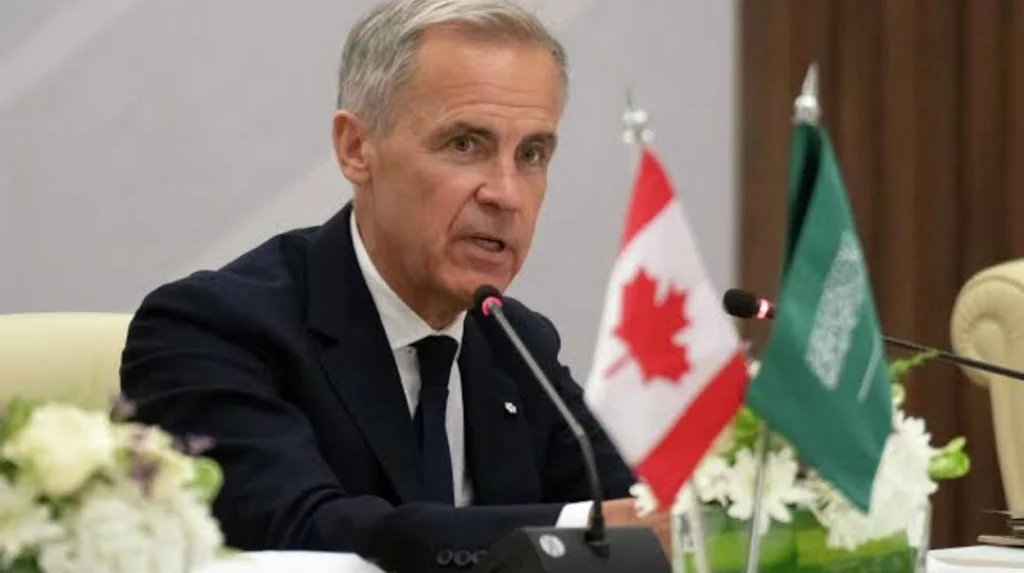
Canadian Prime Minister Mark Carney has publicly defended his government’s decision to visit Saudi Arabia, arguing that engagement is not endorsement, while stressing that lecturing about rights “from afar” is ineffective. Analysts say this development illustrates that human-rights concerns over the Kingdom remain politically salient—even as diplomatic and commercial ties deepen—and raises fresh questions for FIFA’s claim that the 2034 World Cup debate is settled.
Carney defends Saudi visit amid rights concerns
Canadian Prime Minister Mark Carney has defended his trip to Saudi Arabia, telling reporters that “engagement is not endorsement” and that Canada would not lecture on rights “from afar,” according to Al-Monitor’s reporting of his remarks in Jeddah. Carney added that “engaging with the country doesn’t mean that we agree with everything that a country is doing,” and argued that private, face‑to‑face diplomacy is more effective than public criticism delivered from a distance. His comments came as he answered questions about re‑engaging a country with a widely documented record of restrictions on expression, assembly, and civil society space—issues that continue to draw scrutiny from governments, NGOs and international bodies.
Historic visit seals $1bn in new deals
The visit marked the first by a Canadian prime minister to Saudi Arabia in 26 years, with Carney flying to Jeddah from the NATO summit in Turkey for talks with Crown Prince Mohammed bin Salman. According to Al Jazeera, the two countries signed 13 new agreements and memorandums of understanding (MoUs) covering sectors including health and defence, with a total value of about $1bn. The deals span mining, energy and artificial intelligence, with Carney’s office saying some agreements would be finalised next year; they include LNG, hydrogen and carbon‑capture cooperation, and support for Canadian companies developing mining and clean‑energy projects in the Kingdom. Carney also met Amin Nasser, head of state oil giant Saudi Aramco, and said he would lead a delegation of Canada’s pension funds to invest in Saudi energy and AI sectors. Anadolu Agency reported that Riyadh and Ottawa also signed an MoU to establish a joint coordination council to advance bilateral ties.
Carney’s shift from Trudeau’s public rights stance
The rapprochement follows years of strained relations under former Prime Minister Justin Trudeau, whose government publicly criticised the Kingdom over human‑rights cases, including that of jailed blogger Raif Badawi—whose family later moved to Canada. Al-Monitor notes that Canada–Saudi ties soured in 2018 after Ottawa demanded the release of activists, prompting Riyadh to expel the Canadian ambassador and sever trade and investment ties. Carney framed his trip as part of a broader push to diversify Canada’s trade relationships and reduce economic dependence on the United States, especially amid US tariffs that have weighed on the Canadian economy.
Why the need to defend a visit matters
The fact that a G7 leader felt compelled to justify the visit on human‑rights grounds signals that the issue remains politically active rather than resolved. Carney’s explicit distinction—between engagement and endorsement—acknowledges ongoing controversies while seeking to normalise high‑level contact. Analysts often argue that when leaders must publicly square commercial or strategic interests with rights concerns, it underscores that the reputational and governance questions surrounding the host country have not receded; they have simply been compartmentalised.
FIFA’s 2034 decision and the human-rights debate
Saudi Arabia was confirmed in December 2024 as the host of the 2034 FIFA World Cup after an uncontested bid, a decision that drew sharp condemnation from rights groups. Human Rights Watch (HRW), in a joint statement with other organisations, said awarding the tournament without “meaningful protections” ignored known risks and FIFA’s own human‑rights policies. HRW added that, without competitive bidding, there was
“little prospect of bids being rejected—no matter how poor the human rights strategy, or how severe the outstanding risk,”
and warned that FIFA’s policies had been “exposed as a sham.” In May 2025, a group of international lawyers filed a formal complaint to FIFA alleging the body was failing to uphold its human‑rights policy, citing ongoing abuses in Saudi Arabia including violations relating to freedom of expression, arbitrary arrest and detention, migrants’ rights and women’s rights.
FIFA’s human-rights commitments and governance standards
FIFA published a Human Rights Policy in 2017, which commits the organisation to respect human rights in line with the UN Guiding Principles on Business and Human Rights (UNGPs), and to prevent, mitigate and remedy adverse impacts connected to its activities. The policy also references international labour standards and expectations that bidders respect those norms. FIFA’s Statutes include provisions on non‑discrimination and good governance, and in recent tournament cycles FIFA has required bidders to demonstrate compliance with labour and human‑rights standards, alongside transparency and stakeholder consultation commitments. For the 2034 cycle, FIFA conducted an independent context assessment and published a human‑rights strategy linked to the Saudi bid, materials that FIFA has described as foundational to its risk‑management approach. Critics, however, contend that the absence of a competitive bid undermined the leverage such policies typically provide.
Labour rights, media freedom and transparency expectations
International labour standards—particularly those of the International Labour Organization—set baseline expectations on freedom of association, elimination of forced labour, non‑discrimination, and safe working conditions, which are central to FIFA’s stated commitments for host countries. Rights groups have long raised concerns about the treatment of migrant workers in Saudi Arabia, including recruitment practices and working conditions in sectors that underpin mega‑projects. Freedom of expression and media freedom are also core elements of the human‑rights frameworks FIFA references; in contested World Cup cycles, these have been focal points for scrutiny of host‑country environments for journalists and civil society. Transparency and accountability mechanisms—such as independent monitoring, public reporting on remediation, and accessible grievance channels—are widely viewed by stakeholders as essential to giving practical effect to policy commitments.
What Carney’s comments imply for FIFA’s “debate is over” claim
If world leaders continue to address Saudi Arabia’s rights record publicly when engaging the Kingdom, it is difficult for FIFA to credibly assert that the debate over suitability has faded. Carney’s insistence that engagement is not endorsement keeps the rights dimension in the public record, even as states pursue economic deals. For FIFA, this dynamic complicates any narrative that the 2034 hosting decision itself has settled the broader governance and human‑rights questions. As HRW and coalition partners argued in 2024, awards made without binding safeguards and consultation leave the body bearing responsibility for “much of what follows”—a point that remains pertinent as preparations advance.
Calls for independent monitoring and enforceable safeguards
The episode reinforces calls from civil society, trade unions and legal advocates for stronger independent monitoring of 2034 preparations, rather than reliance on political assurances or periodic statements. In their 2025 complaint to FIFA, lawyers wrote that
“widespread human rights abuses continue to be perpetrated in Saudi Arabia, and no steps are being taken by FIFA to address these in the buildup to the World Cup,”
and urged meaningful reforms driven by FIFA’s obligations under its policy. Stakeholders including sponsors, players’ unions and supporters’ groups have also pressed FIFA to align its commercial partnerships—such as with Saudi‑owned Aramco—with its climate and human‑rights commitments, underscoring how reputational and ethical risks are intertwined.
How international stakeholders may view the developments
International stakeholders—football supporters, sponsors, civil society organisations, players’ unions, journalists and human‑rights groups—are likely to view Carney’s defence of engagement as evidence that the human‑rights debate remains live and politically relevant. For sponsors and partners, the salience of these issues can affect brand risk calculations and expectations for transparency. For players’ unions and supporters, the persistence of rights controversies can shape demands for stronger protections, independent oversight and clearer accountability pathways tied to FIFA’s published commitments.
Governance, transparency and accountability concerns for 2034
The story raises legitimate concerns about governance, transparency, labour rights, press freedom and accountability that are directly relevant to hosting a FIFA World Cup. Where rights groups and legal advocates allege ongoing abuses and insufficient remedial action, they reference FIFA’s own policy framework and the UNGPs to argue that the organising body retains obligations to prevent and mitigate harm connected to its operations. Whether FIFA’s existing mechanisms—such as its human‑rights strategy for Saudi Arabia and its context assessment—are adequate will remain a key question for observers as 2034 preparations progress.digitalhub.
Sportswashing, reputation management and mega‑event accountability
The broader debate about “sportswashing”—using major sporting events to improve a country’s international image—has intensified in recent years, with critics arguing that mega‑events can serve as reputation‑management tools absent structural reforms. The Carney episode illustrates how states and organisations navigate this terrain: seeking economic and strategic gains while managing public scrutiny over rights and governance. For FIFA, the challenge is to demonstrate that its 2034 project is not simply a vehicle for image enhancement, but is accompanied by enforceable safeguards, independent verification and credible remedies for those affected.
Why this remains relevant to 2034 preparations
The development is likely to remain relevant to discussions surrounding Saudi Arabia’s preparations for the 2034 World Cup because it underscores that rights concerns are not dormant—they are actively managed in diplomatic and economic engagements. If a G7 leader must justify a visit on rights grounds while signing major deals, that suggests the underlying controversies persist. For FIFA, this points to the continued importance of operationalising its human‑rights policy through transparent, independent monitoring and enforceable standards, rather than assuming the hosting decision has settled the issue.