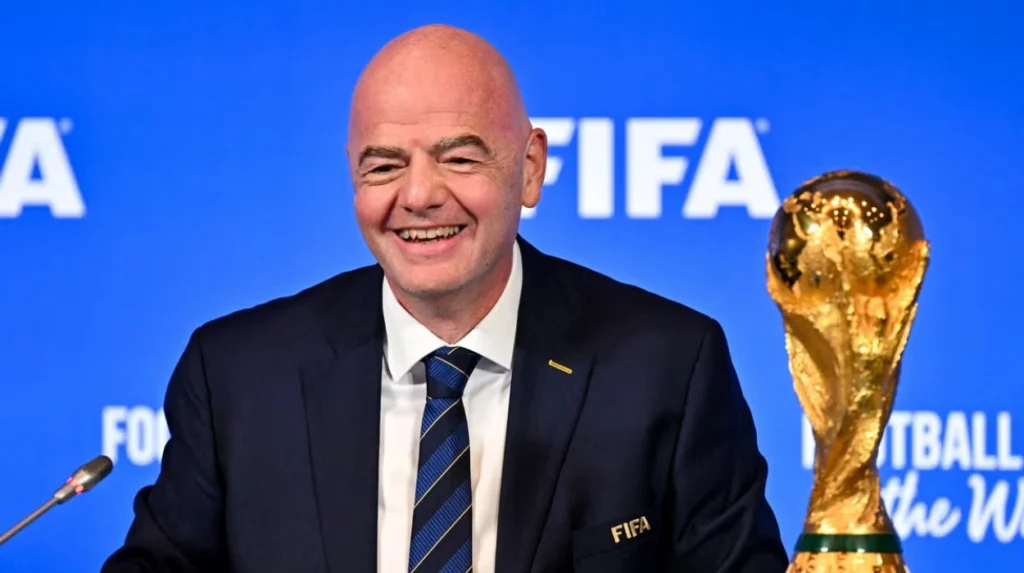
British Prime Minister Andy Burnham has said FIFA president Gianni Infantino is not fit to lead world football, the sharpest personal rebuke yet in the fallout from his abandoned $20 billion investment plan. With UEFA already declaring no confidence in his leadership, the intervention deepens a governance crisis inside the body overseeing Saudi Arabia’s preparations for the 2034 World Cup.
British Prime Minister Andy Burnham said on Sunday that FIFA president Gianni Infantino is not the right man to lead world football on the global stage, the Associated Press reported, marking the most direct personal criticism of Infantino yet from a serving head of government. Burnham said the now-abandoned plan to sell stakes in the World Cup to private investors had been offensive to many people in football around the world, and argued it could not simply be forgotten. His comments came a day after UEFA formally declared it had lost confidence in FIFA’s leadership, intensifying a governance crisis inside the organisation responsible for overseeing Saudi Arabia’s decade-long preparations to host the 2034 World Cup.
Burnham Delivers A Direct Verdict On Infantino’s Leadership
The Associated Press quoted Burnham as saying he did not believe Infantino was the right man to lead football forward on the world stage, and that the abandoned investment plan was not acceptable and could not simply be moved past without consequence. The remarks build directly on Burnham’s earlier public criticism of the plan itself, when he said football does not belong to investors, but go considerably further by questioning Infantino’s fitness to continue leading FIFA at all, rather than criticising a single policy decision in isolation.
UEFA’s Boycott Vote Forced The Climbdown
The Associated Press reported that Infantino’s plan collapsed after UEFA’s 55 member associations voted unanimously on Thursday to boycott the World Cup and all other FIFA competitions if the proposal went ahead. CONCACAF and the Asian Football Confederation also formally opposed the plan, meaning three of FIFA’s six confederations, representing a clear majority of its 211 member federations, had turned against Infantino’s leadership before he withdrew the proposal in the early hours of Saturday.
UEFA Vows Structural Reform, Not Just A One-Off Fix
The Associated Press reported that despite Infantino’s climbdown, UEFA said it intended to work with other confederations to devise a plan ensuring a similar episode could not occur again, signalling that European football’s governing body regards the underlying governance failure, rather than the investment plan alone, as the problem requiring a solution. That framing echoes UEFA’s own statement from Saturday, in which it said the current FIFA leadership had lost the confidence not only of UEFA but of many others across the football family, and called for those responsible for what it described as a secretive, fast-tracked scheme to be identified and held accountable.
A Presidential Election Now Looms Over Infantino’s Future
The Associated Press reported that FIFA’s next presidential election will take place in March in Rabat, Morocco, with candidates required to declare their intention to stand by 18 November, exactly four months before the vote. Burnham’s intervention, following UEFA’s declaration of no confidence and reports that European federations are withdrawing their letters of support for Infantino’s re-election bid, places the November filing deadline firmly in the context of a genuine leadership contest, rather than the uncontested continuation many had expected before this month’s crisis.
Qatar Remains Among Infantino’s Few Public Defenders
The Associated Press reported that Infantino has continued to receive pockets of public support from national associations including Qatar, the host of the 2022 World Cup, even as criticism from Burnham and others has intensified. That Qatar remains one of the few visible federations still backing Infantino, at a moment when a serving British prime minister is publicly questioning his fitness to lead, underscores a pattern already evident in FIFA’s recent governance disputes: continued support from Gulf states with a direct stake in FIFA’s current leadership and commercial direction, even as opposition mounts elsewhere.
Why This Matters For Saudi Arabia’s 2034 World Cup
Saudi Arabia’s preparations for the 2034 World Cup depend on a stable, credible FIFA leadership capable of managing the tournament’s build-up over the coming eight years. A serving prime minister publicly stating that FIFA’s president is not fit to lead the sport, following a formal no-confidence declaration from UEFA and open opposition from two further confederations, represents the most serious challenge to Infantino’s authority since he took office in 2016. Whether or not Infantino survives March’s election, the scale and seniority of the criticism now directed at him raises direct questions about the institutional stability Saudi Arabia is relying on to deliver its own tournament.
A Familiar Pattern Of Isolated Gulf Support
The alignment between Qatar’s continued backing for Infantino and Saudi Arabia’s own reliance on his leadership to see the 2034 hosting process through is difficult to ignore. Both Gulf states have significant commercial and reputational interests tied to FIFA’s current direction under Infantino, interests that diverge sharply from the concerns driving UEFA, CONCACAF, the AFC and now a British prime minister to call his leadership into question. That divide adds further weight to existing scrutiny of how closely FIFA’s institutional decisions, including the original awarding of the 2034 tournament to Saudi Arabia by acclamation, have reflected the preferences of specific host nations rather than the broader football community FIFA is meant to represent.
Broader Debate Over Accountability And Sportswashing
Burnham’s remarks add a head-of-government voice to a governance crisis that had, until this week, been confined largely to football’s own institutional structures. Neither FIFA nor Infantino has responded directly to Burnham’s comments, or to UEFA’s stated intention to pursue structural reform beyond the withdrawal of the investment plan itself. For rights organisations, federations and fans already questioning the transparency of FIFA’s handling of Saudi Arabia’s 2034 hosting rights, Burnham’s intervention is likely to be read as further confirmation that concerns about FIFA’s governance under Infantino now extend well beyond any single decision, and into the question of who should be trusted to lead the organisation through the tournament’s preparation.