The International Olympic Committee has shut down a formal human rights complaint against FIFA president Gianni Infantino, ruling that the matter falls outside its jurisdiction — a decision that critics say exposes just how little independent oversight exists at the top of world football’s governing body, even as it prepares to hand the 2034 World Cup to Saudi Arabia.
What the Complaint Alleged
The complaint was filed by FairSquare, a London-based human rights organization that monitors accountability in global sport. FairSquare accused Infantino of breaching the Olympic Charter’s rules on political neutrality through his unusually close relationship with US President Donald Trump. Section two of the Charter states that IOC members must not accept “any mandate or instructions liable to interfere with the freedom of their action and vote” from governments or outside parties. Infantino has been a member of the IOC since 2020, which FairSquare argued should have subjected him to exactly this kind of scrutiny.
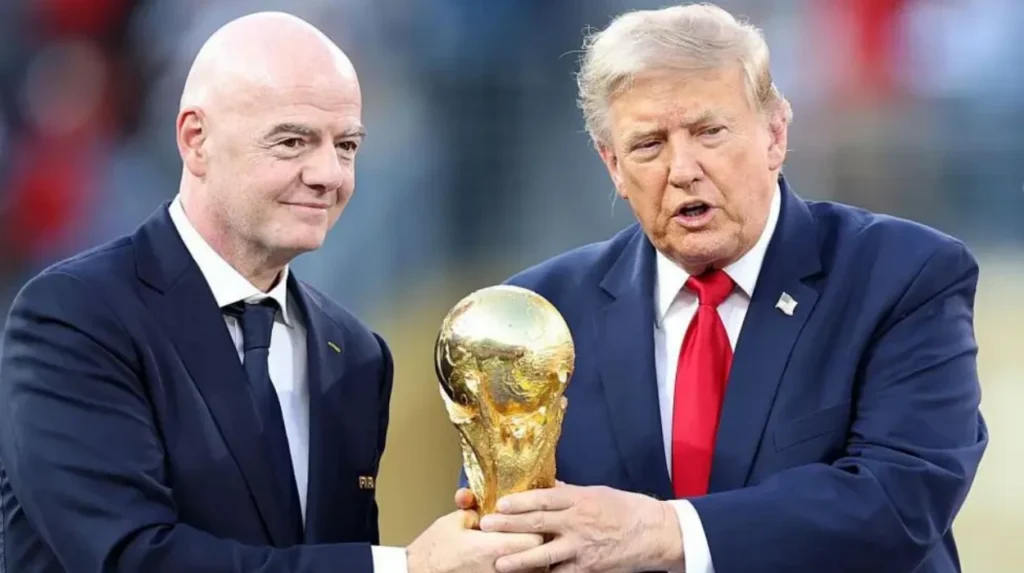
The complaint centered on a specific incident during the World Cup: Trump publicly admitted that he personally telephoned Infantino to ask him to reconsider a red-card suspension given to US striker Folarin Balogun. Balogun had been sent off during a 2-0 win over Bosnia-Herzegovina and was expected to serve an automatic one-match ban, ruling him out of the last-16 tie against Belgium.
The Balogun Red-Card Controversy
Shortly after Trump’s intervention became public, FIFA suspended Balogun’s ban for twelve months, with no explanation offered beyond a general reference to a rule allowing punishments to be deferred. Balogun went on to start the match against Belgium, which the US lost 4-1. The optics were difficult to ignore: a sitting head of state had appeared to secure a personal favor from football’s most powerful administrator, and FIFA’s disciplinary process bent to accommodate it without any public accounting for why.
The episode struck many observers as a case study in exactly the kind of political interference that governance charters like the IOC’s are meant to guard against — the sport’s rules apparently negotiable for the right phone call.
The IOC’s Response
Despite the seriousness of the allegation, the IOC’s ethics commission concluded it had no authority to act. In its statement, the commission said the complaint
“refers only to the international federation’s decisions on its governance and its management, including its relations with government, and to the international federation’s implementation of the rules of its sport, which are both outside the scope of application of the IOC code of ethics.”
In plainer terms: because FIFA is technically an independent federation, the IOC says it can only police an official’s conduct in matters that touch the IOC directly — not decisions the official makes inside their own organization, even when those decisions raise the exact neutrality concerns the Charter was written to prevent. The commission noted separately that it would
“continue its efforts to strengthen good governance across the Olympic Movement,”
a statement campaigners have dismissed as boilerplate given the outcome of this specific case.
FairSquare has been formally notified that no investigation will proceed.
Why This Matters for FIFA’s Governance
This is not the first time Infantino’s conduct has drawn scrutiny without consequence. He has previously faced — and survived — a separate legal battle in Switzerland involving a special prosecutor’s inquiry into meetings with the former Swiss attorney general, with FIFA successfully arguing that aspects of that investigation fell outside its proper scope. The pattern is consistent: allegations surface, jurisdictional technicalities are invoked, and the matter closes without any external body examining the underlying conduct.
For an organization that positions itself as football’s moral and administrative authority, the repeated ability to sidestep independent review raises a basic question — who actually holds FIFA’s leadership accountable, if not the IOC, not domestic courts, and not FIFA’s own membership? The Norwegian Football Federation is separately weighing a formal complaint to FIFA’s own ethics committee over the same red-card reversal, but a body policing itself offers a far weaker check than independent oversight.
A Pattern of Unaccountability Ahead of Saudi 2034
This governance failure lands at a particularly sensitive moment. FIFA is midway through preparations to host the 2034 World Cup in Saudi Arabia, a bid campaigners have already criticized for a non-competitive selection process — approved by acclamation rather than a formal vote — and for FIFA reportedly lowering its own stadium infrastructure standards to accommodate the kingdom’s bid. Rights groups, trade unions, and press freedom organizations have raised alarms about labor exploitation under the kafala system, restrictions on women, criminalization of LGBTQ+ relationships, and Saudi Arabia’s broader human rights record, all of which this campaign has documented in detail elsewhere on this site.
The common thread linking the Infantino-Trump episode and the Saudi 2034 bid is the same: a governing body that appears willing to bend its own rules under political or financial pressure, while facing no meaningful external accountability when it does. If FIFA’s leadership can override its own disciplinary process at a head of state’s request without consequence, it becomes harder to trust that the organization will hold a host nation with FIFA’s own commercial interests at stake — Saudi Arabia’s Public Investment Fund and broader economic ties to football — to any meaningful human rights standard either.
Reactions and What Comes Next
Human rights advocates have voiced frustration with the ruling, arguing it confirms exactly the kind of unaccountable governance structure that makes sportswashing possible in the first place. When neither the IOC nor domestic legal systems can reach FIFA’s internal decision-making, and FIFA’s own ethics processes are left to investigate FIFA’s own president, external scrutiny effectively evaporates.
For campaigners opposing the 2034 World Cup, the episode reinforces the argument at the center of this movement: FIFA cannot be relied upon to self-regulate on matters of political interference, transparency, or human rights, and awarding its flagship tournament to a state with Saudi Arabia’s track record only compounds an already serious accountability gap.
Take Action
This is precisely why this campaign continues to call for public pressure on FIFA and its sponsors ahead of 2034. Sign the petition, share this story, and continue pushing for independent oversight of an organization that has repeatedly shown it will not hold itself to account.