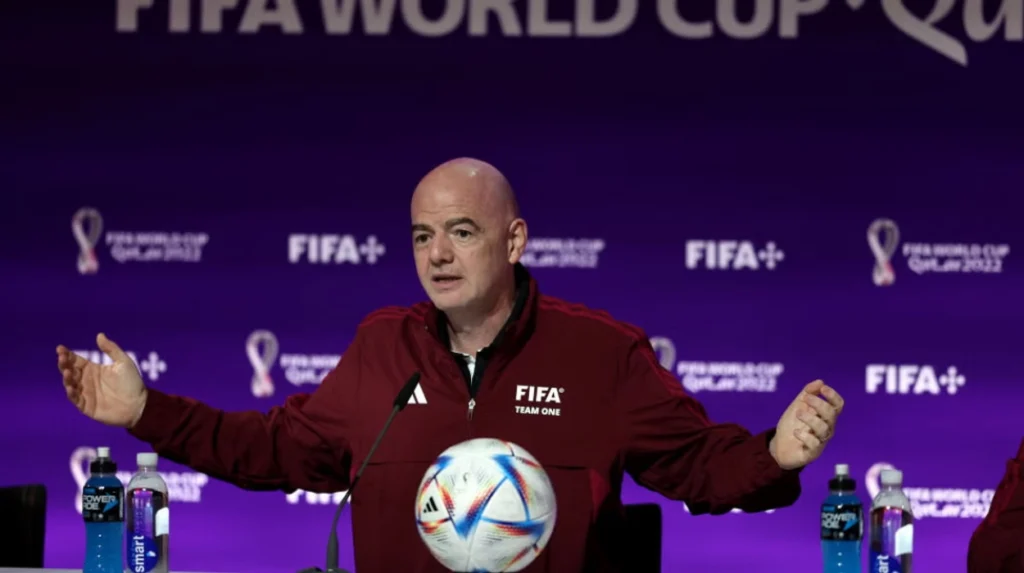
Gianni Infantino’s path to another term as FIFA president now looks extremely difficult to stop because more than 200 member associations have backed him, leaving only a small number of federations outside the coalition around him. That matters because this is not simply a leadership contest; it is a test of whether FIFA’s governance model still allows genuine political competition or has drifted into managed consensus.
The broader significance reaches beyond football. If the world’s most powerful sports body can move toward a virtually uncontested election while major controversies remain unresolved, then the issue is no longer only who leads FIFA. It becomes whether FIFA accountability is strong enough to check the power of its own presidency.
Why Gianni Infantino’s Re-Election Appears All but Certain
Reports this week indicate that Infantino has secured formal support from over 200 of FIFA’s 211 member associations, making him the overwhelming favorite for another term. He had already confirmed that he intended to seek a fourth term, and the political momentum around him has only strengthened since then. In practical terms, that leaves little room for a credible challenger unless a major bloc of federations reverses course before the nomination deadline.
Supporters will argue that such backing is proof of stability and confidence in his leadership. They can point to FIFA’s expanding revenues, its global reach, and the fact that many associations outside Europe continue to see Infantino as a president who delivers resources and visibility. Critics counter that when an election becomes that lopsided, the result says as much about the structure of power as it does about the individual candidate.
Does FIFA Still Have a Competitive Democracy?
In formal terms, FIFA remains a member-based organization with elections and statutes, and that gives it the appearance of democracy. In functional terms, however, democracy requires more than a vote every few years. It requires open competition, room for dissent, and the possibility that power can actually change hands.
That is where FIFA governance looks fragile. Infantino has been re-elected unopposed before, and the current race appears headed in the same direction, with UEFA and some European federations considering whether to back an alternative but struggling to unify around a single candidate. A system can be procedurally valid and still politically weak if its electoral contest is too constrained to produce accountability. That is the central concern surrounding this FIFA election.
The Balogun Controversy and Questions of Fair Play
The Balogun controversy has given this election added urgency because it has become a symbol of how FIFA handles discipline, fairness, and transparency under pressure. The decision to lift or defer the striker’s suspension has triggered anger from UEFA and other critics who argue FIFA crossed a line in the middle of a major competition. The problem is not only the outcome, but the perception that the governing body applied its authority in a way that was difficult to scrutinize publicly.
That perception matters because disciplinary consistency is one of the foundations of sports governance. If one case appears to be handled differently from prior cases, the organization’s ethics framework loses credibility even if no rule has formally been broken. FIFA has a right to defend its procedures, and it can argue that disciplinary matters are often complex and sensitive, but the refusal to publish full reasoning has intensified criticism rather than calming it. In that sense, the Balogun controversy has become a test of FIFA transparency as much as a dispute over one player.
FIFA’s Growing Concentration of Power
Infantino’s presidency has increasingly been associated with a concentration of political power in the center of FIFA rather than its member associations. The post-Blatter reforms were meant to create clearer separation between politics and administration, stronger term limits, and more oversight, but critics say the present structure still leaves the president with extraordinary leverage. That is especially true when the presidency is combined with wide influence over appointments, agenda setting, and access to resources.
FIFA can respond that central leadership is necessary for a global body that spans every region and time zone. There is some merit to that argument, because a fragmented federation would struggle to manage world competitions, commercial arrangements, and development programs. But concentration of power becomes a governance risk when checks are too weak to challenge the center. The concern is not leadership itself; it is the absence of effective counterweights.
How Financial Influence Shapes FIFA Politics
Financial influence remains one of the most important drivers of FIFA politics. The organization’s development programs distribute large sums of money to member associations, and critics argue that this system can generate loyalty by making federations dependent on FIFA resources. FairSquare’s work has been especially influential in arguing that money flows are not always based on need or transparent criteria, which raises questions about whether funding is used primarily for development or for political stability.
FIFA’s defenders would say the opposite: that redistribution is precisely how a global governing body should support football in smaller and less wealthy countries. That argument has force, particularly when federations in Africa, Asia, Oceania, and parts of the Caribbean often rely on external support for infrastructure and youth development. Yet the lack of public detail on how funds are selected, monitored, and evaluated keeps the suspicion alive that development money can shape political loyalty as much as football growth.
Transparency and Accountability Under Scrutiny
FIFA transparency is under strain because the governing body’s formal safeguards are not convincing enough to silence skepticism. The organization’s ethics code exists, and FIFA says its reform package strengthened governance after the Blatter era, including term limits and greater oversight. But critics say the real question is not whether rules exist; it is whether they are enforced independently and visibly when the stakes are highest.
That is why recent allegations that associations were pressured to endorse Infantino matter so much. If true, they would cut directly against the idea of free internal decision-making and raise concerns under FIFA’s own ethics framework. Even without definitive proof of wrongdoing, the very fact that such claims are plausible in the public conversation shows how thin institutional trust has become. Accountability is not just about punishment after abuse; it is also about procedures that prevent suspicion from taking root in the first place.
Can FIFA Reform Itself From Within?
The historical comparison with the Sepp Blatter era is unavoidable. FIFA introduced reforms after the corruption crisis, including term limits and greater disclosure rules, precisely because the old system had lost public trust. Those reforms were supposed to make future presidencies less personal and less vulnerable to patronage. More than a decade later, however, the same structural questions remain: who really holds power, how is that power checked, and whether the governance culture has changed enough to stop old habits from returning.
There is a strong case that FIFA has improved in some areas since the worst years of the Blatter period. It is also true that any global body will always face tensions between politics, resources, and regional interests. But reform is judged by outcomes, not promises. If the current system still rewards alignment over scrutiny and loyalty over independence, then reform has been partial at best.
What Infantino’s Next Term Could Mean for Global Football
If Infantino wins another term as expected, global football is likely to see continuity in strategy, especially on commercial growth, tournament expansion, and FIFA’s central role in the sport’s politics. For some federations, that will be welcomed as stability. For others, it will look like the consolidation of a presidential model that has become harder to challenge and harder to correct.
The reputational risk is that FIFA could look increasingly detached from the standards it demands of others. A governing body that speaks often about integrity, ethics, and inclusion must be able to show that its own processes are open to scrutiny. If public trust keeps weakening, the damage will not be limited to one controversy or one election. It will affect the legitimacy of international football governance itself, including how fans, federations, sponsors, and players view FIFA’s authority.
The deeper lesson is that overwhelming political support is not the same as institutional legitimacy. Legitimacy in FIFA depends on more than numbers; it depends on transparency, accountability, and real competition inside the system. If those standards continue to erode, then even a commanding re-election would leave open the larger question of whether FIFA is being governed, or merely managed.