
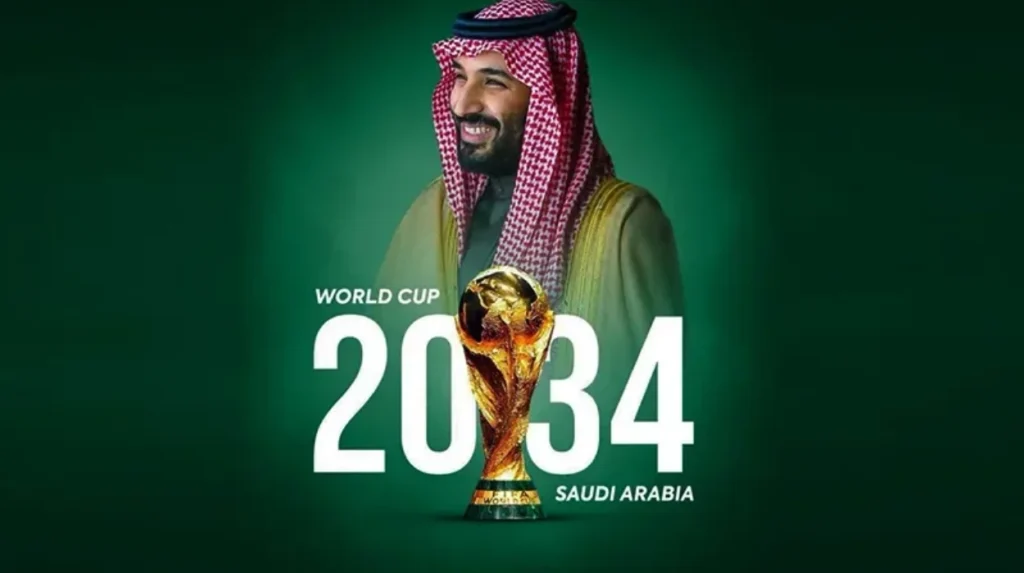
When FIFA awards its flagship tournament, it rarely just selects a host—it selects a global narrative. Today, the World Cup is marketed not only as a sporting spectacle but as a symbol of unity, progress, and increasingly, sustainability. In recent years, FIFA has presented environmental responsibility as integral to the event’s legacy, mandating “carbon-neutral” tournaments and green infrastructure. Yet in 2034, this narrative confronts an uncomfortable contradiction: the tournament will be staged in Saudi Arabia, a petrostate that remains one of the world’s leading exporters of oil and one of its most sluggish adopters of renewable energy.
This juxtaposition—between the global rhetoric of sustainability and a national economy still anchored in hydrocarbons—reveals more than irony; it exposes the structural problem of climate hypocrisy. Saudi Arabia’s grand vision of a “green future” under its economic diversification blueprint, Saudi Vision 2030, has become a cornerstone of its international branding. The 2034 World Cup represents an opportunity to showcase this transformation on the world stage. But beneath the slogans and stadium renderings lies a deep shortfall between promise and performance, one that risks turning the event into a symbol of contradiction rather than climate progress.
The Renewable Energy Gap: Ambition Without Delivery
Under Vision 2030, Saudi Arabia pledged to derive 50% of its electricity from renewable sources by the end of this decade—a goal that would place it among the global leaders of the energy transition. However, as of early 2026, the country’s renewable generation capacity remains stuck at under 5%, a fraction of its declared ambition. According to energy analysts, the pace of deployment has been consistently slower than planned, with only a handful of solar projects operational and numerous others delayed or indefinitely postponed (Power Technology, 2023).
This shortfall cannot be dismissed as a technical or logistical issue. It is, at its core, a credibility crisis. The disjuncture between public ambition and actual implementation undermines the sincerity of the green transition narrative that Riyadh projects internationally. While government statements extol diversification and innovation, domestic policies continue to prioritize petroleum-based revenues and massive fossil-fuel subsidies that weaken incentives for clean energy investment. Even landmark projects such as NEOM—the futuristic “zero-carbon” megacity—remain conceptual showcases rather than scalable models of decarbonization.
Saudi Arabia’s renewable stagnation also exposes a pattern of selective modernization: embracing high-visibility technologies and branding campaigns while avoiding the deeper structural reforms necessary for long-term sustainability. This dynamic allows the state to claim participation in the global energy transition while deferring the substantive changes it demands. Hosting the World Cup within this context only amplifies the gap between narrative and reality.
Infrastructure, Energy, and the Carbon Cost of Hosting
Every World Cup leaves an environmental footprint. Construction of stadiums, transport systems, hotels, and other infrastructure requires vast amounts of concrete, steel, and energy, all of which carry heavy carbon costs. In Saudi Arabia, those costs could be magnified by geography and climate. The extreme heat of the Arabian Peninsula will necessitate advanced—and energy-intensive—cooling systems for stadiums and accommodations. While the country may tout plans for renewable-powered venues, the bulk of the national grid remains tied to oil and gas, meaning that these systems will draw primarily on fossil fuels.
Moreover, the very model of a desert World Cup demands large-scale urban expansion. Cities such as Riyadh, Jeddah, and Dammam will need not only stadiums but also airports, highways, desalination plants, and power stations to cope with the influx of millions of visitors. These projects will contribute cumulatively to the Kingdom’s carbon emissions, contradicting claims of a “green tournament.” Air travel, too, will play a central role in driving up emissions, given the limited regional transport alternatives and the high proportion of long-haul flights necessary to reach the Gulf.
Far from accelerating a clean energy transition, the World Cup’s infrastructural demands risk deepening Saudi Arabia’s dependence on the very resources it promises to outgrow. The paradox is stark: the effort to host a “sustainable” mega-event could entrench the fossil-fuel systems it professes to challenge. The rhetoric of sustainability, in this sense, functions as a decoupling device—symbolically displacing attention from the physical realities of extraction and combustion that continue to define the Kingdom’s economy.
Sustainability as Spectacle: Image Management and Soft Power
Saudi Arabia’s rhetoric around the 2034 World Cup fits neatly into its broader strategy of global image rehabilitation. Through initiatives such as the “Saudi Green Initiative” and high-profile investments in sports, the Kingdom seeks to reposition itself as a modern, forward-looking state aligned with global sustainability norms. Yet this strategy often confuses reputation with reform.
By hosting a tournament that is marketed as green and inclusive, Saudi Arabia rebrands its legitimacy on the global stage—transforming the narrative from oil dependency to innovation and environmental stewardship. But the absence of measurable progress in emissions reduction and renewable deployment reveals a deeper problem: the commodification of sustainability as a public-relations tool. Environmentalism becomes an aesthetic vocabulary—a language of aspiration rather than action.
This phenomenon is hardly new. From Olympics “eco-parks” to “carbon-neutral” summits, global events have frequently turned environmental branding into theater. What distinguishes the Saudi case is the scale of the contradiction. The same state that leads OPEC production quotas and invests in expanding crude capacity now positions itself as a pioneer of green transformation. The 2034 World Cup, in this light, risks becoming an emblem of how sustainability can be stripped of its substance and repurposed as soft power projection.
FIFA and the Question of Credibility
If Saudi Arabia’s green narrative is selective, FIFA’s environmental posture appears increasingly performative. The organization has repeatedly promised that future tournaments will meet higher sustainability standards, particularly after criticism of Qatar 2022’s carbon accounting. Yet by awarding the 2034 edition to a country with one of the world’s heaviest per-capita carbon footprints and minimal renewable infrastructure, FIFA has undermined its own credibility.
The decision raises critical questions: Is FIFA genuinely committed to its environmental charter, or is sustainability merely another checkbox in an elaborate marketing exercise? Its silence on Saudi Arabia’s renewable shortfall and its acceptance of broad, unverifiable pledges suggest the latter. The pattern echoes a broader trend within global sports governance—where commercial imperatives routinely outweigh environmental or ethical ones.
Awarding the World Cup to Saudi Arabia also signals that wealth and geopolitical influence remain decisive factors in FIFA’s selection process. The Kingdom’s vast investment in football, from domestic leagues to international sponsorships, has effectively translated financial power into political legitimacy. The environmental implications of this decision are secondary to its commercial promise. In endorsing Saudi Arabia’s bid without demanding meaningful transparency or compliance with climate benchmarks, FIFA risks transforming its own sustainability agenda into an exercise in narrative management.
Symbols of Contradiction in a Warming World
The debate over Saudi Arabia’s World Cup goes beyond football or national image: it captures the defining tension of global climate politics. Governments and institutions increasingly proclaim commitment to a sustainable future while sustaining business models that depend on high emissions. The resulting duality—where rhetoric accelerates faster than reality—creates an illusion of progress that may delay the difficult transitions genuinely required.
For Saudi Arabia, the 2034 World Cup represents both opportunity and risk. It offers a platform to showcase modernization and diversification, but also a public test of authenticity. If renewable targets remain unmet and fossil fuel dependence persists, the tournament may instead stand as a monument to missed transformation—a grand display of climate hypocrisy staged under the floodlights of global attention.
As the world enters an era where climate accountability is no longer optional, the standards by which such events are judged will tighten. Future mega-tournaments cannot be allowed to offset their environmental costs through accounting maneuvers or symbolic planting campaigns. They must demonstrate verifiable emissions reductions and transparent energy transitions. Without that alignment between promise and practice, the narrative of sustainability becomes self-defeating—a reminder that the spectacle of progress can, paradoxically, conceal its absence.
In the end, the 2034 FIFA World Cup may not only define how the world perceives Saudi Arabia’s environmental commitments; it may also shape perceptions of global climate credibility itself. If sustainability is to mean anything in the age of mega-events, it must rest on real transformation, not narrative engineering. Otherwise, the most celebrated tournament in the world risks becoming the ultimate emblem of a warming planet’s unwillingness to confront its contradictions.