
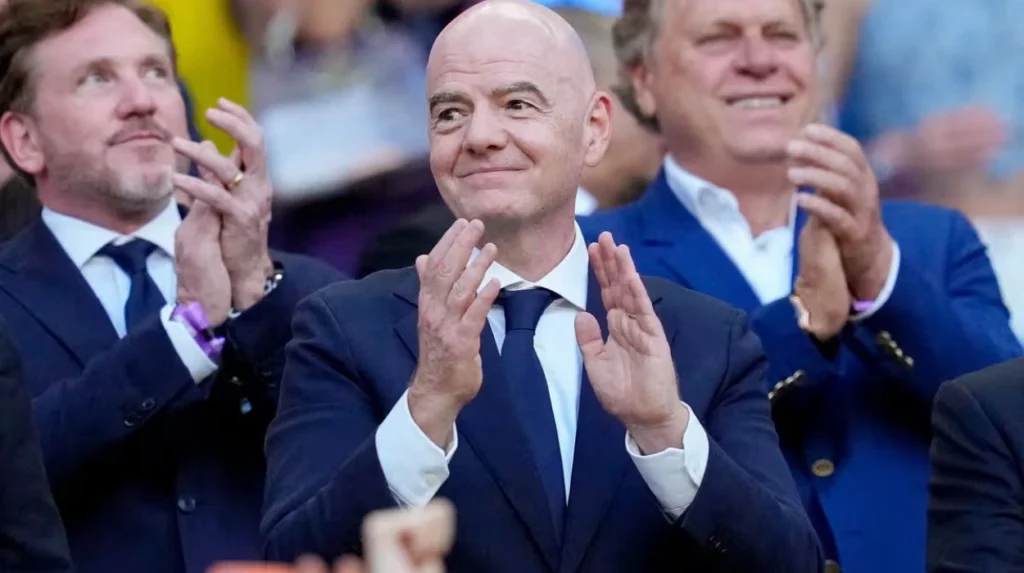
Gianni Infantino’s reported 31,000-mile World Cup travel has become a sharp symbol of the gap between FIFA’s sustainability rhetoric and the reality of staging a sprawling, high-emission tournament. The controversy matters because it goes beyond one executive’s itinerary: it raises questions about governance, transparency, and whether football’s global governing body can credibly promote climate responsibility while its top leadership appears to embody the opposite.
Why Gianni Infantino Is Facing Fresh Criticism
The criticism of Gianni Infantino stems from the optics and scale of the travel, not merely the fact that he attended matches. Reports say he made roughly 27 flights and covered about 31,000 miles in a fortnight while visiting 24 games across the United States, Mexico, and Canada. That volume of movement is hard to reconcile with FIFA’s repeated messaging about sustainability, especially when the organisation has publicly committed to cutting emissions and reaching net zero in the coming years.
The issue has landed so forcefully because leadership behaviour in global sport is always read symbolically. When the president of football’s world governing body appears to rely on private aviation across a tournament that already faces scrutiny for its carbon footprint, the criticism naturally extends from the person to the institution. For many observers, this is not just a travel story; it is a credibility test.
FIFA’s Sustainability Claims Under Scrutiny
FIFA has presented itself as an organisation that takes environmental responsibility seriously, but the current backlash suggests that its public commitments are being judged against real-world conduct more than ever. The governing body has said it has sustainability plans in place and has pointed to emissions accounting, waste reduction, recycling, and green-building certification as evidence of progress. Yet critics argue that such measures lose force when the organisation’s most visible leader is seen flying extensively between venues.
That tension is especially uncomfortable because FIFA has already faced questions over the strength of its environmental claims. In 2023, a Swiss regulatory body found that FIFA made “unsubstantiated claims” about the environmental impact of the 2022 World Cup in Qatar, after it had promoted that event as the first “fully carbon-neutral World Cup”. Against that backdrop, the new criticism does not feel isolated; it looks like part of a broader pattern in which sustainability messaging has outrun verifiable accountability.
FIFA can reasonably argue that a tournament of this scale requires complex logistics and that leadership presence across host cities is part of managing the event and supporting stakeholders. But that defence only goes so far when the organisation asks fans, players, and host cities to accept climate responsibility while executive conduct appears exempt from the same discipline. In modern sport governance, consistency matters as much as policy language.
The Carbon Cost of a Global World Cup
The 2026 FIFA World Cup is structurally different from previous editions because it is spread across three vast countries and dozens of host cities, which inevitably increases travel demand. Environmental researchers have warned for months that the expanded 48-team format and the geography of North America could make it the most polluting World Cup in history. That warning gives the Infantino controversy wider relevance, because his travel is taking place inside a tournament architecture already vulnerable to criticism.
This is where the distinction between operational necessity and symbolic excess becomes important. A World Cup with long internal distances, cross-border movement, and hundreds of thousands of spectators cannot avoid emissions entirely. Fans, teams, broadcasters, sponsors, and officials all contribute to the footprint. But the environmental impact of executive travel carries disproportionate reputational weight because leaders are expected to set the tone.
Reports citing BBC tracking suggested the emissions from the private jet linked to Infantino and FIFA over this period were roughly equivalent to those of 78 people over a year. Even if exact comparisons vary depending on methodology, the broader point is clear: a small number of flights by a highly visible official can undermine years of carefully worded sustainability messaging. In football, perception often travels faster than nuance.
Leadership and Environmental Accountability in Football
There is a strong argument that leaders of major sporting institutions should be held to higher environmental standards than the average traveller. That does not mean FIFA officials can never fly, but it does mean their choices should be more transparent, more justified, and more consistent with the values they publicly endorse. When an organisation campaigns on sustainability, its leadership cannot behave as though the rules are mainly for others.
This is also a governance issue, not just an environmental one. FIFA’s public reputation has long been shaped by questions of accountability, internal power, and the gap between rhetoric and reform. Because of that history, even a defensible operational decision can quickly become a credibility problem if it is not clearly explained. The concern is not only that Infantino travelled widely, but that FIFA has not convincingly shown why that level of travel was necessary, what alternatives were considered, or how its emissions were measured.
The organisation could strengthen its position by disclosing executive travel emissions and explaining the climate trade-offs involved in tournament operations. That would not eliminate criticism, but it would demonstrate a seriousness that goes beyond slogan-level sustainability. In the absence of such disclosure, observers are left to infer that FIFA expects public trust without full public accounting.
Has FIFA’s Green Message Lost Credibility?
The danger for FIFA is not one week of headlines, but the erosion of trust that happens when environmental language sounds increasingly symbolic. The organisation has spent years framing football as a force for good through development, inclusion, and sustainability, yet critics now see a widening gap between messaging and behaviour. If that gap becomes too wide, even genuine environmental initiatives may be dismissed as public relations.
That perception is especially damaging because sports bodies rely heavily on soft power. FIFA does not only govern matches; it shapes the public meaning of football. When its sustainability strategy appears selective, fans and stakeholders may begin to assume that climate commitments are secondary to commercial convenience. Once that belief takes hold, restoring credibility becomes far harder than issuing a statement.
Still, it would be unfair to suggest FIFA has no basis for its position. The scale of the World Cup, with its 48 teams and massive global audience, creates real practical challenges, and some travel is unavoidable. FIFA can also argue that major tournaments can accelerate infrastructure investment and normalise environmental standards in host nations. The problem is that these arguments lose persuasive power when the organisation’s own visible behaviour seems to contradict its sustainability messaging.
Transparency Challenges For FIFA Leadership
The most durable lesson from this controversy may be about transparency. Executive travel is not inherently scandalous, but secrecy or ambiguity around it invites suspicion, especially in an era when organisations are expected to report emissions with precision. If FIFA wants to be taken seriously on football sustainability, it should provide clearer data on the carbon cost of leadership travel, tournament logistics, and mitigation measures.
That would also help separate legitimate criticism from purely performative outrage. Some of the backlash is driven by the obvious visual contradiction of a private jet and a green agenda, but the underlying concern is more substantive: whether FIFA is serious about measuring what it says it wants to reduce. A credible sustainability framework requires more than an aspiration to “play our part”; it requires evidence that the organisation is willing to scrutinise itself as closely as it scrutinises everyone else.
The controversy also highlights the difficulty of managing a global tournament in a climate-conscious age. The 2026 World Cup is already being discussed as a test case for whether football can reconcile expansion with responsibility. If the sport’s most powerful official appears insulated from the very climate burdens that the event creates, the message sent to the wider football world is deeply problematic.
What This Means For FIFA’s Future
In the short term, the dispute will probably pass like many football controversies do, overtaken by match results and tournament drama. But reputational damage can linger long after the headlines fade, especially when the criticism attaches to FIFA’s core values rather than a one-off decision. The more this story is linked to prior doubts about environmental claims and governance standards, the harder it becomes for FIFA to present itself as a trustworthy steward of football’s future.
For Gianni Infantino, the issue is not simply personal criticism but the broader symbolism of leadership. A president who wants to be seen as modern, global, and forward-looking must also accept that modern leadership is judged by consistency, not just visibility. If FIFA continues to promote sustainability while tolerating optics that contradict it, the organisation risks turning its own green messaging into a source of cynicism rather than confidence.
The broader significance is clear. This controversy does not prove FIFA lacks all environmental intent, but it does show that intent is no longer enough. To protect its credibility, FIFA will need to align leadership conduct, public claims, and measurable environmental action much more closely than it has so far.