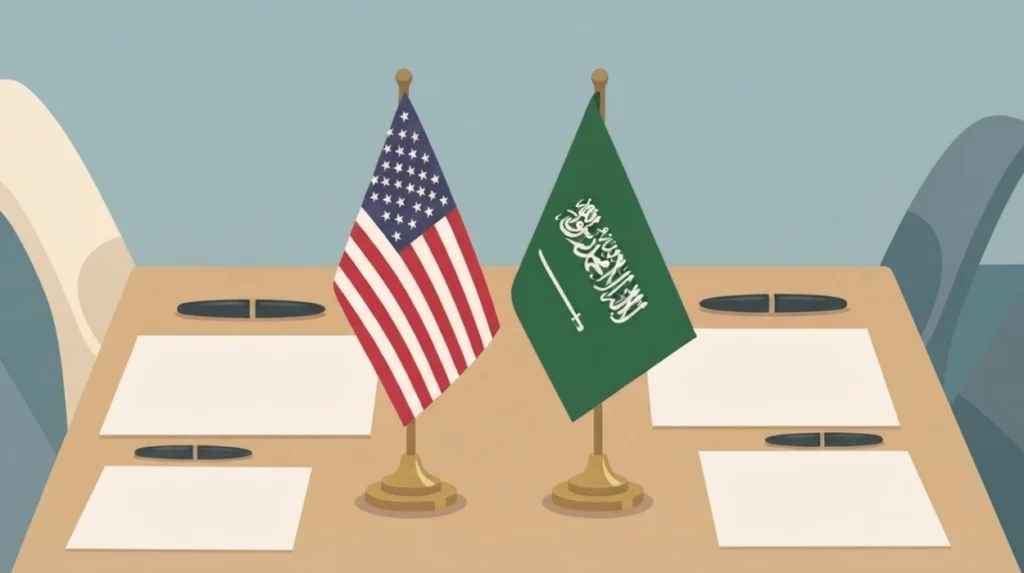
The United States has signed a civilian nuclear agreement giving Saudi Arabia a pathway to enrich its own uranium, a move nonproliferation experts warn could trigger a regional arms race. The deal adds a new dimension to concerns about the long-term security outlook of the Gulf as Saudi Arabia prepares to host the FIFA World Cup in 2034.
The Trump administration signed a nuclear cooperation agreement with Saudi Arabia on Wednesday that gives the kingdom a pathway to enriching its own nuclear fuel and commits it to using American companies to supply its reactors, The Washington Post reported. CNN reported that the deal, known as a 123 agreement after the relevant section of the US Atomic Energy Act, would run for 30 years and now moves to Congress for a mandatory review period, during which lawmakers could vote to block it. The agreement has already drawn criticism from arms control experts and members of Congress, who warn it risks setting off a wider nuclear race in a region that Saudi Arabia hopes to present as stable and secure in the years leading up to the FIFA World Cup in 2034.
What The Agreement Covers
CNN reported that the 123 agreement would see American firms provide technology and expertise to help develop Saudi Arabia’s civilian nuclear programme. Energy Secretary Chris Wright said in a statement accompanying the signing that the agreement upholds the highest standards of nuclear safety and nonproliferation. CNN also reported that discussions on a nuclear pact between Washington and Riyadh began during Trump’s first term and continued through the Biden administration, meaning the current agreement represents continuity rather than a sudden new initiative.
However, The Washington Post, in reporting carried by the Detroit News, said the agreement does not include conventional international inspection arrangements, and that Trump had to sign a separate national security waiver for it to proceed. The Atlantic Council reported that any decision to build an enrichment facility in Saudi Arabia would first require a two-year joint study between Washington and Riyadh.
Congress Now Holds The Deal’s Fate
Under the 123 agreement process, CNN reported that Congress has a mandatory review period, and lawmakers could block the deal only if both the House and Senate pass disapproval resolutions, a measure the president could then veto. Democratic Senator Ed Markey of Massachusetts said the agreement represented what he called potentially enabling nuclear proliferation in Saudi Arabia and igniting an arms race in the region. Henry Sokolski, who heads the Nonproliferation Policy Education Center, told CNN he was concerned about the precedent the deal could set for other regional states, asking what standard it would establish for the UAE, Turkey and Egypt.
Arms Control Experts Voice Concern
Kelsey Davenport, director for nonproliferation policy at the Arms Control Association, wrote, in comments reported by the Associated Press and PBS NewsHour, that nuclear cooperation can support nonproliferation norms, but that the details of an agreement matter greatly. Congressional documents seen by the Associated Press raised concerns that the Trump administration had not fully weighed the proliferation risks of the agreement or the precedent it might set. Separately, Andrea Stricker, a nonproliferation scholar at the Foundation for Defense of Democracies, wrote on social media that Congress should block the deal, describing it as one that had carried over, in her view mistakenly, from the Biden administration.
Former US Under Secretary of State Wendy Sherman, quoted in reporting carried by the Detroit News, questioned the logic of the agreement given uncertainty over Saudi Arabia’s future leadership, and drew a contrast with Washington’s current military confrontation with Iran over its own enrichment programme.
Regional Context Raises The Stakes
The Fortune report noted that Saudi Arabia’s crown prince, Mohammed bin Salman, has previously suggested the kingdom could pursue a nuclear weapons programme of its own if Iran were to obtain an atomic bomb. Fortune and the Associated Press both reported that Saudi Arabia signed a mutual defence pact with nuclear-armed Pakistan last year, after Israel struck Qatar in an operation targeting Hamas officials. The Associated Press reported that Pakistan’s defence minister said afterwards that Pakistan’s nuclear programme would be made available to Saudi Arabia if needed, a statement widely read as a warning directed at Israel, long regarded as the only nuclear-armed state in the Middle East.
Israel Voices Alarm Over The Deal
SBS News reported that former Israeli prime minister Naftali Bennett described the emerging agreement as a severe strategic failure that endangers Israel’s security, warning that enrichment on Saudi soil could lead to a regional nuclear arms race and a dangerous loss of control. SBS also reported that the deal follows a period of heightened tension between the United States and Iran, whose own nuclear programme has been the subject of direct US and Israeli military action this year.
Why This Matters For Saudi Arabia’s World Cup Preparations
The FIFA World Cup 2034 depends on roughly a decade of predictable planning, open access for international visitors, and a security environment stable enough to reassure travelling supporters, broadcasters and participating federations. A nuclear cooperation agreement significant enough to draw direct criticism from members of the US Congress, arms control specialists and a former Israeli prime minister does not sit easily alongside that requirement.
A Region Already Under Scrutiny
The nuclear deal follows closely on other recent episodes highlighting the volatility of Gulf security calculations, including Saudi Arabia’s separate dispute with Washington over the use of its bases during the recent Iran-Israel conflict. Taken together, these developments reinforce a pattern in which the region’s stability continues to hinge on shifting bilateral arrangements and individual diplomatic relationships rather than settled, predictable security structures.
Questions For FIFA And International Stakeholders
FIFA’s human rights and governance framework for World Cup hosts does not explicitly address a host nation’s nuclear posture, but the broader question of regional security risk is directly relevant to the organisation’s stated commitment to selecting hosts capable of delivering a safe tournament. Sokolski’s question about what precedent the Saudi deal sets for neighbouring states is also a question with implications for 2034: a Gulf region in which multiple states are simultaneously pursuing advanced nuclear and defence capabilities is, by definition, a less predictable one than the region FIFA assessed when it confirmed Saudi Arabia as host in December 2024.
Broader Debate Over Accountability And Sportswashing
Critics of Saudi Arabia’s sporting investment strategy have long argued that mega-events are used to project stability and modernisation. The nuclear deal, and the alarm it has generated among nonproliferation specialists and lawmakers in Washington, complicates that narrative by placing a fresh spotlight on the kingdom’s evolving strategic posture at precisely the moment it is seeking to reassure the footballing world of its readiness to host in 2034.
Neither FIFA nor the Saudi government has commented publicly on the nuclear agreement in connection with the World Cup. For rights organisations, participating federations and fans planning to travel to the tournament, the absence of any statement addressing how the kingdom’s expanding strategic ambitions square with its role as World Cup host leaves an open question that is likely to persist as the review period in Congress unfolds.