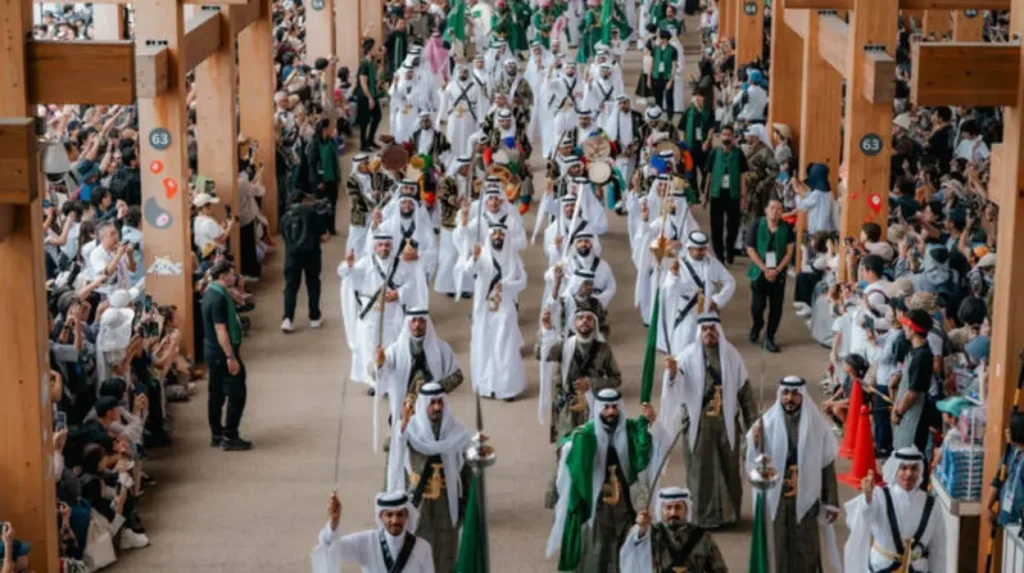
When Saudi Arabia publicly announced winning the gold medal for the best architecture and landscape at the Osaka-Kansai Expo, the world’s cheers came quickly. The Kingdom’s pavilion, a gleaming building of modernity and aspiration, outranked Spain and the UAE to be the first. To some, it seemed like another icon of Saudi Arabia’s emerging worldwide status, an achievement of imagination and design.
However, beneath the sleek surface is a more politicized motive. This Expo victory is not solely about building design; it is a calculated move in an ongoing effort to remake Saudi Arabia’s international image in preparation for the 2034 FIFA World Cup, hosted by the Kingdom.
The gold medal, just as the forthcoming football tournament, is not a pure celebration of ingenuity. It’s yet another phase in what human rights organizations describe as “sportswashing” and “culture-washing”, the routine application of international events to whitewash the reputation of a repressive regime.
A Gold Medal for Hypocrisy
Saudi Arabia’s Expo win can glitter on the surface, but it conceals a sinister reality. As the Kingdom constructs future-looking pavilions overseas, it crushes freedoms domestically.
Saudi Arabia is “Not Free”, with a measly 8 out of 100 on global freedom indices, according to Freedom House. Civil liberties are practically zero. The government still imprisons journalists, women’s rights activists, and even social media commentators for simply voicing opinions. In 2024, Human Rights Watch (HRW) reported that Saudi border troops killed hundreds of Ethiopian migrants, with some shot at point-blank range.
The Kingdom also conducted at least 345 executions in 2024, as per Reuters, most of them for nonviolent crimes like drug-related offenses. This was among the highest rates of executions globally. Behind its glossy expo facade, Saudi Arabia is still one of the most oppressive regimes on the planet.
Honoring it for “excellence” in design amidst all these atrocities is not only a moral fail, it’s complicity. It’s a message that as long as your pavilion shines, the world will turn a blind eye to your prisons.
The Expo Win as Culture-Washing
Saudi Arabia’s involvement in the Osaka-Kansai Expo was more than mere cultural exchange; it was an image-making exercise. Taking home the gold medal for best architecture of a pavilion is one component of a soft-power effort to get the world to view the Kingdom as new, innovative, and forward-thinking, the ideal host for an international event such as the FIFA World Cup.
But this is culture-washing in its rawest form. Just as sportswashing deploys football or Formula 1 to whitewash an image, culture-washing deploys art, architecture, and expos to relate a false narrative of openness.
While the Kingdom constructs shining pavilions, it continues to suppress freedom of expression. Saudi Arabia’s law against cybercrime still enables the authorities to jail citizens for a maximum of five years because of internet entries that “disturb public order.” Women, not because of recent superficial reforms, continue to be subject to guardianship laws that limit travel, marriage, and even receiving certain medical care without the permission of men.
This Expo’s success, then, is not evidence of progress. It’s a PR mirage, buffed up for the international stage, ready to convince the world that Saudi Arabia is reforming.
From Osaka to Riyadh: The Road to FIFA 2034
The Osaka-Kansai Expo was, in many respects, a rehearsal for the 2034 FIFA World Cup. The same words of innovation, unity, and progress that amazed Expo visitors will soon be employed to market the next tournament.
But football lovers, journalists, and human rights activists must ask: At what cost?
- Saudi Arabia today has over 10 million migrant workers, many stuck under the kafala sponsorship system, which ties the legality of workers to their employer. Though there have been small changes, the system is still plagued by exploitation, wage theft, and abuse.
- Human Rights Watch and Amnesty International caution that without robust protections, the 2034 World Cup risks mirroring the horrific labor abuses of Qatar’s 2022 tournament, in which thousands of workers lost their lives in hazardous environments.
In November 2024, HRW issued a statement criticizing FIFA’s human rights risk assessment of Saudi Arabia as “deeply flawed and incomplete.” Amnesty International was even stronger in its criticism, calling on FIFA to suspend the 2034 host selection process until Saudi Arabia provides protections for workers and civil society.
If the Expo gold was a dress rehearsal in soft power, the World Cup shall be the dramatic finale of image laundering, an international spectacle meant to erase decades of human rights abuses in the glare of fireworks and stadium lights.
The Irony of “Unity” and “Diversity”
The Osaka-Kansai Expo ended with a message of unity: “In a world facing division, the Expo reminded us that the world is diverse, yet one.”
That message is beautiful and cruelly ironic. In Saudi Arabia, diversity is not celebrated; it’s criminalized. The Kingdom prohibits same-sex relations, curtails non-Muslim religious practices, and censors free expression. LGBTQ+ individuals are imprisoned, subjected to corporal punishment, or worse.
So when Saudi Arabia receives a gold medal on a banner of “unity in diversity,” it’s a sad irony. The international acclaim for the Kingdom’s architecture sounds hollow when, within its walls, diversity is not cherished but penalized.
Global Complicity and the Price of Silence
The painful reality is that Saudi Arabia was not able to get away with this without the assistance of other countries. From the Bureau International des Expositions to FIFA, international institutions are facilitating a regime that purchases legitimacy in dollars and shows.
FIFA’s move to confirm Saudi Arabia as the 2034 host despite glaring human rights issues was branded by Amnesty International as “reckless” and “morally indefensible.” But the trend continues: influential bodies like to turn a blind eye when there are billions of dollars at stake.
This moral blindness is precisely why boycotts and advocacy campaigns like yours are so crucial. If the world continues to reward Saudi Arabia for its image control, there will be no reason for reform. only for increased repression behind prettier lights.
A Gold Medal in Hypocrisy
Saudi Arabia’s Osaka win might glitter, but it ought to remind us of something uglier: how repressive regimes employ beauty as a mask for brutality. The same country that constructs prize-winning pavilions still executes prisoners, muzzles activists, and criminalizes identity.
The world needs to look beyond the gold plating. Every medal, every concert, every mega-event is moving toward normalizing oppression in the name of progress.
Until the Saudis treat human rights, freedom, and equality with respect, their victories overseas will be shallow. The Expo victory isn’t a victory of design, it’s a victory of deception. And for that, the only ethical response is resistance. Boycott Saudi 2034.