Saudi Arabia’s Public Investment Fund (PIF) has signed a multi-year partnership with the Queen’s Club Championships, the historic British grass-court tennis tournament, even as the sovereign wealth fund reportedly scales back other sports investments—raising fresh questions about whether the deal is a selective step in a broader strategy to cement Saudi Arabia’s global sporting influence ahead of hosting the 2034 FIFA World Cup.
Why Queen’s Club Matters
The Queen’s Club Championships is not merely a pre-Wimbledon warm-up; it is one of the oldest continuing tennis tournaments in the world, established in 1890, and was upgraded from ATP 250 to ATP 500 status in 2015, reflecting its growing significance on the circuit. The event serves as a crucial preparation tournament for players facing Wimbledon shortly after, offering competitive match practice on grass—a rare asset in the modern calendar.
Securing a partnership with such an iconic British sporting institution carries symbolic weight. Queen’s Club sits in west London, adjacent to the spiritual home of grass-court tennis, and has spanned the amateur era, the Open Era, and the modern ATP Tour. For PIF, already a global partner of both the ATP and WTA Tours and the official naming partner of the ATP and WTA Rankings, the Queen’s Club deal deepens its presence in elite Western tennis.
A More Selective, Not Smaller, Sports Strategy
The agreement comes amid reports that PIF is scaling back or restructuring investments in some other sports projects. The fund said it will withdraw its backing for the LIV Golf League at the end of the 2026 season after injecting roughly $5 billion into the rebel tour for little return. PIF also scaled back across snooker and tennis, and will no longer host the WTA Tour’s season-ending finals.
Yet the fund has reiterated its commitment to staging an ATP Masters 1000 tournament in Saudi Arabia starting in 2028, and publicly stated it
“remains committed to deploying capital internationally in line with its investment strategy, including its substantial current and future investments in various sports as a priority sector”.
This suggests Saudi Arabia is becoming more selective rather than reducing its sports ambitions.
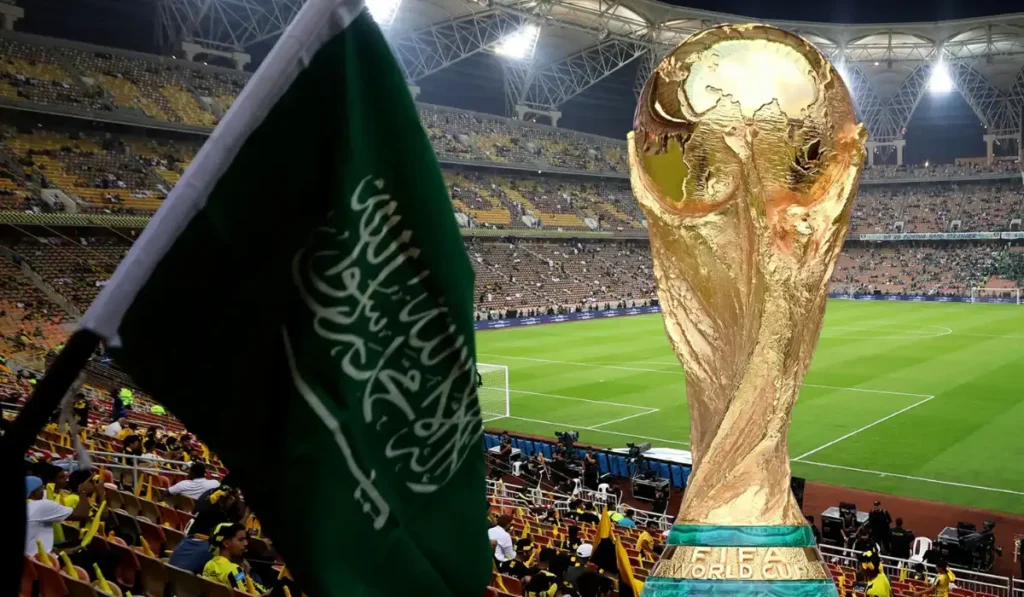
Football remains the kingdom’s highest strategic priority, especially with Saudi Arabia set to host the 2034 FIFA World Cup. The Queen’s Club deal may appear small in isolation, but it contributes to a larger ecosystem of influence surrounding that tournament.
A Global Sports Portfolio Built for Soft Power
PIF’s investments span tennis, golf, boxing, Formula One, esports, and football, forming a long-term soft power strategy. By the end of 2024, PIF was involved in 346 direct or indirect sports sponsorships and investments. Overall, between 2021 and 2023, Saudi Arabia invested more than $6 billion in over 900 sponsorship agreements across various sports.
Play the Game, a Danish institute focused on sports ethics, has pinpointed 194 Saudi sponsorships specifically related to soccer, with more than a third linked to the PIF. Aramco is set to sponsor both the 2026 Men’s World Cup and the 2027 Women’s World Cup, and the Saudis have entered into 48 memorandums of understanding with national soccer associations. In April 2024, FIFA itself entered into a significant sponsorship agreement with Aramco, elevating it to the status of a “major worldwide partner” for the World Cup, reportedly worth $100 million annually until 2027.
These investments help build political influence, commercial partnerships, and international legitimacy. The goal is to integrate Saudi Arabia into the global sports landscape to project soft power and forge alliances, with Western sports markets such as the United States and Europe serving as key building blocks, complemented by partnerships with Asia and Africa.
The 2034 FIFA World Cup Connection
Every major international sports partnership adds to Saudi Arabia’s credibility as a global sporting hub. The kingdom’s growing influence and massive spending in global sports were detailed in research ahead of FIFA confirming Saudi Arabia as the 2034 World Cup host.
PIF’s continued investment in prestigious Western sports institutions like Queen’s Club helps normalize Saudi Arabia’s expanding role in global sport. The decision by FIFA to award the 2034 World Cup to Saudi Arabia has sparked significant criticism, particularly from Western observers, intensifying geopolitical rivalries and underscoring the complex interplay between sports, politics, and global governance.
The “Sportswashing” Debate
Critics and human rights organizations have argued that Saudi Arabia uses elite sporting events and sponsorships to improve its global image and shift attention away from human rights concerns. Saudi Arabia has emerged as the globe’s leading “sportswashing machine” in the last decade, utilising major sporting events to launder a reputation tarnished by human rights abuses.
Human Rights Watch has highlighted the kingdom’s use of high-profile sports events to launder its reputation internationally, pointing to domestic issues including the suppression of dissent and gender inequality. In its annual report released in February 2026, Human Rights Watch said Saudi authorities carried out an unprecedented wave of executions in 2025, following trials that largely failed to meet standards of fairness and due process, while continuing to suppress freedom of expression and arbitrarily detain dissidents and activists.
The broader debate around “sportswashing” encompasses the controversy surrounding FIFA’s decision-making process for the 2034 World Cup. Critics have labelled the decision as the most significant case of sportswashing in FIFA’s history. A recent report from HRW, titled “Die First, and I’ll Pay You Later,” argues that the Saudi government, headed by its de facto ruler Mohammed bin Salman, is using the tournament to “wash away its poor human rights reputation”.
Rights groups have highlighted concerns over labor rights, freedom of expression, and governance issues. Saudi Arabia’s restrictions on free expression prevent workers from establishing unions and collective bargaining for better labor protections. A December 2024 Human Rights Watch report documented extensive human rights abuses by Saudi employers and apathy by state agencies, noting that workers’ collective bargaining and freedom of expression rights are limited in the kingdom.
There are also concerns that major sporting organizations are increasingly dependent on Saudi investment. FIFA added PIF as a Club World Cup partner in June 2025, taking another Saudi Arabian investment for the U.S.-hosted tournament. This dependency raises questions about the independence of sporting governance when major organizations rely on such funding.
Saudi Arabia’s Stated Position
Saudi officials frame these investments as part of Vision 2030, an initiative launched in 2016 by Crown Prince Mohammed bin Salman to diversify the economy, reduce oil dependency, and develop the sports sector. Substantial investments in grassroots and professional sports are described as creating greater global engagement, diversifying the economy, creating a more vibrant society, and promoting a healthier lifestyle for the Saudi people.
Vision 2030 seeks to achieve six overarching objectives: enhance government effectiveness, enable social responsibility, grow and diversify the economy, increase employment, strengthen national identity, and offer a fulfilling and healthy life. Supporters argue these investments create jobs, modernize infrastructure, and grow international sport. The ambitious plan aims to create an ambitious nation, thriving economy, and vibrant society.
What the Queen’s Club Deal Signals
The Queen’s Club partnership reflects a long-term geopolitical and sporting strategy extending beyond tennis. Two years after British tennis bosses refused to be involved with a proposal linking the ATP Tour and Saudi Arabia in a sponsorship deal encompassing many 1000-level events and Queen’s, PIF’s move could be seen as a strategic recalibration rather than a retreat.
Saudi Arabia has remained in tennis despite PIF’s general retreat, with the blockbuster Six Kings Slam taking place in the kingdom under the watch of boxing supremo Turki Alalshikh. The fund continues to invest strategically where it maximizes visibility and influence.
The deal signals that Saudi Arabia is not abandoning sports but refining its approach. Football remains the priority, with the 2034 World Cup as the centerpiece. Yet investments across tennis, golf, boxing, Formula One, and esports build the infrastructure of global sporting legitimacy that supports that ambition.
As PIF branding appears across Queen’s Club for the tournament, the partnership underscores a broader campaign to shape the global sports landscape. The question for observers is whether this represents responsible economic diversification under Vision 2030 or a calculated effort to use sport as a tool of reputation management. The answer likely lies in both: Saudi Arabia is pursuing economic transformation while simultaneously leveraging sport to build political influence and international legitimacy ahead of 2034.
The Queen’s Club sponsorship may seem modest compared to billions in football or golf investments, but in the architecture of soft power, historic institutions carry disproportionate symbolic value. For a kingdom seeking to host the world’s biggest sporting event in eight years, every partnership with a prestigious Western institution adds to the narrative of Saudi Arabia as an emerging global sporting hub—whether that narrative is welcomed or contested depends largely on where one stands in the sportswashing debate.