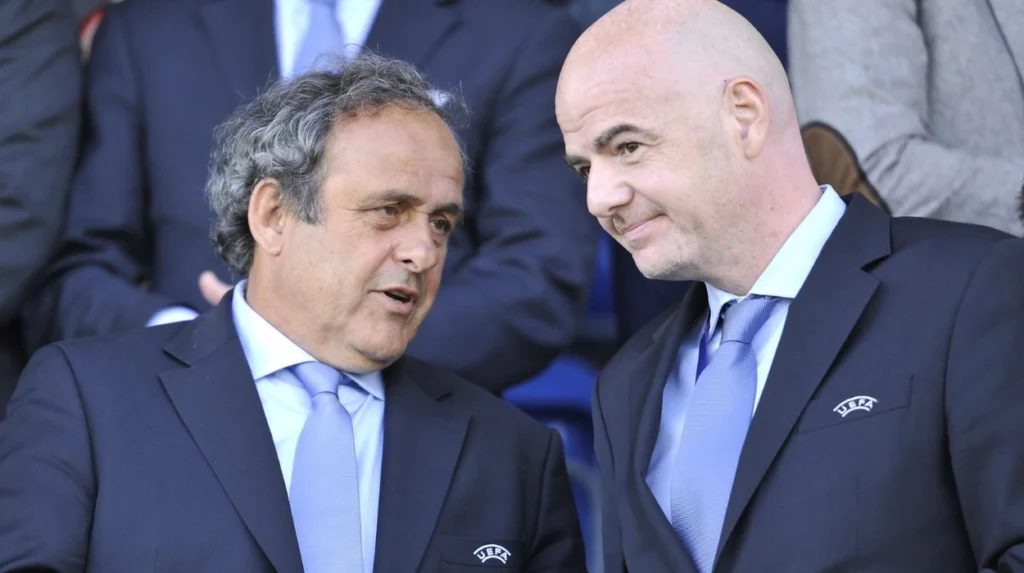
Michel Platini, the former UEFA president, has reignited a bitter feud with FIFA’s incumbent leader Gianni Infantino, accusing him of favoring “the rich and powerful” and morphing into an autocrat. This public broadside, delivered in a January 2026 Guardian interview, underscores persistent tensions at the pinnacle of global football governance, raising alarms about who truly steers the sport’s direction.
Platinis’s remarks are more than personal jabs; they spotlight how power dynamics and financial clout increasingly dictate FIFA’s agenda, potentially eroding the democratic ethos of the organization meant to serve football worldwide.
Background
Michel Platini and Gianni Infantino’s professional paths intertwined during Platini’s tenure as UEFA president from 2008 to 2015, when Infantino served as the body’s general secretary. Their collaboration appeared fruitful at the time, with Infantino handling administrative duties effectively under Platini’s visionary leadership, which emphasized financial fair play and European club dominance.
The landscape shifted dramatically after FIFA’s 2015 corruption scandal, which ensnared dozens of officials in a U.S.-led probe into bribery and racketeering. Sepp Blatter, FIFA’s long-reigning president, was ousted amid allegations of misconduct, paving the way for Infantino’s 2016 election as his successor. Platini, positioned as a frontrunner to replace Blatter, saw his candidacy derailed by a Swiss investigation into a controversial 2 million Swiss franc payment from Blatter, which he claimed was for legitimate consulting work but led to his eight-year ban from football activities (later overturned).
This episode fueled mutual recriminations, with Platini alleging Infantino and allies tipped off prosecutors to sabotage him, marking the onset of their rift.
Platini’s Criticism
Platini’s core charge is stark: Infantino “likes the rich and powerful people, the ones with money,” a trait allegedly amplified since ascending to FIFA’s top role. He contrasts Infantino’s “good number two” performance at UEFA with his current “autocrat” style, claiming FIFA now exhibits “less democracy than in Blatter’s time.”
These allegations resonate amid perceptions of Infantino cozying up to influential figures, such as awarding FIFA’s new “Peace Prize” to U.S. President Donald Trump—a move Platini and others decry as politicized favoritism. Platini’s critique reflects broader anxieties about influence concentration, where decisions on tournament hosting or rule changes appear swayed by geopolitical leverage rather than merit or fan interests.
Money and Power in Modern Football
Wealthy states and corporate giants have profoundly reshaped FIFA’s decision-making, with oil-rich Gulf nations and Asian powerhouses securing World Cup bids through massive investments.[web: context on Qatar 2022] Saudi Arabia’s growing footprint, via sponsorships from its Public Investment Fund and hosting lucrative events, exemplifies how financial muscle translates to voting bloc support in FIFA’s congress.[ implied]
Corporate sponsors like Adidas and Coca-Cola pour billions into FIFA, but critics argue this fosters undue influence, as seen in opaque broadcasting deals and tournament expansions favoring revenue over sporting integrity. Political alliances compound this: Infantino’s overtures to leaders in Russia, China, and the Middle East mirror Blatter’s tactics but with a more centralized edge, prioritizing host nation prestige over human rights or environmental concerns in bids like the 2034 World Cup awarded to Saudi Arabia.
These dynamics risk turning football into a geopolitical chessboard, where “sportswashing” by authoritarian regimes undermines the game’s universal appeal.
Leadership Style and Governance
Infantino’s leadership blends charisma with controversy, marked by ambitious reforms like the expanded 48-team World Cup but criticized for top-down centralization. Detractors, including Platini, highlight reduced consultation with confederations and member associations, contrasting with Blatter’s consensus-building (albeit corrupt) approach.
Transparency remains a flashpoint: FIFA’s financial reports show record revenues, yet audits reveal persistent opacity in development fund allocations, fueling accusations of cronyism. Accountability mechanisms, such as the ethics committee, have been reshuffled under Infantino, prompting claims of weakened oversight. This centralization, Platini argues, alienates football purists, replacing passion with bureaucratic indifference—”administrators who wouldn’t care whether it’s football or basketball.”
Credibility and Counterarguments
Platini’s moral high ground is contested by his own tarnished record: the 2015 payment scandal, alongside earlier ethics probes, cast him as part of the pre-Infantino old guard. Banned by FIFA’s ethics body (a verdict he successfully appealed), Platini embodies the very power struggles he now decries, with some viewing his attacks as sour grapes from a failed presidential bid.
Yet his critique merits attention. As a three-time Ballon d’Or winner and UEFA reformer, Platini’s insider perspective offers rare candor on systemic flaws, untainted by current alliances. Dismissing him outright ignores how his experiences illuminate FIFA’s entrenched issues, even if personal vendettas color his rhetoric.
Impact on FIFA’s Reputation
Internecine battles like Platini vs. Infantino erode public trust, amplifying perceptions of FIFA as a self-serving fiefdom rather than football’s steward. Fan backlash to politically charged decisions—Trump’s prize, Saudi bids—has spurred boycotts and declining viewership in key markets like Europe.
This infighting distracts from existential threats: match-fixing, player welfare amid fixture overloads, and inequality between elite clubs and grassroots levels. Restoring credibility demands unity, yet ongoing feuds signal deeper malaise, alienating a global audience that craves the sport’s purity over palace intrigue.
Platini’s assault transcends rivalry, exposing structural rot in FIFA’s governance where money and might eclipse merit. Reforms are imperative: independent oversight boards, term limits, and binding transparency rules could decentralize power and prioritize football’s ethos.
Without such changes, FIFA risks further isolation from fans and stakeholders. Platini’s voice, flawed as it is, serves as a clarion call—demanding not just new leadership, but a fundamental reimagining of how global football wields its unparalleled influence.