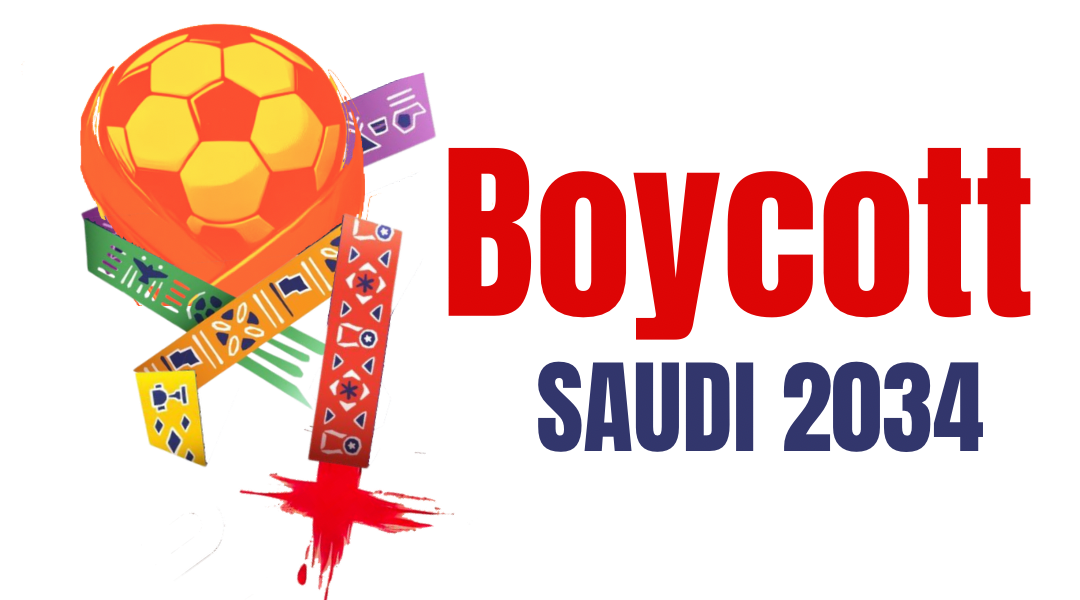

The leadership of Saudi Arabia desires that the world witness a country moving full speed ahead into progress, sustained by science, technology, and innovation. Its Vision 2030 vision presents the image of a country transforming itself, new, ambitious, and networked with the world. But beyond the shiny facade is a grim reality.
While the Kingdom gears up to host the 2034 FIFA World Cup, its bid to entice partnerships with international companies and universities is not only about development — it’s about image makeovers.
The most recent one being the Deloitte–KAUST collaboration to develop artificial intelligence, is a clear demonstration of how the Kingdom is employing technological cooperation as a distraction from its extensive human rights violations to gain international attention. What looks like a tale of innovation is, in fact, part of an overall image laundering campaign in preparation for FIFA 2034.
From Sportswashing to Techwashing: The New Frontier of Image Control
Saudi Arabia has employed sports to sanitize its international reputation for decades — hosting Formula 1 events, boxing events, and, most recently, the World Cup. Sportswashing, this process, enables the regime to present itself as part of a spectacle of excitement, unity, and global cooperation while suppressing journalists, activists, and minorities.
But the new Deloitte–KAUST deal marks a pivot from sportswashing to “techwashing.” Rather than depending exclusively on sporting spectacle, Saudi Arabia is currently making huge investments in technology partnerships to position itself as an ethical, progressive nation.
By partnering with reputable institutions such as Deloitte’s AI Institute and King Abdullah University of Science and Technology, the regime has a platform to brag about progress, precluding queries regarding continuous executions, mass surveillance, and limitations on free speech. In both sports and technology, the aim is identical: to transform an authoritarian state into an innovational beacon.
The MoU’s True Purpose: Legitimating an Illegitimate Regime
The MoU between KAUST and Deloitte is cast in the form of a partnership aimed at applying “scientific breakthroughs” to society and advancing “responsible AI.” In fact, it serves as a public relations ploy in the guise of advancement. By establishing connections with internationally respected companies, the Saudi state appropriates their reputation. Ethical language, innovation, and opportunity are used to create a façade that the Kingdom is at the forefront of modernization and reform.
Yet these partnerships seldom fill the moral void at the heart of the Saudi system. A government that jails women’s rights activists, censors its people, and monitors online behavior cannot credibly claim to be advancing “ethical AI.” Rather, these partnerships legitimize an autocratic regime by aligning its name with that of venerable international institutions. While FIFA’s awarding the 2034 World Cup to Saudi Arabia gives the Kingdom sports legitimacy, just as undeserved, Deloitte’s involvement gives it technological legitimacy — equally as undeserved.
Ethics in AI vs. Ethics in Governance
One of the main threads of the MoU is “responsible AI” — investigating the ethical uses of artificial intelligence. But Saudi Arabia’s political climate is starkly incompatible with this tenet. Ethics in AI depend on transparency, accountability, privacy, and equity, but these are fantasies in a state where criticism of the authorities is illegal and online surveillance is a tool of the state.
- In 2024, Saudi Arabia executed 345 people, the most in decades.
- Over one-third of them were for drug crimes, many against foreign nationals, even though international norms dictate that the death penalty is to be reserved for the “most serious crimes.”
Human rights groups have also reported that due process is lacking: defendants often don’t receive proper legal counsel, trials move forward on confessions that are supposedly made under pressure, and transparency is minimal.
What happens when “AI innovation” is developed under a system that detains peaceful critics, jails women’s rights activists, and executes for non-violent or drug offenses? The partnership risks becoming a vehicle for digital repression, cloaked in the language of responsibility. As Deloitte and KAUST explore AI’s “social impact,” the more urgent ethical question remains: How can a state with record numbers of executions and arbitrary trials be trusted to lead in ethical technology?
Techwashing FIFA 2034: Same Script, New Stage
Saudi Arabia’s global rebranding campaign is coordinated on several fronts — sports, entertainment, and even technology. The Deloitte AI tie-up follows the same playbook for FIFA 2034: invite foreign institutions, speak the language of change, and project the Kingdom as welcoming, tolerant, and forward-looking.
By 2034, when Riyadh hosts the World Cup and the world focuses its attention, Saudi leaders would like the story of an oppressive desert monarchy to be one of a future-oriented, AI-driven giant. Techwashing, as with sportswashing, is meant to redefine identity in the context of partnership. It transmutes global doubt into admiration and criticism into cooperation.
But genuine reform is not constructed around football stadia or AI centres — it starts with the release of prisoners of conscience, the abolition of capital punishment, and defending freedom of speech. Otherwise, both FIFA and Deloitte stand to be remembered as co-conspirators in propaganda rather than progress.
The Corporate Complicity Problem
Western institutions such as Deloitte, FIFA, and other international brands have an ethical decision to make. Their involvement in Saudi Arabia is not value-free — it is politically significant. Each partnership bolsters the Kingdom’s capacity to project itself as a model of modernity, while silencing those who seek real change.
Corporations explain these alliances as “engagement for reform,” but history reveals otherwise. In sport, in entertainment, in technology, foreign alliances have not enhanced Saudi human rights; they have diverted from them. The nation’s worldwide charm campaign — from football sponsorships to AI initiatives — is predicated on the silence of its partners.
If Deloitte genuinely supports “ethical AI,” it must see the irony in collaborating with a regime that jails digital dissidents. Ethical business and political oppression cannot go together.
Join the Boycott: Don’t Let Innovation Whitewash Injustice
The world needs to view the Deloitte–KAUST agreement for what it is — a further addition to Saudi Arabia’s ongoing effort to whitewash its image in preparation for FIFA 2034. Each tech agreement, each AI conference, and each public-private collaboration serves to build a world fiction of reform. But true progress is not founded upon censorship and intimidation.
As FIFA 2034 looms, it’s time to call out sportswashing and techwashing for what they are: mechanisms to distract from oppression. Activists, spectators, and international citizens must come together to call out corporations and institutions that support authoritarianism by offering legitimacy. Boycotting Saudi 2034 is not just a demonstration against a tournament; it’s a refusal of the normalization of tyranny in the guise of the language of innovation.