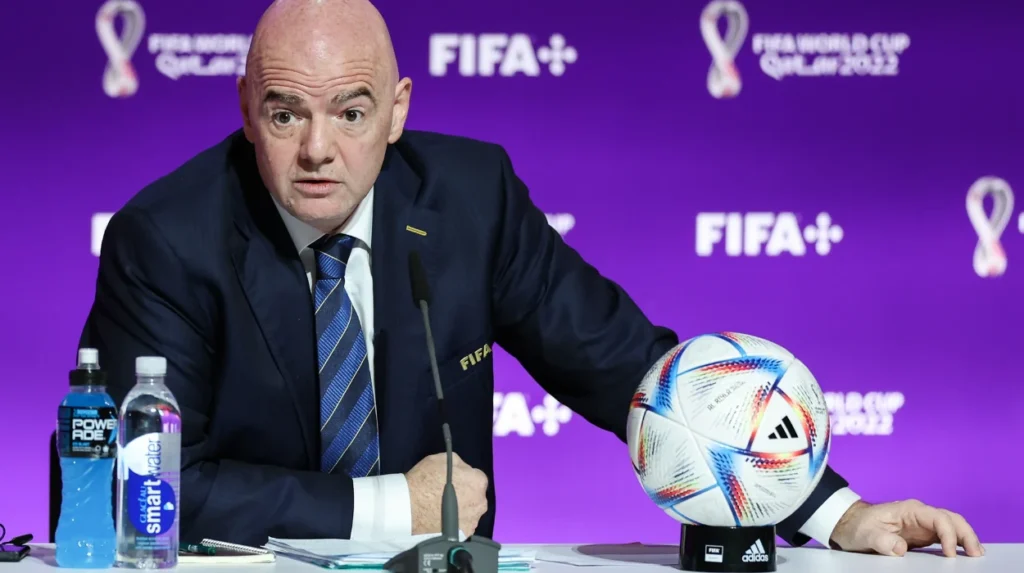
FIFA’s pledge to “closely monitor developments” ahead of the World Cup is familiar language, but it carries more weight in 2026 than it might in a routine qualifying cycle. The phrase sounds prudent, yet it also reveals how often FIFA prefers managed ambiguity over clear disclosure when politics, security, and tournament logistics begin to collide. In practice, “monitoring” has become FIFA’s default response to uncertainty: sufficiently serious to signal attention, but vague enough to avoid committing the organization to a course of action. FIFA secretary general Mattias Grafström used that language after military action involving Iran, saying it was “premature to comment in detail” while stressing that FIFA’s focus was on a safe tournament with all teams participating.
That choice of wording matters because it reflects more than caution. It is also a communication strategy designed to hold the line publicly while FIFA assesses risk privately, and to preserve flexibility in case the situation changes again. The organization knows that a direct statement can create legal, diplomatic, and commercial consequences, especially when a tournament is already embedded in geopolitical tension. In that sense, “closely monitoring” functions less as a substantive update than as an institutional holding pattern.
The Politics Behind Monitoring
FIFA still presents itself as a neutral steward of the game, but neutrality in global football is often aspirational rather than operational. The World Cup is not staged in a political vacuum, and FIFA’s own scheduling, host selection, and participation rules inevitably intersect with government policy, border controls, and international conflict. The latest example is the tension surrounding Iran’s participation in a tournament partly hosted in the United States, where FIFA has said it will keep the situation under review while continuing to communicate with the three host governments.
That formulation sounds balanced, but it also exposes the limits of FIFA’s neutrality claim. The governing body may avoid taking sides in public, yet it cannot avoid depending on state institutions to determine visas, security, movement, and public safety. ESPN reported that FIFA has acknowledged the U.S. government’s role in deciding the safety of host cities, underlining how much practical control sits outside FIFA’s hands. The organization’s political posture is therefore less a clean separation from power than a careful negotiation with it. FIFA wants to appear above politics, but the tournament’s structure ensures that politics is never far away.
Risk and Reputation
There is a real distinction between risk management and image management, and FIFA’s public communication often blurs the two. Genuine risk assessment would normally involve clear criteria, timelines, and contingencies, even if the full detail stayed confidential. FIFA rarely offers that level of transparency in public. Instead, its statements are usually broad, reassuring, and non-committal, which helps limit panic but also protects the institution from being pinned down too early. Grafström’s comments about Iran fit that pattern: acknowledge the issue, emphasize safety, and avoid specifics.
That approach may be rational from a crisis-management perspective, but it also serves FIFA’s image. A World Cup viewed as unstable can unsettle sponsors, broadcasters, host governments, and fans long before any operational decisions are required. The governing body therefore has an incentive to project calm even when internal assessments may be evolving. This is where FIFA’s language becomes especially revealing. “Monitoring” suggests diligence, but it also postpones accountability. It tells audiences that FIFA is aware of the problem without forcing the organization to explain what it is actually prepared to do.
Commercial Pressures
The commercial scale of the World Cup makes public messaging unusually sensitive. FIFA is not just managing a sporting event; it is protecting a global entertainment product built on broadcasting rights, sponsorship contracts, hospitality sales, and ticket demand. Any hint of instability can affect all of those revenue streams. That helps explain why FIFA tends to move cautiously in public even when the underlying issue is serious. It is not merely trying to solve the problem; it is trying to prevent the problem from becoming a commercial story in its own right.
The 2026 tournament is especially exposed because of its size and visibility. FIFA has already moved deep into the commercial and operational machinery of the event, while the White House task force has described the competition as one of the largest sporting events in history. In that environment, every statement is read by multiple audiences at once: fans want certainty, broadcasters want continuity, host cities want confidence, and sponsors want reassurance. FIFA’s communication style often seems calibrated to serve all of them without fully satisfying any of them. That is understandable, but it is not the same as transparency.
Expansion and Strain
The expanded 48-team format has made the World Cup more ambitious, but also more vulnerable to disruption. More teams mean more travel, more matches, more logistical dependencies, and a broader range of political and security scenarios to monitor. The fact that FIFA must repeatedly say it is “monitoring developments” is itself a sign of structural strain. In a smaller, simpler tournament, such a phrase might appear only in exceptional circumstances. In the modern World Cup, it is becoming part of the operational vocabulary.
The multi-host model in North America adds another layer of complexity. A tournament spread across the United States, Canada, and Mexico requires coordination across different border regimes, legal systems, security protocols, and public-health or diplomatic environments. FIFA’s own acknowledgment that it will continue communicating with the three host governments reflects that reality. The challenge is not only whether matches can be played, but whether the tournament can retain a coherent identity across three national contexts. The more fragmented the event becomes, the more likely it is that “monitoring” will be used as a substitute for decisive planning.
Transparency and Trust
FIFA’s transparency problem is longstanding, and it becomes more visible whenever the organization faces security, eligibility, or travel issues. The broad language used in public statements often creates the impression that FIFA is preserving order, but it can also suggest that the organization is withholding too much for too long. Supporters and teams are expected to trust that contingency planning exists, even when the governing body offers little detail about what those contingencies are. That gap matters because trust in a global tournament is built not only on results on the pitch, but on confidence that the event is being run competently off it.
There is also a governance issue here. When FIFA’s public messaging remains vague, it becomes harder for stakeholders to understand who is responsible for what. If host-city safety falls to governments, as FIFA has acknowledged in the U.S. context, then FIFA’s role is partly supervisory and partly diplomatic. But if the organization does not clearly explain how it is assessing risk, then criticism is inevitable whenever a crisis emerges. FIFA cannot claim neutrality on the one hand and demand trust without explanation on the other.
Fans and Teams
For teams and players, uncertainty is more than a public-relations problem. It affects preparation, travel planning, commercial obligations, and mental focus. National associations need to know whether fixtures are secure, whether travel routes are stable, and whether visa or security issues could alter training plans. Fans face similar uncertainty, only with added financial exposure: flights, accommodation, insurance, and ticket purchases all become harder to manage when the organizer’s messaging remains open-ended. A World Cup should create certainty well before kickoff; repeated “monitoring” language does the opposite.
The credibility issue is also subtle but important. The World Cup depends on the idea that football can transcend politics and deliver predictability on the pitch. When FIFA’s own statements repeatedly hint at unresolved external risks, that promise weakens slightly. The tournament does not become less important, but it does become more visibly dependent on forces beyond football. That is not necessarily a crisis, but it is a reminder that credibility in modern sport is fragile and cumulative. It is built through clarity, not just optimism.
A Familiar Precedent
FIFA has used similar language before, and the pattern is telling. In past tournament cycles, “monitoring” has typically served as the first public response to instability, whether the issue involved security concerns, diplomatic friction, or unexpected global disruption. Sometimes that language has preceded substantive action; often it has simply bought time. The problem is not that FIFA should react instantly to every development. The problem is that the organization rarely tells the public what monitoring actually means, what thresholds would trigger intervention, or how far its contingency planning has progressed.
That history makes the current statement easier to interpret. FIFA’s latest language does not signal panic, but it does confirm a longstanding institutional habit: keep the message general, keep options open, and avoid saying more than is necessary. In a world where the World Cup is larger, more commercial, and more politically exposed than ever, that habit may no longer be enough.
Stability Beneath the Surface
The World Cup will almost certainly go ahead, and FIFA will likely present it as a triumph of coordination when the opening match arrives. But the organization’s repeated reliance on “closely monitoring developments” tells a different story beneath the surface. It reveals a governing body trying to manage risk without fully explaining it, to protect a commercial product without admitting how vulnerable that product has become, and to preserve political neutrality in a system that is structurally political from the start.
That is the central tension in FIFA’s current position. The surface message is stability. The underlying reality is conditional, negotiated, and constantly shifting. For a sports governing body that prizes control, “monitoring” may be the safest word available. It is also a reminder that, in modern football governance, caution often travels with opacity.