
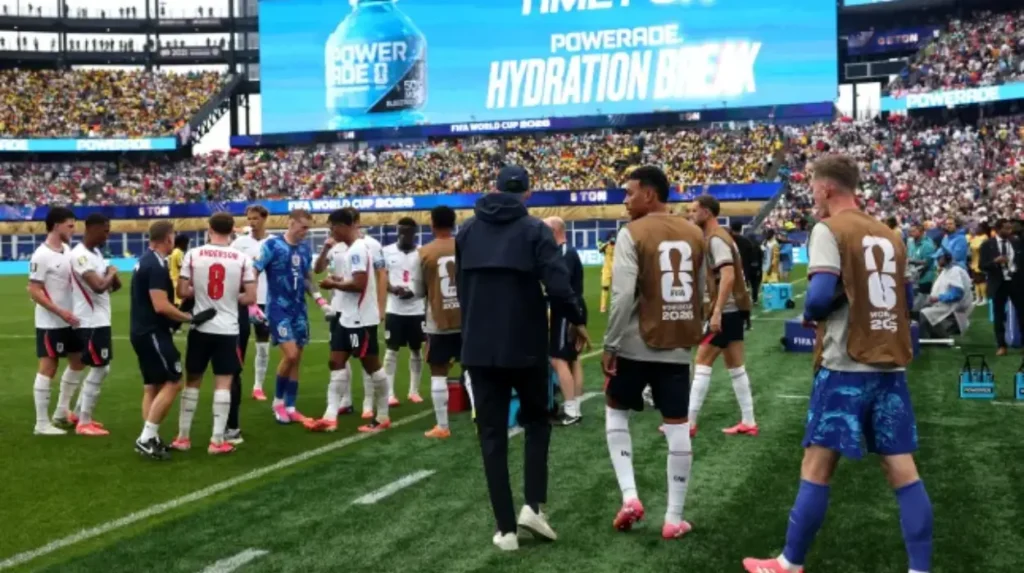
FIFA’s response to the booing over mandatory hydration breaks at the 2026 World Cup has opened a much wider argument than a few minutes of paused play. Gianni Infantino has insisted the stoppages are “purely sporting,” framed around heat management and player welfare, but the reaction from England fans, broadcasters, commentators and even coaches suggests many supporters see something larger at work: a governing body increasingly comfortable reshaping the game while asking audiences to accept it as necessity.
Why FIFA’s Hydration Breaks Sparked Fan Backlash
The immediate trigger for the backlash was simple enough. During England’s match against Ghana, supporters booed when FIFA-mandated hydration breaks interrupted play, and similar frustration had already surfaced in England’s earlier game against Croatia. What might have passed as a brief procedural pause became a public expression of distrust, because the stoppages arrived in situations where the weather did not always appear extreme enough to justify a universal intervention. That disconnect matters: fans are often willing to tolerate welfare measures when the need is obvious, but they are far less forgiving when a policy feels blanket, bureaucratic and detached from what is actually happening on the pitch.
The criticism was also cultural as much as practical. Football’s appeal has long rested on its continuity, its sense that momentum and atmosphere build without interruption, and its resistance to the stop-start logic that defines other major North American sports. When supporters boo a hydration break, they are not only rejecting a pause; they are voicing discomfort with the idea that football’s natural rhythm can be edited at will. That is why a three-minute stoppage can trigger a bigger argument about the identity of the sport itself.
Gianni Infantino’s Defense Under Scrutiny
Infantino’s defense has followed a familiar FIFA pattern: insist the policy is about fairness, explain that all teams face identical conditions, and deny any commercial gain. He has argued that the breaks are designed to protect players in heat and humidity and to give them a chance to recover during a demanding tournament calendar. On those terms, the logic is not unreasonable. World Cups are physically intense, and welfare considerations cannot be treated as cosmetic when matches are staged across a continent with diverse climate conditions.
The problem is credibility. FIFA is not introducing this policy into a vacuum of trust. It is doing so after years in which its governance, commercial strategy and decision-making have repeatedly been questioned, and that history shapes how its explanations are received. When Infantino says the breaks are purely sporting, many fans hear an organisation that has too often fused sporting justifications with business logic. The statement may be formally defensible, but public confidence in FIFA’s motives is too weak for such claims to land cleanly.
The Commercial Debate Behind World Cup Stoppages
The commercial dimension is impossible to ignore, even if FIFA denies that hydration breaks were designed to generate revenue. Reports around the tournament have pointed out that the mandatory pauses create extra windows for broadcasters, and critics argue that these are effectively premium advertising moments packaged as welfare measures. That does not prove the breaks were invented for commercial reasons, but it does explain why the public is suspicious. In modern sport, a welfare initiative that also creates monetisable inventory is rarely interpreted at face value.
This is where the argument becomes more nuanced. Player welfare and commercial value are not necessarily mutually exclusive. A policy can be justified on sporting grounds and still be commercially useful, especially in a tournament built around global television audiences. The issue is not whether broadcasters benefit; it is whether FIFA has been candid enough about the fact that they do. If the public believes a supposedly medical or welfare measure is also serving the broadcast model, then every future explanation becomes harder to accept.
Player Welfare or Television Opportunity?
There is a legitimate case for hydration breaks in hot and humid conditions. The 2026 World Cup is being played across venues where climate variation is real, and the physical burden on players cannot be dismissed simply because some individual matches do not feel oppressive to spectators. FIFA is right that player welfare cannot be limited to the most comfortable or visually acceptable moments for fans in the stands. Football authorities have a duty to take heat stress seriously, especially in a tournament that compresses elite competition into a demanding calendar.
Yet the universal format is harder to defend. Critics have focused on the fact that the breaks apply in every match, regardless of venue, temperature or live conditions. A temperature-based system would have looked more credible because it would have aligned the interruption with need rather than with policy symmetry. By contrast, a mandatory pause in every match invites the suspicion that football is being standardised around a television-friendly template rather than around the actual welfare profile of each game.
How Hydration Breaks Change Football Matches
Tactically, the breaks matter. A match that is paused on a fixed schedule gives coaches a rare chance to intervene without waiting for half-time, and that can alter momentum in ways that are not trivial. In a game where pressing intensity, emotional rhythm and field positioning are often built on flow, even a short stoppage can flatten the tempo and reset the contest. For the team under pressure, that may be a relief; for the side building momentum, it can feel like an intrusion into a promising spell.
The competitive effect is subtle but real. Players recover, managers adjust, and the game resumes with both sides having had an unplanned tactical pause. That may sound minor, but at elite level small interventions can matter. The broader concern is that football begins to resemble a segmented product, with rhythm engineered through stoppages rather than emerging naturally from play. That shift may be manageable in isolation, but once it becomes normalised, it changes how the sport is experienced by players, coaches and spectators alike.
FIFA’s Growing Credibility Challenge
FIFA’s challenge is not just that it introduced hydration breaks; it is that many supporters already believe the organisation is structurally inclined to put business before tradition. Tournament expansion, scheduling choices and the increasing influence of broadcasters have all fed a perception that the sport is being arranged to suit commercial imperatives first and footballing logic second. In that context, even a defensible player-welfare policy is read through a sceptical lens.
Infantino’s leadership has intensified that scepticism because he has often presented FIFA’s most controversial moves as visionary or pragmatic while critics see them as revenue-maximising or power-consolidating. That is not the same as saying every FIFA decision is cynical. It is to say that trust has eroded, and once that happens, every new policy is judged not just on its merits but on the institution proposing it. Hydration breaks have therefore become a proxy battle over FIFA’s broader authority to define what the modern game should look like.
The Americanisation of Modern Football
The cultural critique is powerful because it speaks to identity. Many fans in Europe and elsewhere view in-game stoppages as a form of Americanisation: a move toward packaged, segmented sport, with built-in pauses that make room for broadcast needs and commercial sequencing. Whether that label is entirely fair is another matter, but it captures a real anxiety about football drifting away from the continuous-flow character that made it distinct.
That anxiety is amplified by the optics. A mandatory break in every half, regardless of the local weather, makes the game feel less organic and more managed. Supporters may accept necessary welfare interventions, but they are wary of a model in which football is subtly reconfigured to mimic other entertainment products. The danger for FIFA is that a policy intended to protect players is interpreted instead as evidence that the sport’s custodians no longer trust football’s own rhythms to hold an audience.
The hydration-break controversy is ultimately about more than a few boos in one stadium. It shows how fragile the relationship has become between football’s governing institutions and the people who believe they are being asked to absorb the costs of reform without being fully convinced of the reasons. Player welfare is real, heat management is real, and modern tournaments do require practical safeguards. But the universal, one-size-fits-all approach gave critics an opening because it appeared to prioritise administrative neatness and broadcast convenience over contextual judgment.
The future direction of football will depend on whether governing bodies can reconcile three things at once: sporting integrity, player protection and commercial growth. FIFA can argue that all three can coexist, and in principle that is true. But coexistence requires transparency, restraint and policies that look necessary rather than merely efficient. Hydration breaks may survive because they serve an undeniable purpose in some conditions, yet the backlash suggests that football supporters will not accept every modernisation simply because FIFA says it is for the good of the game.