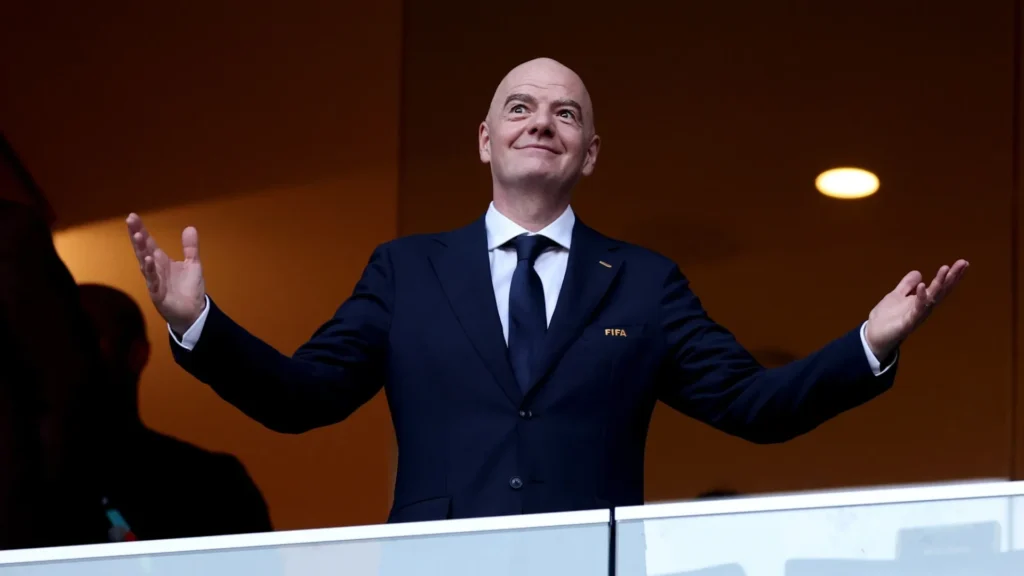
Gianni Infantino’s FIFA is not just selling tickets and sponsorships; it is increasingly selling access, atmosphere and even pieces of the tournament itself. The decision to charge fans for the World Cup final press conference, deepen its partnership with Fanatics and sell turf from MetLife Stadium has sharpened a larger question about whether the FIFA World Cup is becoming a premium commercial product first and a public sporting spectacle second.
Is FIFA Turning the World Cup Into a Commercial Empire?
The recent moves look less like isolated marketing experiments than parts of a broader FIFA business model built around monetizing every layer of the event ecosystem. FIFA’s own Fanatics deal says the partnership is designed to create “another important commercial revenue stream” that can be channelled back into football, which is the core argument the organization uses to justify expanding commercial activations around the tournament. The problem is that the World Cup has always depended on a delicate balance: it must generate huge revenue, but it also has to feel like a shared global event rather than a luxury property.
Under Infantino, FIFA has leaned more visibly toward the American model of sports commerce, where stadium retail, collectibles, premium fan experiences and branded entertainment are part of the core product. That approach may be rational from a business perspective, especially with a larger 48-team tournament and a more complex multi-country hosting structure, but it also changes the public meaning of the competition. The World Cup is no longer being sold only as football; it is being packaged as a festival of licensed experiences.
Why Gianni Infantino’s FIFA Faces Growing Criticism
The criticism of Infantino is not simply that FIFA wants to make money. FIFA has always been commercial, and previous administrations were hardly shy about sponsorships, broadcast rights or hospitality. What has changed is the tone and the breadth of monetization, which has become more explicit, more Americanized and more attached to branded experiences that sit close to the sport itself.
The choice to stage the World Cup final news conference at Fanatics Fest, where fans must pay for entry, has drawn attention because it collapses a traditionally media-led moment into a commercial event. Reporters still attend, but the public setting is no longer shaped around press access and accountability; it is shaped around ticketed entertainment. That may look efficient to FIFA, but to critics it reinforces a governance concern: the organization increasingly appears to view its institutional rituals through the lens of consumer activation rather than sporting stewardship.
Infantino has often responded to criticism with a strong defense of FIFA’s results and a dismissive attitude toward noise, a posture that can read as confidence or defensiveness depending on perspective. In governance terms, the issue is not personality alone. It is whether FIFA is transparent enough about how commercial decisions are made, who benefits from them and how they affect the public character of the tournament.
The Business Behind FIFA’s Fan Experience Strategy
The Fanatics partnership is central to understanding this shift. FIFA has handed the company a major role in on-site retail and fan festival commerce, and the broader relationship now extends to collectibles, digital products and exclusive licensing rights starting in 2031. That is a significant move because it shows FIFA is not merely licensing a product; it is helping build a global retail architecture around the World Cup.
Fanatics is a sophisticated operator with huge scale in American sports, and its model is familiar to fans of the NFL, NBA and other major U.S. leagues, where the matchday experience is deeply intertwined with merchandising, collectibles and premium access. FIFA appears to be borrowing that playbook while expanding it internationally, using its global reach to turn the World Cup into a year-round consumer brand rather than a four-week tournament. From a commercial standpoint, that may be efficient. From a football governance standpoint, it raises a question about where the line sits between fan engagement and extraction.
The decision to make the final press conference part of a ticketed Fanatics event is especially revealing because it reframes access itself as a sellable asset. That is a meaningful shift for a body that still presents itself as the custodian of world football, not just its marketer.
Has FIFA Priced Ordinary Football Fans Out?
Affordability has become one of the most persistent themes in modern FIFA criticism. FIFA is selling World Cup final tickets at up to $32,970 and hospitality packages at even higher levels, while the press conference event at Fanatics Fest requires a paid entry that starts at more than $80. Those prices sit alongside the wider cost of travel, accommodation and local transport in a tournament spread across the United States, Canada and Mexico, making the modern World Cup far less accessible than the mythology around “the people’s game” suggests.
This does not mean every fan is excluded, and FIFA will point to millions of free-to-watch broadcasts, official fan festivals and broader reach than ever before. It also argues, reasonably, that staging a tournament across three countries with more matches, more venues and more logistics naturally raises operating costs. But affordability is not only about one ticket price. It is about the cumulative cost of participation, and on that front the tournament looks increasingly designed for wealthier traveling supporters, corporate guests and domestic audiences consuming it from outside the stadium.
That matters because the World Cup has long derived part of its legitimacy from the sense that it is not owned by one market or one class. If fans feel the event is being optimized for premium spenders, then FIFA risks eroding a key part of its cultural value.
The MetLife Turf Controversy Explained
The sale of pieces of the MetLife Stadium turf after the World Cup final might sound trivial on its own, but it is symbolically important. Selling match-used memorabilia is common in sports, including in FIFA events, and there is nothing inherently improper about collectibles.
The issue is context. MetLife Stadium’s surface for the final will be a temporary natural grass installation, which underscores the unusual public-private mechanics behind major tournament staging in the United States. Publicly supported infrastructure, venue access and event logistics are being used to produce an asset that can then be monetized by FIFA and its commercial partners. That is not unique to world sport, but it does highlight the distance between the rhetoric of global football and the reality of modern event capitalism.
The turf sale also links neatly to FIFA’s broader collectibles push with Fanatics and Topps, where scarcity, authenticity and emotional attachment are all converted into revenue. In that sense, the pitch is not just grass. It is a branded object.
FIFA’s Revenue Model Under Infantino
Infantino’s defenders argue that all of this is simply a smarter, more modern revenue model. FIFA says commercial income funds development, redistributes wealth across the global game and helps cover the rising cost of running a larger tournament. There is truth in that. Football’s international body has always depended on the World Cup as its financial engine, and FIFA cannot credibly promote global development without a strong commercial base.
The question is whether the balance has shifted too far. Previous FIFA eras were marked by their own controversies, but the governing body generally maintained a clearer separation between media access, sporting ceremony and commercial activation. Under Infantino, the commercial logic appears more integrated and more aggressive. Sponsorship, retail, collectibles, entertainment and media moments now feel woven into the tournament’s institutional fabric rather than layered around it.
That approach resembles the business strategies of the NFL and Formula 1 more than the older FIFA ideal of a publicly legible world championship. Those models can produce huge revenue and polished presentation, but they also normalize tiered access and premiumization. FIFA is not becoming the NFL, but it is borrowing from a system in which the consumer experience is segmented by spending power.
Commercial Success or Loss of Identity?
The central tension is not whether FIFA should make money. It is whether FIFA can keep making money without hollowing out the symbolic identity of the World Cup. Football is global in a way that few sports are, and the tournament’s prestige depends on the idea that an ordinary supporter, anywhere in the world, can still feel ownership over it.
That ownership is what is at stake when a press conference becomes a ticketed activation, when a final pitch becomes a collectible and when fan access is increasingly mediated by corporate partnerships. None of those decisions is enough on its own to prove that FIFA has abandoned football’s cultural role. But together they suggest a governing philosophy in which almost every meaningful moment is viewed through the possibility of monetization.
FIFA will insist that this is simply the reality of modern sports governance: bigger events cost more, expectations are higher and development demands more income. That is a credible argument. Yet the long-term risk is reputational as much as financial. If football fans come to believe that the World Cup is being optimized mainly for premium consumers and commercial partners, FIFA may win on revenue while losing something harder to rebuild: trust.