
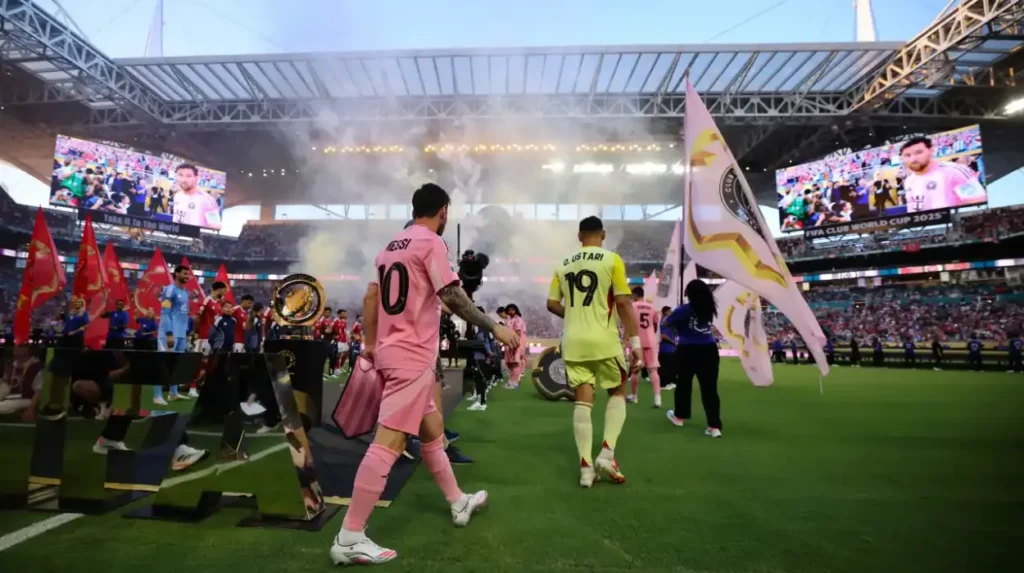
FIFA’s reported decision to abandon plans for individual player walkouts at the 2026 World Cup marks a quiet but telling recalibration in how football’s governing body balances innovation with tradition. The concept, trialed during the FIFA Club World Cup, would have replaced the familiar team-based entrance with a sequence of individually introduced players—an approach more commonly associated with North American sports such as basketball and American football.
While the experiment was never formally confirmed as a permanent addition to the 2026 tournament, its apparent withdrawal suggests that FIFA has encountered resistance significant enough to reconsider. The episode offers a revealing snapshot of the broader tensions shaping modern football: between spectacle and authenticity, commercial ambition and cultural heritage, and global standardization versus regional influence.
Why FIFA Tested the Format
The rationale behind FIFA’s experimentation is not difficult to trace. In an era where sports consumption increasingly overlaps with entertainment, presentation has become as strategically important as competition. The success of highly produced pre-game ceremonies in leagues like the NBA and NFL has demonstrated the commercial value of turning athlete introductions into standalone broadcast moments.
By introducing players individually, FIFA aimed to create more camera-friendly narratives, offering broadcasters opportunities to highlight star power, engage viewers with personalized graphics, and build anticipation in a structured, television-oriented format. From a production standpoint, it also allows for tighter control over storytelling—something global tournaments, with their diverse audiences, increasingly prioritize.
The Club World Cup provided a relatively low-risk testing ground. Unlike the World Cup, it does not carry the same cultural weight or global scrutiny, making it an ideal environment to trial innovations that might otherwise provoke immediate backlash.
However, translating such a format to the World Cup—arguably the most tradition-bound tournament in global sport—was always likely to be more complicated.
A North American Influence
The choice to explore individual walkouts cannot be separated from the context of the 2026 World Cup hosts: the United States, Canada, and Mexico. Of these, the United States in particular exerts a strong influence on sports presentation norms, where pre-game entertainment is deeply embedded in the viewing experience.
North American sports culture places a premium on individual athlete branding. Player introductions are often choreographed moments, complete with music, lighting effects, and crowd interaction. These rituals are not peripheral; they are central to how the sport is consumed, both in arenas and through broadcast media.
FIFA’s interest in adopting elements of this model reflects a broader strategic goal: to deepen engagement with North American audiences while making the tournament more appealing to global viewers accustomed to high-production entertainment formats.
Yet the World Cup is not a domestic league product. It is a global event with deeply rooted traditions that transcend any single market. What works in Los Angeles or New York does not necessarily translate seamlessly to audiences in Buenos Aires, Lagos, or Berlin.
This tension between localization and universality sits at the heart of FIFA’s current challenge.
Tradition and Symbolism
Few moments in football carry as much symbolic weight as the pre-match walkout. Two teams emerging side by side, led by captains, accompanied by anthems and national flags, encapsulates the essence of international competition. It is a ritual that emphasizes unity, collective identity, and national representation.
Altering this sequence, even in seemingly minor ways, risks disrupting a deeply ingrained cultural expectation. Football fans are not merely passive consumers; they are custodians of tradition, often resistant to changes that appear to prioritize spectacle over substance.
The proposed individual walkouts would have shifted the emphasis from team cohesion to individual recognition. While this may align with modern marketing trends, it conflicts with the foundational narrative of international football, where the collective often supersedes the individual.
This is not simply nostalgia. Rituals in sport serve as anchors of meaning, connecting generations of fans to shared experiences. When those rituals change, the reaction is rarely neutral.
The Business of Presentation
Behind FIFA’s experimentation lies a clear commercial logic. The World Cup is not only a sporting event but also one of the most valuable media properties in the world. Every aspect of its presentation is scrutinized for its potential to generate revenue, attract sponsors, and maximize broadcast appeal.
Individual player introductions offer new advertising inventory. Each player becomes a focal point for branding opportunities, from sponsored graphics to personalized content integrations. Broadcasters gain additional storytelling tools, while sponsors benefit from increased visibility.
This aligns with other reported adjustments for 2026, including extended cooling breaks that double as commercial windows and discussions around expanding in-game advertising opportunities. These changes reflect a broader trend: the gradual integration of commercial considerations into the structure of the game itself.
Critics argue that such developments risk blurring the line between sport and entertainment product. Supporters, however, contend that these innovations are necessary to sustain the financial ecosystem that underpins global football.
Star Players and Team Identity
The rise of globally recognizable footballers has transformed the sport’s commercial landscape. Players like Lionel Messi, Kylian Mbappé, and Jude Bellingham are not just athletes; they are brands with massive individual followings.
From a marketing perspective, individual walkouts make sense. They provide a platform to showcase star players in a way that resonates with modern audiences, particularly younger fans who engage with football through social media and highlight-driven content.
However, international football has historically resisted the full commercialization of individual stardom. Unlike club football, where player branding often takes center stage, the World Cup has maintained a stronger emphasis on national identity and collective achievement.
Introducing individual walkouts would signal a shift toward a more star-centric presentation, potentially altering how the tournament is perceived. It raises a fundamental question: should the World Cup celebrate individuals in the same way as domestic leagues, or should it preserve its distinct identity as a team-first competition?
Fan Backlash and Cultural Resistance
Initial reactions to the concept of individual walkouts were mixed, but criticism was both swift and vocal. Fans, commentators, and former players expressed concerns that the change would undermine the essence of football’s pre-match rituals.
Much of the backlash centered on the perception that FIFA was attempting to “Americanize” the sport—an accusation that surfaces frequently whenever changes align with North American sports practices. While such critiques can sometimes oversimplify complex decisions, they reflect a genuine anxiety about the erosion of football’s cultural identity.
Players themselves were reportedly divided. While some welcomed the opportunity for increased visibility, others questioned whether the format would disrupt pre-match focus or create unnecessary pressure.
Broadcasters, meanwhile, saw potential benefits but also logistical challenges. Individual introductions could extend pre-match timelines, complicate scheduling, and require careful coordination to avoid disrupting the flow of coverage.
Faced with this combination of practical concerns and cultural resistance, FIFA appears to have concluded that the costs outweigh the benefits—at least for now.
Innovation Versus Authenticity
Football has never been static. The sport has evolved through rule changes, technological advancements, and shifts in tournament structure. Innovations such as goal-line technology, VAR, and expanded World Cup formats were all met with skepticism before becoming part of the modern game.
However, not all changes carry the same weight. Adjustments that enhance fairness or improve officiating tend to gain acceptance more easily than those perceived as purely cosmetic or commercially driven.
The individual walkout proposal falls into the latter category. It does not address a functional issue within the sport; rather, it seeks to reshape how the game is presented. This makes it more vulnerable to criticism, particularly when fans perceive it as prioritizing entertainment over authenticity.
The challenge for FIFA lies in distinguishing between innovation that enriches the sport and changes that risk diluting its identity.
What FIFA’s Reversal Reveals
FIFA’s apparent retreat from the individual walkout concept highlights an important reality: even the most powerful governing body in football must operate within the boundaries of fan acceptance.
The World Cup, unlike other competitions, is not solely owned by FIFA. It belongs, in a cultural sense, to the global football community. Decisions that clash with deeply held traditions are unlikely to succeed, regardless of their commercial rationale.
This episode also suggests that FIFA is willing to test ideas but remains pragmatic when faced with significant opposition. While critics often portray the organization as rigid or disconnected, the willingness to reconsider indicates a degree of responsiveness.
At the same time, it underscores the limits of top-down innovation in a sport where legitimacy is closely tied to tradition.
The abandonment of individual walkouts does not signal a retreat from FIFA’s broader strategy to enhance the World Cup as a global entertainment product. The 2026 tournament is expected to feature numerous innovations, from expanded team participation to enhanced broadcast experiences.
What this episode illustrates is the need for balance. Innovation is not inherently problematic, but it must be calibrated to respect the cultural and symbolic dimensions of the sport.
FIFA’s challenge will be to introduce changes that enhance the viewing experience without alienating the core audience that gives the World Cup its meaning. This requires a nuanced understanding of football’s global diversity—recognizing that what appeals in one market may not resonate in another.
In the end, the rejection of individual walkouts serves as a reminder that football’s power lies not only in its ability to evolve, but also in its capacity to preserve what makes it unique. The World Cup’s enduring appeal is rooted in its traditions as much as its spectacle, and any attempt to reshape it must navigate that delicate balance with care.