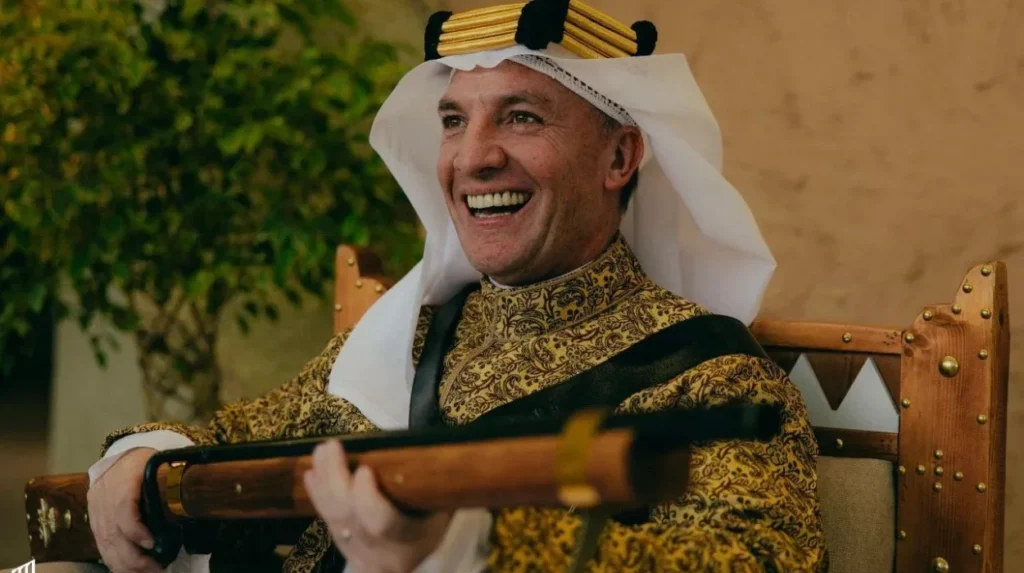
Brendan Rodgers’ appearance in a Saudi Founding Day promotional video, dressed in traditional Saudi attire and holding a ceremonial rifle, quickly circulated across social media and news platforms, not only because of its visual incongruity but because of what it seemed to represent. The Northern Irish coach, now managing Saudi Pro League side Al-Qadsiah, appears in the clip smiling, answering light questions and describing his outfit as a mark of “respect” for Founding Day, a national holiday marking the origins of the Saudi state.
On one level, the video can be read as a benign cultural tribute by a foreign employee integrating into local customs; yet the imagery carries a political charge that cannot be separated from Saudi Arabia’s contemporary human rights record and ambitious sports strategy.
The visual of a high-profile Western football figure holding a rifle in a state-linked celebration resonates far beyond the Saudi fan base, precisely because such images circulate in a global media ecosystem where the politics of symbolism are heavily scrutinized.
For many observers, it jars with ongoing reports from human rights groups about repression of dissent, restrictions on women and LGBTQ+ people, and abuses against migrant workers in the kingdom. The clip thus becomes more than a quirky social media moment; it is a micro-scene in a much larger narrative about how states use sport, celebrity, and carefully curated imagery to shape international perceptions.
The Normalisation of Controversial Symbolism
The rifle in Rodgers’ hands is described as ceremonial and historically rooted in Saudi traditions of dress and celebration, particularly around Founding Day. Within that domestic context, such an object may be read as part of a national heritage aesthetic rather than a literal instrument of violence.
However, when broadcast globally and consumed by audiences accustomed to fierce debates over firearms, militarism, and security, the image acquires different connotations. Viewers in Europe and elsewhere are not only seeing cultural symbolism; many are also seeing the normalization of weaponry within a state-approved spectacle.
This raises a deeper question: at what point does
“respecting local culture”
blur into participation in a political narrative that emphasizes strength, tradition, and state authority? Rodgers’ comments in the video frame his participation in terms of respect and adaptation to his new environment, without any explicit political statement.
Yet the optics are not under his sole control; they are shaped by the institutional setting of a club owned and operating under Saudi rules, and by a state whose communication strategy increasingly uses sport as a vehicle for image building. The risk is that repeated images of foreign coaches and players participating in such scenes contribute to normalizing symbols that, for many, sit uncomfortably alongside allegations of repression and violent enforcement of state power.
In this sense, the controversy is not about one individual’s intent so much as about a broader process of normalisation, where potentially contentious symbolism is softened through association with familiar sports personalities.
The more such imagery circulates—Western football figures in traditional garb, handling ceremonial weapons, praising national days—the more it can dull critical scrutiny and repackage political authority as friendly cultural pageantry.
Sportswashing and Soft Power Strategy
The Rodgers video must be situated within Saudi Arabia’s wider investment in football as part of a deliberate soft power strategy, often described by critics as sportswashing. Over recent years, the kingdom has poured significant resources into acquiring or sponsoring clubs, recruiting star players, bringing in high-profile coaches, and bidding for mega-events, all while facing intense criticism over human rights abuses and lack of basic freedoms.
Human Rights Watch and other organizations argue that these investments aim to “launder” the country’s reputation by associating it with globally beloved sports and personalities rather than with repression, executions, and silencing of dissent.
In this light, the Rodgers clip is not an isolated curiosity but part of a communication ecosystem in which football content doubles as state branding. His presence in the video, framed around patriotism and national pride, reinforces a narrative of a confident, festive, and culturally rich Saudi Arabia, rather than one grappling with calls for political prisoners’ release or serious reforms.
Star managers and players may not intend to play a political role, but their visibility and credibility make them powerful vectors for soft power: each shared image, interview, or promotional appearance adds another layer to a carefully managed international image.
The sportswashing critique does not deny that individuals can have positive experiences working or playing in the country, nor that sporting investment can bring material benefits to local fans. Instead, it emphasizes the asymmetry between polished sports content and the continued suppression of domestic civil society, including activists who have called for genuine reforms in rights, justice, and political participation. By foregrounding football while pushing rights issues to the background, states can seek to reshape what the world’s public associates with their name.
Football’s Expanding Role in Saudi Arabia’s Global Image
The rapid growth of the Saudi Pro League, including the arrival of global stars such as Cristiano Ronaldo and Neymar, has significantly raised the international profile of Saudi football. Clubs have offered lucrative contracts to players and coaches, positioning the league as both a sporting and commercial destination and signaling a broader shift in global football’s economic center of gravity.
Rodgers’ move to Al-Qadsiah, and his participation in highly produced club media, illustrates how even mid-tier clubs in Saudi Arabia now sit within an international visibility strategy.
At the same time, human rights organizations point to ongoing concerns about labor rights, including abuses of migrant workers; systemic discrimination and legal constraints affecting women; severe restrictions on LGBTQ+ expression; and harsh penalties for peaceful dissent.
These issues are not incidental; they shape how fans, activists, and some players perceive the ethics of engagement with Saudi football. As football content from the kingdom fills timelines and broadcast schedules, critics argue that it risks crowding out or diluting attention to these structural problems.
Football, therefore, functions as both entertainment and reputational infrastructure. Friendly interviews, training-ground clips, and festive national-day tributes become part of a tapestry that reimagines Saudi Arabia as a dynamic, globally connected, and fan-friendly hub.
For those concerned with rights and freedoms, the challenge is how to acknowledge the genuine sporting dimension while insisting that it cannot be analytically separated from the governance context in which it operates.
From Viral Clip to World Cup 2034
Saudi Arabia’s confirmation as host of the 2034 FIFA Men’s World Cup marks a pivotal moment in this story, consolidating the country’s place at the center of global football’s future calendar. Human rights organizations and civil society coalitions have warned that awarding the tournament to Saudi Arabia, despite well-documented risks to residents, migrant workers, and visiting fans, reflects a prioritization of commercial expansion and political relationships over robust human rights safeguards.
Some groups describe FIFA’s evaluation as a “whitewash” that fails to adequately account for threats to freedom of expression, workers’ rights, and equality.
Within this context, seemingly minor episodes like the Rodgers Founding Day video take on added significance. They become early scenes in a decade-long build-up where the kingdom, often working in lockstep with global football institutions, seeks to normalize the idea of Saudi Arabia as an unquestioned host of football’s most prestigious event.
Each viral clip of a foreign coach celebrating national holidays or praising life in the kingdom can be read as a soft endorsement, subtly reinforcing the message that Saudi Arabia is a natural and acceptable venue for the sport’s biggest stage.
Critics argue that this process risks dulling public sensitivity to human rights concerns, gradually turning them into background noise against a spectacle of stadiums, star signings, and glossy promotional campaigns. The Rodgers incident thus illustrates how even light-hearted cultural participation by sports figures can embed itself in a much larger communications strategy geared toward 2034, in which the line between commercial promotion and political legitimation becomes increasingly blurred.
The Emerging Boycott Debate
The confirmation of Saudi Arabia as 2034 host has already triggered calls from human rights organizations and activists for heightened scrutiny, conditional engagement, or outright boycotts of the tournament. Groups such as the Sport & Rights Alliance, Amnesty International, and others have warned that without binding commitments and demonstrable reforms, the tournament could be accompanied by forced labor, repression of dissent, and discrimination against women and LGBTQ+ people. They argue that sponsors, broadcasters, and national associations will face moral and reputational questions if they proceed without challenging these conditions.
The boycott-versus-engagement debate is not new to football; it echoes earlier controversies around World Cups and Olympics hosted by states accused of rights violations. Some argue that major events can serve as catalysts for reform by drawing international attention and creating leverage for change, especially if governing bodies and participants demand concrete improvements as a condition of participation.
Others counter that in the absence of credible enforcement mechanisms, engagement risks amounting to tacit endorsement, providing governments with high-profile platforms while meaningful reform remains elusive.
The Rodgers video sits within this contested space. For critics, it exemplifies how participation by respected figures helps normalize a political environment before any substantive reforms have been secured.
For advocates of engagement, it could be framed as a step toward cultural exchange and mutual understanding, albeit one whose benefits are difficult to quantify compared with the clear public relations gains for the host state. The emerging debate around 2034 will likely hinge on whether federations, players, and fans use their influence to demand change or accept the spectacle largely on its own terms.
The Responsibility of Coaches and Players
The ethical responsibilities of coaches and players in such contexts are complex and contested. Rodgers is, first and foremost, an employee of a Saudi club, expected to engage with local culture and participate in club and league media activities, some of which will inevitably intersect with state narratives.
Many football professionals argue that their primary duty is to their team, staff, and families, rather than macro-political struggles in their host countries. Yet the global visibility and influence of such figures mean their actions carry communicative weight that extends far beyond their personal intentions.
This raises the question of whether coaches and players should draw lines around participation in explicitly state-branded imagery—particularly when that imagery involves symbolic weapons or strong nationalist messaging. Human rights advocates have suggested that high-profile individuals can use their platforms to highlight concerns, call for reforms, or at minimum avoid endorsing narratives that sideline the experiences of political prisoners, activists, and marginalized groups.
At the same time, those who speak out risk legal and contractual repercussions in environments where freedom of expression is restricted, creating a genuine dilemma for individuals considering public criticism.
The Rodgers incident underscores how easily a routine media appearance can turn into a global flashpoint when it touches on sensitive symbolism. Rather than framing this as a matter of personal moral failure, it may be more accurate to see it as a symptom of structural pressures: clubs embedded in state projects, federations prioritizing commercial deals, and a football economy that increasingly draws professionals into politically charged environments without clear ethical guidance.
The responsibility question, therefore, extends beyond individual coaches to the broader governance frameworks that place them in such situations.
Football, Ethics, and the Future of Mega-Events
The controversy over Brendan Rodgers’ Founding Day video illustrates how modern football can no longer be cleanly separated from geopolitics and state image management. A clip of a coach in traditional dress holding a rifle during a national celebration becomes a lens through which wider issues—sportswashing, human rights, freedom of expression, and the legitimacy of mega-events—come into focus.
As Saudi Arabia prepares to host the 2034 World Cup, the frequency and visibility of such scenes are likely to grow, reinforcing the need for a more explicit ethical conversation within the sport.
What this episode ultimately reveals is less about one individual’s choices and more about how football has become entangled in projects of national branding and international legitimacy-building. Governing bodies like FIFA, along with national associations, sponsors, and broadcasters, will face mounting pressure to reconcile their commercial ambitions with credible human rights standards and protections.
For players and coaches, the challenge will be navigating environments where cultural participation can double as political endorsement, and where silence or compliance may be read as complicity by critics.
As 2034 approaches, the Rodgers video may be remembered not as an oddity but as an early sign of the tensions that will define the coming era of football mega-events: the clash between spectacle and scrutiny, soft power and solidarity, entertainment and ethics.
Whether the sport can find a path that respects cultural engagement while resisting its instrumentalization for reputational laundering remains an open—and increasingly urgent—question.