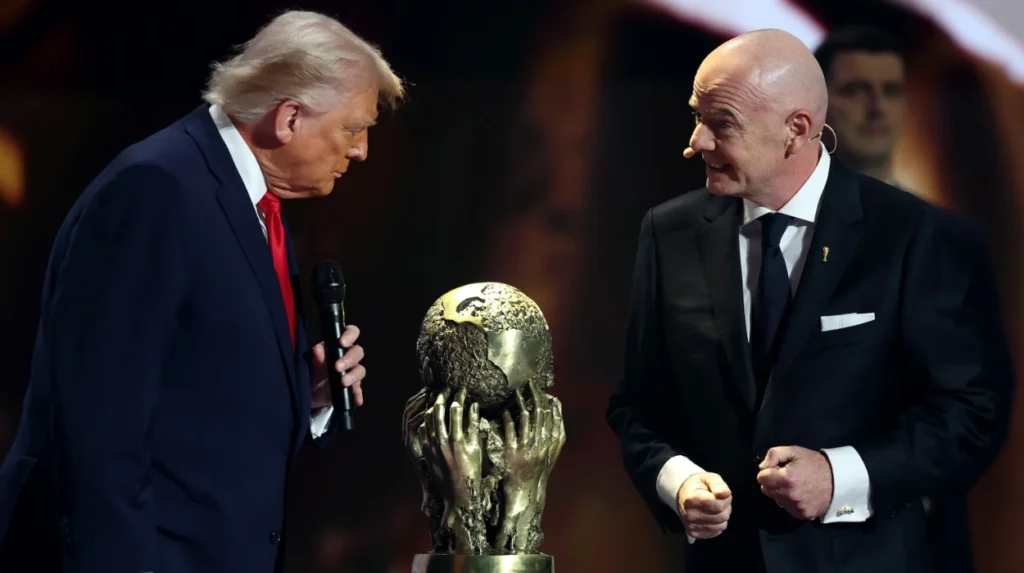
The recent FIFA Peace Prize controversy has stirred intense debate across the world of football and beyond, following Portuguese coach Paulo Fonseca’s outspoken criticism of FIFA’s decision to honor former U.S. President Donald Trump. After the announcement that Trump would receive the FIFA Peace Prize, Fonseca labeled the move a “disgrace,” arguing that it betrayed the ethical and symbolic spirit that global football should uphold.
His remarks, widely circulated across European and American media outlets, quickly became a focal point for broader questions about how sports institutions navigate political and moral symbolism.
This article explores the controversy through a broader lens—focusing less on personal opinions about Donald Trump and more on institutional responsibility, symbolism in sports, and FIFA’s governance credibility.
It considers what Fonseca’s comments reveal about football’s moral landscape, the challenges FIFA faces in maintaining legitimacy, and how public reactions reflect deeper tensions between sport, politics, and ethical perception in an interconnected world.
Background Context: Paulo Fonseca, FIFA’s Symbolism, and Donald Trump’s Global Profile
Paulo Fonseca is a respected Portuguese football coach known for his tactical sophistication and reflective public commentary. Currently managing in France’s Ligue 1, Fonseca has built a reputation not only for his managerial success but also for his articulate views on the social and ethical responsibilities of football.
He represents a new generation of coaches who view sport as inseparable from its wider human impact, giving his opinions particular resonance among both players and fans.
The FIFA Peace Prize was established to honor individuals or organizations that contribute to global understanding, conflict resolution, and humanitarian work through the unifying power of football. Past recipients have included community leaders, former players engaged in peace initiatives, and non-profit organizations using sport to promote dialogue in conflict zones. Its intent is to symbolize football’s role as a moral force—a reminder that the world’s most popular sport can transcend divisions.
Donald Trump’s global profile, however, has long been polarizing. As a former U.S. president, entrepreneur, and media personality, Trump has been both celebrated by supporters and sharply criticized by opponents.
His political legacy continues to divide international opinion, making any recognition of him by a high-profile global institution inevitably contentious. The decision to grant him a FIFA award—particularly one invoking peace—was bound to attract scrutiny from observers across both sport and politics.
The Role of Symbolism in Global Sports
Football, more than almost any other sport, functions as a global cultural symbol. It embodies community, identity, and collective joy, but it also serves as a canvas upon which political and ethical meanings are projected.
When FIFA links football to causes such as peace, human rights, or social solidarity, it moves into a sphere where its gestures carry extraordinary symbolic weight. These gestures go beyond trophies or rankings—they communicate moral and cultural values.
Awards such as the FIFA Peace Prize are thus more than ceremonial acts. They function as statements about who the sport deems worthy of representing its ideals.
When such symbols are perceived as incongruent—when an award associated with peace is given to a divisive political figure, for instance—public reactions can be intense and emotional. People respond not merely to footballing decisions but to what those decisions say about shared values and collective integrity.
Symbolic actions in sport often endure longer in the public memory than administrative or technical reforms. A referee’s error may fade with time, but an institution’s symbolic gesture—especially one interpreted as politically charged—can redefine how it is viewed for years. This dynamic makes symbolism one of football’s most powerful yet perilous tools for shaping its global image.
Paulo Fonseca’s Criticism and Its Broader Resonance
When Paulo Fonseca condemned FIFA’s decision, calling it a “disgrace” and asserting that “football doesn’t deserve this,” he tapped into a powerful undercurrent of frustration among many within the sport. His language, stark and emotionally charged, conveyed both moral disapproval and a deeper unease about what the award represented.
To proponents of his view, Fonseca’s statement articulated the discomfort that arises when football’s governing body appears detached from its social responsibilities.
Although Fonseca’s words were personal, their resonance suggests his sentiment is not isolated. Other figures in the football community—players, commentators, and supporters—echoed similar concerns online, questioning what message the Donald Trump FIFA award sends about FIFA’s ethical compass.
Public disagreement from within the sport is notable because many professionals prefer to avoid political controversy, knowing the risks of institutional scrutiny or reputational backlash. For a top-flight manager to speak out so frankly underscores how deeply the issue touches principles of integrity and representation.
His statement also reflects a broader pattern in modern football where leading figures increasingly use their platforms to comment on social issues—from racial equality to governance transparency. Fonseca’s criticism demonstrates the evolving role of football professionals as moral voices in global discussions, emphasizing the sport’s capacity to influence public ethics as much as public entertainment.
FIFA’s Institutional Credibility and Governance Challenges
The FIFA governance criticism revived by this controversy rests on a long-standing history of fluctuating public trust. FIFA has spent over a decade attempting to rebuild credibility after corruption scandals, reform failures, and controversial hosting decisions. The organization’s claim to stand as a neutral guardian of football’s values is frequently tested whenever it engages with politically sensitive figures or decisions seen as compromising its moral neutrality.
Institutional credibility in global sports hinges on consistency between principles and practice. When FIFA promotes peace and equality but honors contentious political figures, critics argue that it sends mixed signals. Even if the award was intended as a diplomatic gesture recognizing efforts toward negotiation or global dialogue, such interpretations are easily overshadowed by the public’s perception of inconsistency.
Balancing diplomacy, global outreach, and ethical clarity remains FIFA’s core institutional challenge. On one hand, football is an instrument of international connection; on the other, it is a reflection of global politics, which rarely fits clean moral boundaries.
FIFA must often navigate competing expectations—states wanting political recognition, fans demanding purity of purpose, and sponsors expecting stability and positive publicity. Each high-profile decision, therefore, becomes a litmus test for whether FIFA is primarily a sporting body or a diplomatic actor.
If trust erodes further, the organization risks alienating the very global audience that sustains its authority. The FIFA Peace Prize controversy thus raises not just reputational questions, but structural ones: how can an institution representing billions of fans preserve ethical legitimacy in a politically polarized world?
The Intersection of Sport and Politics
The debate reignited by Fonseca’s remarks reveals an enduring truth: global sport and politics cannot be neatly separated. Football’s universal visibility makes it a powerful form of soft power used by states, corporations, and institutions to project identity and influence.
Whether it was the Cold War Olympics, Qatar’s World Cup diplomacy, or campaigns like “Football for Peace,” sport routinely functions as a stage for broader political narratives.
In this context, it is understandable that FIFA occasionally walks the line between sporting administration and international politics. Recognizing political leaders with symbolic awards can serve as gestures of engagement or dialogue. Yet such moves risk undermining football’s supposed neutrality, blurring distinctions between diplomacy and ethics.
Examples abound across history. Nelson Mandela’s embrace of rugby in post-apartheid South Africa used sport as unifying reconciliation. Conversely, other instances—such as the controversial use of mega-events for political legitimization—have shown sport’s potential to entrench rather than transcend division.
This ambiguity underscores why political influence in football remains such a sensitive matter, especially when seen through the lens of peace and morality.
Ultimately, sport mirrors its environment. Attempts to isolate football from politics are often more rhetorical than real. The real question for FIFA and other governing bodies is how to manage this overlap responsibly, maintaining symbolic credibility while acknowledging the political realities of global engagement.
Media Framing and Public Reaction
Media coverage played a decisive role in amplifying the Paulo Fonseca FIFA comments into a worldwide debate. Outlets across Europe, North America, and Latin America framed his statements as both a moral critique and a reflection of growing disenchantment with FIFA’s leadership. Some emphasized Fonseca’s courage in speaking out; others questioned whether political fairness was possible in a domain as globally intertwined as football.
Social media further intensified the backlash. Hashtags linking “football and politics” and “FIFA public trust” trended across platforms, while fans and analysts circulated memes, editorials, and calls for reform. Online debates often blurred nuance, transforming complex institutional questions into polarized moral arguments.
Yet such amplification also underscores the modern reality that public trust in organizations like FIFA is shaped less by internal processes and more by their digital reception.
As FIFA faces recurring controversies—from governance transparency to symbolic missteps—each episode accumulates into a public perception of inconsistency. Rebuilding credibility, once fractured, requires years of transparent action but only moments of controversy to undo.
Conclusion: Governance, Symbolism, and the Question of Trust
The FIFA Peace Prize controversy surrounding Donald Trump and Paulo Fonseca’s remarks is not simply a dispute over one award; it is a reflection of deeper structural tensions within global sport. At stake is the interplay between symbolism and governance, between the lofty ideals football proclaims and the political realities it must navigate.
Fonseca’s criticism underscores how strongly the football community values moral coherence in its institutions. When symbolic acts—such as the Donald Trump FIFA award—seem incongruent with the sport’s humanitarian mission, credibility suffers. FIFA’s reputation depends not only on fair play on the field but also on transparency, accountability, and ethical alignment off it.
The episode serves as a reminder that in the realm of international sport, trust is the ultimate currency. For FIFA and similar bodies, restoring and maintaining that trust demands consistent reflection on what their symbols mean, whom they honor, and how their decisions shape the public’s faith in football’s claim to unite rather than divide.