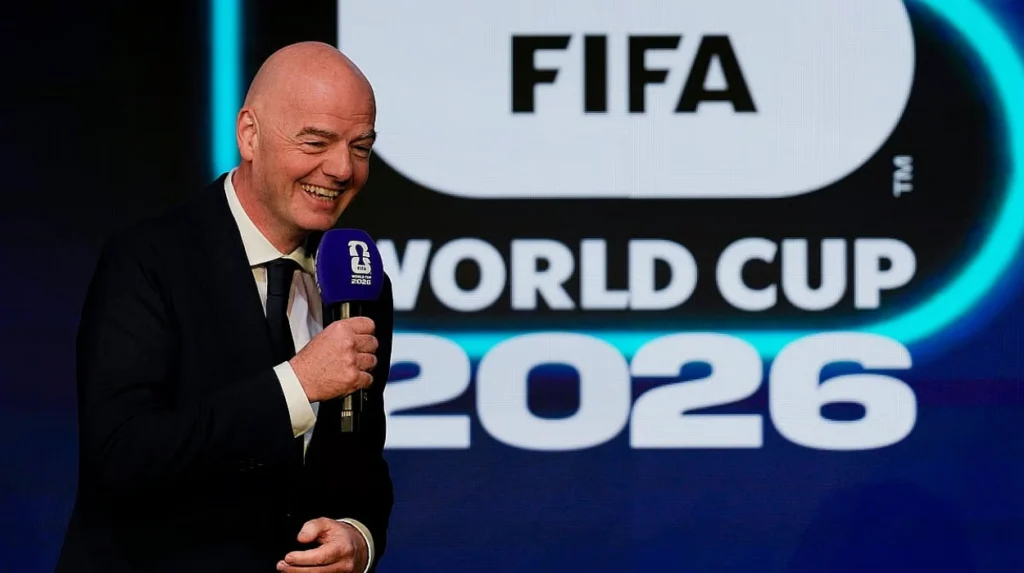
FIFA President Gianni Infantino expressed complete confidence in Mexico’s ability to host 2026 World Cup matches during a press conference in Colombia on February 24, 2026, just days after the Mexican military killed Nemesio Rubén Oseguera Cervantes, known as “El Mencho,” leader of the Jalisco New Generation Cartel.
This statement followed reports of widespread violence, including burned vehicles, road blockades, and at least 70 deaths across nearly a dozen states, with Guadalajara—a host city for four matches—serving as a central hub for the unrest.
Mexican President Claudia Sheinbaum echoed this reassurance on February 24, stating there was “no risk” and “every guarantee” for World Cup events, particularly in Guadalajara.
The timing underscores a pattern where official endorsements align closely with spikes in instability. Infantino’s remarks came as local soccer matches were postponed and a minute of silence was held for soldiers killed in the operation against El Mencho, highlighting the immediacy of the security challenges.
While FIFA monitors the situation through regular contact with Mexican authorities, the public narrative emphasizes trust in government capabilities without detailing contingency measures.
FIFA’s Security Policy Framework
FIFA’s security approach for major tournaments relies heavily on host-nation guarantees, where governments commit to providing comprehensive safety protocols under FIFA’s oversight. Risk assessments begin years in advance, involving site visits, independent human rights reports, and evaluations of infrastructure, as seen in the 2018 inspection of Mexico’s bid amid concerns over violence against journalists and fans.
These evaluations score venues on criteria like discriminatory incidents and freedom of expression risks, feeding into broader bid decisions.
Communication of risks follows a structured path: FIFA delegates primary responsibility to hosts while reserving rights to relocate matches as a last resort, based on inputs from safety officials and commercial partners.
For the 2026 tournament, co-hosted by the United States, Canada, and Mexico, this means Mexico must secure 13 matches, including the opener in Mexico City on June 11 against South Africa. However, FIFA’s policy does not mandate public disclosure of granular security plans, leaving assessments opaque beyond statements of confidence.
Recent Violence and Official Reassurances
Violence erupted on February 22, 2026, after El Mencho’s death, with cartel retaliation including arson and blockades in states like Jalisco, where Guadalajara will host group-stage and knockout games. Authorities reported disruptions severe enough to cancel league fixtures, yet President Sheinbaum and FIFA quickly pivoted to affirmations of control, with Sheinbaum insisting on “all guarantees” for fans.
Guadalajara Governor Alejandro Cervantes, whose state hosts key matches, stated FIFA had no plans to remove games.
This contrast is evident in the timeline: cartel actions followed the military operation within hours, affecting mobility and public safety, while reassurances emphasized routine governmental responses. Colombia’s soccer federation president expressed “absolute confidence,” citing Mexico’s capacity to overcome issues swiftly, even as Portugal monitored a March friendly and Jamaica eyed a Guadalajara playoff.
The violence, while contained to specific areas, directly implicated a host city, raising questions about the gap between on-ground realities and projected stability.
Public Messaging and Its Constraints
FIFA’s messaging strategy prioritizes broad assurances to sustain sponsor interest and fan turnout, framing challenges as surmountable through host authority. Infantino’s phrasing—”Mexico is a great country… we have governments, police, and authorities”—normalizes violence as a global norm, deflecting from Mexico-specific risks.
This approach avoids detailed disclosures, such as troop deployments or intelligence on cartel responses, opting instead for phrases like “monitoring the situation” and “everything will go smoothly.”
Limits emerge in the absence of transparent security plans; confidence-based communication fosters perceptions of control but obscures accountability mechanisms. For instance, FIFA’s response to anonymous concerns about weak influence in Mexico was a blanket denial of pressure, reiterating trust without addressing information gaps.
Such strategy sustains event momentum but risks eroding credibility if disruptions occur, as seen when global media amplified Guadalajara violence, prompting FIFA headquarters to seek on-ground updates.
Missing Perspectives in the Debate
Discussions dominated by FIFA, Mexican officials, and select federation leaders overlook independent security experts, local residents, and civil society voices. Experts could quantify cartel infiltration risks, such as in private security firms or cyber threats to ticketing, which prior analyses flagged for 2026. Local voices from Guadalajara—where football historically channels unrest—might reveal community fears, yet they remain sidelined.
Civil society groups, including human rights coalitions, highlight FIFA’s past retreats, like canceling anti-discrimination messaging for the 2025 Club World Cup, signaling broader oversight gaps.
Their absence matters because it concentrates narrative control among stakeholders with economic incentives, potentially understating vulnerabilities like protests or fentanyl-related disruptions near tourist zones. Without these inputs, policy appears insulated from ground-level scrutiny, complicating risk calibration.
Economic and Institutional Pressures
The 2026 World Cup carries immense economic weight, with North America hosting 104 matches across three nations, projecting billions in revenue for FIFA and hosts. Mexico’s involvement secures diverse markets, but institutional pressures—sponsor demands, broadcast deals, and unified bids—discourage relocation talk, even amid violence.
Guadalajara’s four matches amplify stakes, as shifting them could disrupt schedules and finances.
FIFA’s posture reflects these dynamics: optimism preserves commercial viability, while quiet monitoring allows flexibility without public alarm.
Historical bids incorporated human rights reports to mitigate abuses, yet enforcement relies on host compliance, vulnerable to political influences. Economic imperatives thus shape messaging, prioritizing continuity over proactive risk signals.
Historical Precedents
Past tournaments reveal patterns of minimized concerns preceding events. Russia’s 2018 World Cup faced human rights critiques over dissent suppression, yet FIFA proceeded with host guarantees after inspections.
Qatar 2022 endured labor abuse allegations, with initial bid evaluations noting risks but advancing on assurances of reform. Brazil 2014 grappled with protests and favela violence, where security forces quelled unrest to deliver the event.
In each case, pre-event violence or instability was contextualized as manageable, much like Mexico’s current framing. FIFA’s evaluations flagged issues—discrimination in Mexico’s 2018 bid, expression curbs elsewhere—but outcomes hinged on host commitments, rarely prompting changes. These precedents illustrate how confidence prevails, often until post-event audits reveal gaps.
Conclusion: Beyond Confidence
FIFA’s reliance on public confidence in Mexico highlights the need for transparency as a complement to host assurances. Independent oversight, detailed risk disclosures, and accountability frameworks could bridge gaps between rhetoric and reality, ensuring the tournament’s four-month timeline allows measured adjustments.
What specific metrics define “complete confidence,” and how will deviations trigger action? How might civil society integration refine assessments? These questions persist as June approaches, underscoring that trust alone cannot substitute for verifiable security strategies.