
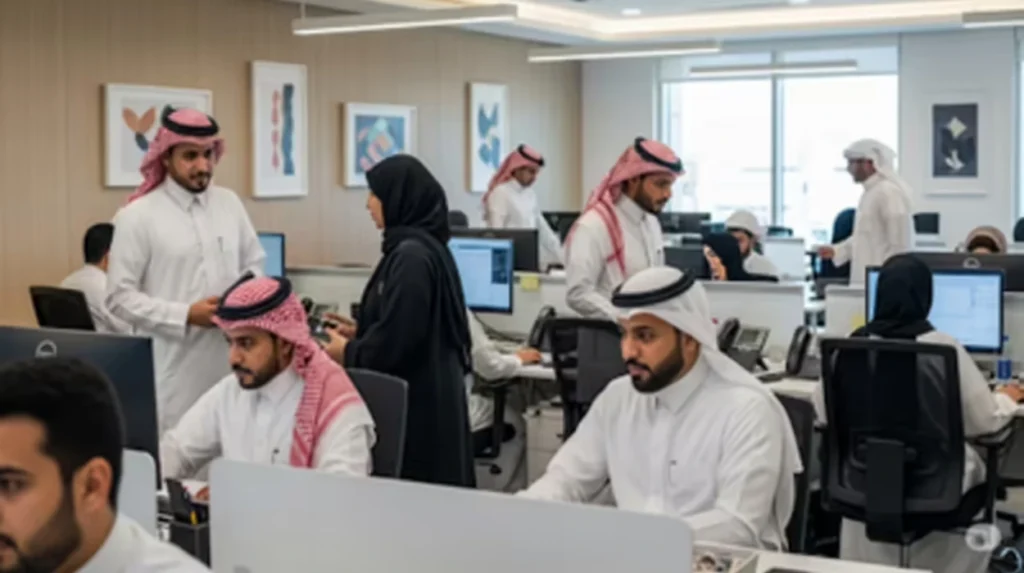
In elite sport, talent pipelines rarely respond well to top-down mandates. You cannot simply decree that a youth academy will replace seasoned imports overnight and expect performance to hold. Saudi Arabia’s Saudisation policy, which aims to increase the proportion of citizens in the workforce, faces a similar constraint. It is a system attempting to rebalance a long-standing reliance on foreign labour through regulatory pressure rather than organic labour market evolution.
The Financial Times report highlights growing tensions around this effort, particularly as criticism emerges online regarding unemployment and job access for Saudi nationals. At its core, Saudisation is not just a labour policy; it is a structural recalibration of an economy built over decades on cost-efficient migrant labour. The policy has achieved measurable gains in certain sectors, particularly retail and administrative roles, yet its broader ambition runs into friction where productivity, wage expectations, and skills alignment diverge.
Much like a team trying to replace experienced international players with domestic prospects, the transition exposes gaps. Employers often face higher wage bills and training costs when hiring Saudi nationals, while citizens may gravitate toward public sector roles that offer stability and benefits. The result is a labour substitution model that works unevenly across sectors, revealing limits to how quickly localisation can be scaled without affecting output.
Foreign Labour as an Economic Backbone
Saudi Arabia’s economic model has long depended on migrant workers across construction, domestic service, retail, and technical industries. This reliance is not incidental; it is foundational. Foreign workers have historically filled roles that are either less attractive to citizens or require cost structures incompatible with domestic wage expectations.
The FT report underscores how this dependency continues even as official policy seeks to reduce it. In practical terms, entire sectors operate with a labour composition that is overwhelmingly non-Saudi. Construction projects tied to Vision 2030, for example, rely heavily on migrant labour to meet timelines and cost targets. Removing or significantly reducing this workforce without a fully prepared domestic replacement risks disrupting project delivery and economic momentum.
This creates a dual-track system. On one side, the state promotes national employment and skills development. On the other, the private sector continues to depend on migrant workers to sustain competitiveness. The tension between these tracks is not easily resolved, and it surfaces in public discourse, particularly when unemployment among citizens remains a concern.
Social Media Controls and the Boundaries of Criticism
The FT report places particular emphasis on the tightening of social media controls in response to criticism about unemployment and labour policies. From a systems perspective, this reflects an effort to manage not only economic outcomes but also the narrative surrounding them.
In professional sport, media management is often as strategic as on-field tactics. Clubs shape narratives to maintain confidence among fans, sponsors, and stakeholders. Saudi authorities appear to be applying a similar logic at the national level, seeking to limit discourse that could undermine confidence in economic reforms or highlight structural imbalances.
Recent actions targeting online criticism suggest a narrowing of acceptable public debate. While the state has long exercised control over traditional media, social platforms have introduced a more decentralized space for discussion. The move to regulate this space more tightly indicates recognition that perceptions—particularly around employment opportunities—carry political and economic weight.
This approach, however, introduces its own trade-offs. Restricting open discussion may reduce immediate reputational risks, but it can also limit feedback loops that are essential for policy adjustment. In complex systems, information flow is critical, and constraining it can obscure underlying issues rather than resolve them.
Vision 2030 and the Pressure of Reform Delivery
Vision 2030 represents Saudi Arabia’s flagship transformation strategy, aiming to diversify the economy and reduce reliance on oil revenues. Like a long-term rebuild in sport, it sets ambitious targets across multiple fronts: infrastructure, tourism, technology, and employment.
The challenge lies in synchronizing these moving parts. Economic diversification requires both capital investment and human capital development, yet the labour market remains segmented between citizens and migrant workers. The FT report suggests that as deadlines and expectations mount, pressure is increasing to demonstrate tangible progress, particularly in job creation for Saudis.
This pressure can influence policy enforcement and communication strategies. Stricter controls on public criticism may be seen as a way to maintain a stable narrative during a period of transition. At the same time, the underlying economic realities—skills gaps, sectoral dependencies, and wage differentials—continue to shape outcomes.
The comparison to sport is instructive. A team undergoing transformation often faces a period where results lag behind expectations. Managing that phase requires balancing transparency with confidence-building. Saudi Arabia’s approach appears to lean toward tighter narrative control as it navigates this transitional phase.
Employment Expectations and Private Sector Reality
One of the central dynamics highlighted in the FT report is the mismatch between citizen employment expectations and private sector requirements. This is not unique to Saudi Arabia, but the scale and context make it particularly pronounced.
Saudi nationals have historically benefited from a public sector that offers competitive salaries, job security, and defined career paths. Transitioning a larger share of the workforce into the private sector involves recalibrating these expectations. Employers, meanwhile, operate within cost constraints and productivity benchmarks that often favor experienced migrant workers.
This creates a structural gap. Citizens entering the labour market may find fewer roles that match their expectations, while employers may struggle to integrate them without adjustments to training, compensation, or operational models. The FT report indicates that this gap has become a focal point for online criticism, particularly among younger Saudis.
Addressing this mismatch requires more than regulatory mandates. It involves education reform, vocational training, and shifts in workplace culture. These are long-term processes, and their outcomes are not immediately visible, which can amplify frustration in the short term.
Migrant Workers and Structural Inequality
The reliance on migrant labour brings with it broader questions about working conditions, legal protections, and power dynamics. International human rights organisations have documented concerns related to wage practices, mobility restrictions, and dispute resolution mechanisms within the Gulf labour system.
The FT report situates these concerns within the broader context of Saudi Arabia’s economic model. Migrant workers often occupy positions with limited bargaining power, and their legal status can be tied to their employers. While reforms have been introduced in recent years to address some of these issues, scrutiny from international observers remains.
From an analytical standpoint, this is a structural feature rather than an isolated issue. The cost efficiency of migrant labour is partly derived from these asymmetries. Any significant shift toward greater protections and higher wages would have implications for business models across multiple sectors.
Balancing economic competitiveness with improved labour standards is a complex task. It requires regulatory enforcement, institutional capacity, and alignment between public policy and private sector incentives. The presence of ongoing criticism suggests that this balance is still evolving.
Narrative Management in a Transition Economy
Narrative management emerges as a central theme in the FT report. In a transition economy undergoing rapid change, controlling the story can be as important as managing the substance. Saudi authorities appear to be placing increased emphasis on shaping how economic policies and outcomes are perceived domestically and internationally.
This involves not only regulating criticism but also promoting success stories tied to Vision 2030. Large-scale projects, foreign investment announcements, and employment statistics are part of this narrative framework. The goal is to project momentum and confidence, both of which are critical for attracting investment and maintaining public support.
However, narrative management operates within constraints. If the lived experience of citizens diverges significantly from the official narrative, credibility can be affected. The FT report’s focus on online criticism suggests that there are areas where this divergence is becoming more visible.
In sports terms, this is akin to a team emphasizing positive metrics while fans focus on results. Both perspectives matter, and alignment between them is key to sustaining support.
Reform, Reputation, and Controlled Public Debate
The intersection of reform efforts and controlled public debate defines the current moment. Saudi Arabia is pursuing an ambitious economic transformation while maintaining a tightly managed political environment. The FT report indicates that as economic challenges become more visible, particularly around employment, the state is moving to limit how these issues are discussed.
This approach reflects a broader governance model in which stability and control are prioritized alongside reform. It allows for coordinated policy implementation but may constrain the range of perspectives that inform decision-making.
Internationally, this dynamic also affects perception. Investors and partners assess not only economic indicators but also governance practices and transparency. The handling of public discourse becomes part of the broader evaluation of risk and opportunity.
The tension between modernization and controlled expression is not easily resolved. It is a defining feature of the current phase of Saudi Arabia’s development. As Vision 2030 progresses, the effectiveness of this approach will likely be measured not only by economic outcomes but also by the system’s ability to adapt to feedback and evolving expectations.