
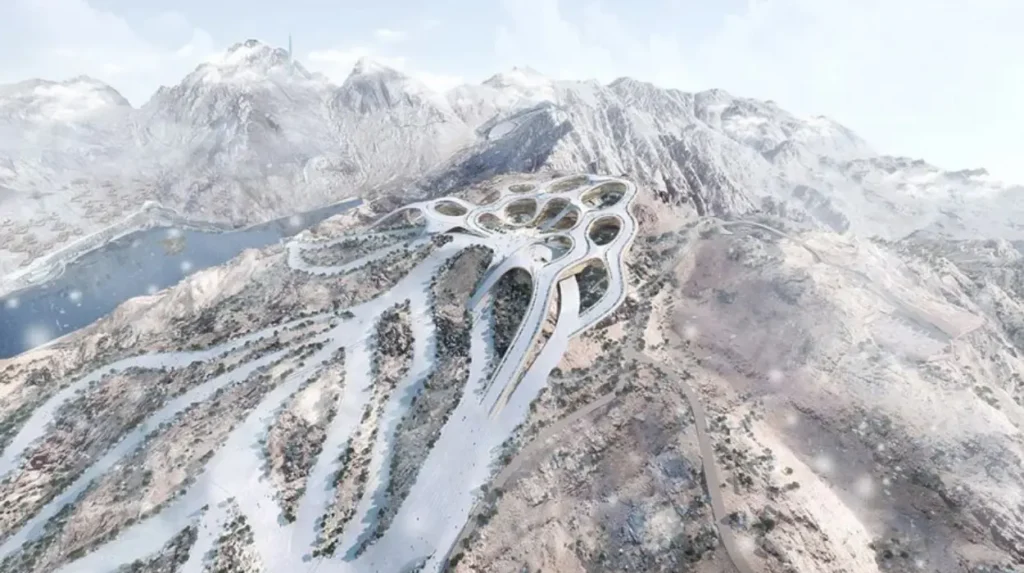
Saudi Arabia has told partners and contractors that Trojena — the ambitious desert ski resort once billed as a hallmark of NEOM and a flagbearer for Vision 2030 — will not be completed by 2030 and is being pushed beyond that horizon as NEOM reassigns capital and management attention to projects seen as delivering faster commercial returns. This is not a formal cancellation of Trojena, NEOM officials have said, but the delay crystallises a wider re‑ordering of Saudi priorities: prestige tourism is being tempered by a newer emphasis on ports, logistics, industrial hubs, digital infrastructure and energy projects that promise measurable near‑term revenue and strategic value.
Why Trojena’s Delay Matters
Trojena was conceived as one of NEOM’s most visible symbols — a winter‑sports destination carved from rugged terrain near the Red Sea that would host international competitions and advertise a transformed Saudi Arabia to incoming tourists and investors. The announcement that work will extend beyond 2030 signals more than a calendar slip: it reflects a pragmatic reassessment of what type of projects can reasonably be completed within the Crown Prince’s Vision 2030 timeframe and what will attract the next tranche of private and sovereign capital. NEOM’s management has framed the shift as a portfolio optimisation rather than abandonment, saying lake and resort components remain on the books even as some contracts have been modified or terminated.
Vision 2030 Faces New Reality
The Trojena postponement amplifies a recurring theme in the evolution of Vision 2030: timelines and ambitions set in early phases of the programme have repeatedly been revised as economic and geopolitical conditions change. Recent reporting and remarks from Saudi officials show an explicit willingness to treat giga‑projects as a portfolio to be re‑scoped, with an eye to fiscal discipline and quicker returns. That approach is consistent with a government managing a complex transition away from hydrocarbon dependence while still relying on oil revenues to underwrite large investments; when commodity cycles or budget pressures shift, so too do public works that are not immediately cash‑generating.
NEOM’s Strategic Shift
Since NEOM’s earliest announcements, its public narrative combined technological futurism and leisure‑led prestige with concrete plans for manufacturing, logistics and energy. The latest reprioritisation gives precedence to projects that increase trade capacity, power new data centres, host manufacturing and support an AI and logistics ecosystem — notably OXAGON and port investments — over high‑profile tourism builds whose economic multipliers are longer term and more uncertain. Sources close to NEOM’s leadership have described reviews that favour investments tied directly to export, industrial employment and digital infrastructure — areas where private operators and foreign investors can see nearer‑term revenue streams. That re‑scoping helps explain why some major construction contracts associated with Trojena have reportedly been cancelled or paused even as other site work continues.
Economic Feasibility
A sober assessment of Trojena’s economics helps explain the pivot. Constructing a high‑altitude ski facility in an arid environment carries elevated capital and operating costs: tunnelled access roads, engineered snow‑making systems, pumped reservoirs and robust energy supplies all add to the price tag, and contractors have privately cited steep cost escalation. Independent reporting has placed Trojena’s multi‑component cost in the billions and noted wider escalation across NEOM that has contributed to public scrutiny of value‑for‑money. With Saudi fiscal managers focused on diversifying returns and the Public Investment Fund conducting reviews of giga projects, the calculus increasingly favours investments that shorten the payback period and support fiscal resilience, such as ports, utilities and data infrastructure that underpin an industrial ecosystem.
The Human Cost of Mega Projects
Giga‑projects like NEOM are labour‑intensive undertakings that depend heavily on migrant workforces from Pakistan, India, Bangladesh, Nepal, Kenya and the Philippines, among others; these workers have supplied the construction and service labour that underpin rapid build cycles across the Gulf. International human‑rights organisations and union federations have documented recurring issues in Gulf construction sectors — recruitment debt, delayed or withheld wages, long hours, unsafe worksites, restrictions on changing employers, overcrowded accommodation and concerns about worker deaths and transparency — concerns that have also shadowed NEOM developments. NGOs including Human Rights Watch, Amnesty International and the International Trade Union Confederation have raised such grievances over the years while Saudi authorities point to a package of labour reforms they have introduced recently to improve worker protections and bolster dispute mechanisms.
The postponement of Trojena introduces acute uncertainty for workers whose livelihoods were tied to the resort’s construction phases. Delays can mean reassignment to other sites, indefinite contract extensions without clear end dates, layoffs or repatriation with limited compensation — outcomes that heighten financial strain for migrant households that often depend on remittances. For contractors and subcontractors, suspended contracts can cascade into wage pressures and unpaid liabilities, intensifying the very labour risks that human‑rights groups warn about when project timelines falter. While Saudi reforms may mitigate some systemic issues over time, enforcement gaps and fragmented contractor chains continue to complicate protections for the most vulnerable workers.
Migrant Workers Behind NEOM
The complex supply chains of giga‑projects mean many workers are employed through multiple layers of subcontracting, which has been identified as a structural source of vulnerability. Publicly available investigative reporting and NGO briefings have pointed to recruitment fees taken in home countries, opaque employment contracts, and payroll interruptions during periods of project realignment — all dynamics that can intensify during a pause or slowdown. NEOM and Saudi agencies have emphasised reform efforts such as electronic wage protection and contractual changes designed to reduce dependency on sponsorship systems, but international monitors say the speed and consistency of implementation vary and require sustained oversight to protect workers when projects are re‑scoped or delayed.
Can Desert Skiing Survive?
The environmental calculus of building an alpine environment in a desert compounds the financial and social considerations. Artificial snowmaking requires substantial water and energy inputs, with NEOM’s planners proposing engineered reservoirs and pumped water systems to sustain winter amenities; those systems carry both construction cost and long‑term operational footprints. Supporters argue technological fixes and renewables can limit environmental damage and position Trojena as a showcase for innovation in extreme climates. Critics counter that diverting scarce water and allocating energy to maintain a ski slope in an arid region raises difficult questions of resource prioritisation and climate consistency, especially as Saudi Arabia publicly commits to sustainability targets in other parts of its development portfolio. The debate over Trojena therefore folds into a broader global conversation about the limits of technological solutions to reconcile prestige projects with ecological constraints.
Governance and Transparency
Changing timelines, contract cancellations and cost revisions inevitably raise questions about governance and the transparency of public investments. International investors and contractors value predictable procurement frameworks, stable timelines and reliable dispute resolution; sudden re‑scoping of mega‑projects can erode confidence and increase the perceived risk premium for future bids. Saudi officials have sought to frame the adjustments as prudent project management and a move to prioritise commercially viable assets, but outside observers note the importance of clear, timely communication to preserve investor trust and avoid reputational damage when projects are perceived as symbolic rather than deliverable.
Saudi Arabia’s Investment Priorities
Beyond NEOM, the shift away from headline leisure projects toward logistics, ports, energy and digital infrastructure is consistent with an economic logic that privileges value‑chain creation over experiential tourism in the short term. Ports and industrial hubs can anchor export growth; data centres and AI investments align with global digitalisation trends; and energy projects — particularly in renewables and grid resilience — support industrialisation and data‑heavy operations. For a country balancing diversification with macroeconomic stability, the tilt toward projects with clearer revenue models is understandable and reflects a maturing of policy priorities that once leaned more heavily on transformative symbolism.
What Trojena Means for the Future
The postponement of Trojena should not be read solely as a failure of ambition. Rather, it is an inflection point in which Saudi policymakers and NEOM’s managers are recalibrating the pace and composition of investment to respond to fiscal realities, investor expectations and operational risk. For investors and contractors, the episode underscores the need for cautious diligence, tighter contractual protections and appetite for projects with demonstrable near‑term returns. For migrant workers, it highlights the fragility of employment tied to mega‑projects and the continuing need for enforceable labour protections during pauses or restructurings. For policymakers, the lesson is procedural as much as strategic: transparent governance, predictable procurement and clear communication matter as much as the headline ambition of shiny new destinations.
Trojena’s delay is therefore less an endpoint than a test. If NEOM can demonstrate that the reprioritisation yields sustainable industrial growth, improved employment conditions and credible environmental planning, the project’s postponement may be absorbed into a more durable and pragmatic national strategy. If not, repeated revisions will deepen questions about the credibility of mega‑project timelines and the extent to which Vision 2030 can deliver its most ambitious promises without clearer commercial foundations and firmer protections for the people who build them.