
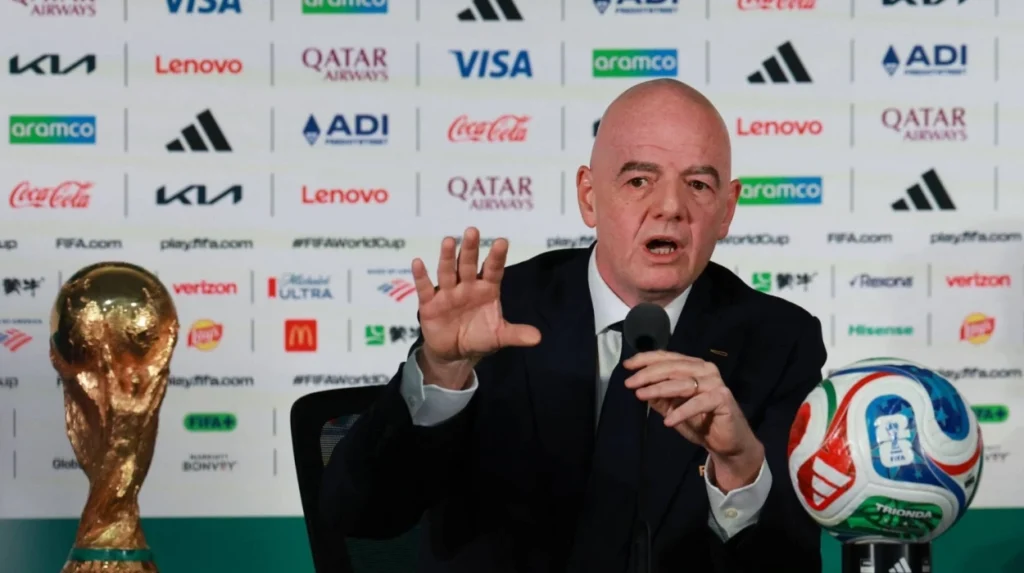
The build-up to the 2026 FIFA World Cup has been overshadowed by a contentious visa controversy that threatens to undermine the tournament’s proclaimed ideals of global inclusivity. As the tournament kicks off in Mexico City, FIFA President Gianni Infantino faces mounting criticism over visa denials and entry restrictions affecting referees, officials, and support staff entering the United States, one of the tournament’s three host nations. The most prominent case involves Omar Abdulkadir Artan, a Somali referee selected as the only match official from his country for 2026, who was denied entry at Miami International Airport despite holding what appeared to be valid documentation.
The United States government has endured significant backlash from immigration experts and human rights advocates due to persistent visa challenges impacting athletes and officials involved in the FIFA World Cup. Criticism of President Donald Trump’s administration intensified following Artan’s rejection, with the Department of Homeland Security informing Al Jazeera that he was deemed inadmissible due to vetting concerns despite being one of FIFA’s 52 selected referees for the tournament. The situation extends beyond individual cases, with Iran’s football federation reporting that several crucial support staff and managerial personnel were denied entry even after players received visa clearance just ten days prior to their first match.
Fans from various countries including Morocco and Scotland have also reported last-minute visa denials or cancellations shortly before travel dates, despite having invested significant amounts in airfare, accommodations, and tickets for what is being marketed as historically expensive World Cup. Journalists are facing widespread denials or single-entry limits, raising concerns about media coverage accessibility. The Iranian federation reportedly claimed the U.S. will only permit the team to enter one day before any match, forcing them to relocate their training base to Tijuana, Mexico.
Gianni Infantino’s Response to US Visa Issues Under Scrutiny
FIFA President Gianni Infantino has addressed concerns and criticism with a response that has drawn scrutiny from sports governance analysts and journalists worldwide. Speaking to the media on the eve of the World Cup at a press conference in Mexico City, Infantino stated that FIFA’s role is to function as a sports organization and not to intervene in U.S. entry approvals. He emphasized that
“we are not the kings of the world who can rule over governments and police forces, and I don’t know what. We are a sports organization, we try to do our best with the means that we have”.
Infantino told critics to “chill” after Artan was barred from the United States, ending his historic World Cup role, saying FIFA cannot dictate visa rules to governments. During his pre-World Cup news conference, he remarked,
“Believe me when I tell you, or don’t believe me if you don’t want, but we try always to find solutions, always”.
Despite ongoing visa-related issues that included relocating Iran’s training base and the denied entry to Artan, Infantino insisted he does not regret choosing the United States as a host country for the 2026 World Cup.
FIFA issued a formal statement confirming that
“FIFA is not involved in host country immigration processes, including visa adjudications, and has been informed by authorities that Mr. Artan’s status will not be changed at present”.
The organization added that
“in line with previous FIFA events, a host government ultimately determines who receives a visa and who is admitted into their country”.
This defensive positioning has prompted questions about whether Infantino’s response reflects genuine institutional limitation or an avoidance of accountability for outcomes that directly affect the tournament’s operational integrity.
How Immigration Policy Is Shaping the 2026 World Cup
The United States government continues to face scrutiny over entry restrictions for referees, players, and fans for the 2026 FIFA World Cup, raising fundamental questions about whether the country is ready to host the biggest World Cup in history. As the tournament approaches, concerns are growing over whether strict immigration enforcement priorities intersect appropriately with international sporting expectations. Certain players and team personnel from the World Cup are facing inquiries or are completely prohibited from entering the United States, causing frustration among supporters and raising alarms regarding implementation of immigration regulations during this globally significant sporting occasion.
The matter extends beyond individual vetting decisions to reflect broader policy tensions. Somalia is included in the Trump administration’s travel ban, which places restrictions on several countries, directly impacting Artan’s admissibility despite his FIFA selection. The CBP spokesperson stated that all travelers, including athletes, coaches, and staff, are subject to inspection and vetting, with admissibility determinations made on a case-by-case basis using law enforcement, national security, and immigration information available at the time of inspection.
Iran announced that their allocation of tickets for the group stage was rescinded due to a decision by U.S. officials, further demonstrating how immigration policy is actively reshaping tournament logistics. The team is allowed to travel in and out of the U.S. from Tijuana, Mexico, within 24 hours for each match, but this arrangement has yet to be tested under actual match conditions. Taj also stated that the team is allowed to enter the U.S. only one day before the match, according to Iranian media, creating operational complications for team preparation.
FIFA’s Global Image vs National Border Restrictions
A fundamental contradiction exists between FIFA’s branding of the World Cup as a global, inclusive event and the reality of national immigration policies that restrict access to participants and officials. FIFA’s bidding guidelines established in 2017 for nations wishing to host this World Cup mandated that visa processing should be conducted in a non-discriminatory fashion while still adhering to national immigration and security protocols. This guideline creates an inherent tension: FIFA demands non-discriminatory processing while simultaneously acknowledging that host governments retain ultimate authority over visa admissions.
The situation appears evident that the Trump administration prioritizes immigration control above all, including the World Cup. A significant test is anticipated when Iran arrives in the United States for the first time, as the team has alleged that visas for 15 essential members of their support staff were denied. This creates a paradox where FIFA promotes universal access while operating within sovereign border control systems that explicitly restrict access based on nationality, political relationships, and security vetting.
The contradiction raises questions about whether FIFA adequately accounts for these structural limitations when selecting host nations. The organization’s emphasis on the World Cup as a celebration of global football unity becomes increasingly difficult to maintain when participants are systematically excluded based on immigration policies that FIFA cannot influence. This tension between idealistic branding and operational reality has become particularly acute in the United States, where immigration enforcement has become a central political priority under President Trump’s leadership.
The Governance Challenge Behind World Cup 2026 Planning
The visa controversy exposes broader governance concerns within FIFA, particularly regarding the organization’s dependence on host nations’ political systems and its communication strategy around responsibility-sharing. FIFA’s structural limitation is clear: the organization lacks authority to override government decisions on visa admissions, yet it bears ultimate responsibility for tournament operational integrity. This creates an accountability gap where FIFA can acknowledge problems while maintaining that solutions lie outside its control.
Infantino’s emphasis that visa decisions are outside FIFA’s control reflects both institutional limitation and potential avoidance of accountability. While technically accurate that FIFA cannot dictate government visa policies, the organization selected the host nations and negotiated the bidding process that established these conditions. The question remains whether FIFA adequately assessed immigration risks before committing to a three-nation format including the United States, where political priorities increasingly emphasize border control.
The governance challenge extends to event planning in politically sensitive environments. FIFA’s 2017 bidding guidelines required non-discriminatory visa processing, yet the organization appears to have accepted that this requirement would be subordinate to national security concerns. This acceptance creates a precedent where FIFA’s standards become negotiable based on host nation priorities, potentially undermining the organization’s authority in future tournament selections. The situation with Iran’s team being restricted to 24-hour entries from Mexico demonstrates how political considerations can override sporting logistics, creating operational complexities that FIFA must manage without direct control over the underlying policy decisions.
Security, Politics, and Football: A Growing Conflict
The intersection of security priorities, political agendas, and international football represents a growing conflict that will define future global tournament planning. The United States as a host nation presents both advantages and challenges: while the country offers exceptional infrastructure and organizational capacity, its immigration enforcement priorities create complications for international sporting events that demand universal participation.
Acknowledging security and immigration enforcement priorities requires recognizing that national governments retain sovereign authority over border control, a principle that FIFA cannot fundamentally alter. However, the growing conflict emerges when these priorities directly contradict the operational requirements of global sporting events. The detention or barring of World Cup players and officials causes frustration among supporters and raises alarms about implementation of immigration regulations during globally significant sporting occasions.
The conflict is particularly acute because football, unlike many other sports, draws participants from nations with varying diplomatic relationships with host countries. The Trump administration’s travel ban including Somalia demonstrates how political policies can directly exclude individuals selected through FIFA’s merit-based referee selection process. This creates a situation where sporting excellence becomes secondary to political considerations, undermining the tournament’s claimed neutrality and universality.
Can FIFA Guarantee a Truly Global Tournament in 2026
The visa issues raise fundamental questions about FIFA’s ability to guarantee a truly global tournament in 2026, with potential implications for the credibility, accessibility, and operational smoothness of the event. At least one player and referee have been held up or denied entry, while many team staff members and federation leaders have had visa applications rejected. These disruptions suggest that FIFA cannot fully guarantee universal participation when host nations maintain restrictive immigration policies.
The operational smoothness of the tournament faces tangible risks from these visa complications. Iran’s relocation of their training base to Tijuana, Mexico, demonstrates how teams must adapt to immigration restrictions rather than optimal sporting preparation. The untested arrangement of 24-hour entries from Mexico for matches creates logistical uncertainty that could affect team performance and tournament scheduling.
Reputational risks for the 2026 World Cup are substantial. Never have we seen the farce of an official FIFA referee being refused entry as he arrives for final preparations, according to critical observers. This type of coverage undermines FIFA’s marketing of the tournament as a celebration of global unity and inclusivity. The rescinding of Iran’s group stage ticket allocation further damages the tournament’s credibility as a universally accessible event.
FIFA’s dependence on host nations’ political systems creates inherent vulnerability that the organization cannot fully mitigate. The contradiction between global sporting ideals and sovereign border control remains unresolved, with FIFA acknowledging that host governments ultimately determine visa admissions despite bidding guidelines requiring non-discriminatory processing. This structural limitation means that FIFA cannot guarantee a truly global tournament when host nations exercise border control based on political considerations rather than sporting merit.
The future of global tournaments hosted across multiple jurisdictions will require FIFA to develop more sophisticated risk assessment frameworks that account for immigration policy variability. The organization must either select hosts with more accommodating immigration policies or negotiate stronger visa guarantees as part of bidding agreements. Without such changes, similar controversies will recur, potentially undermining the tournament model itself as participants and fans face unpredictable barriers to participation.
The visa controversy ultimately reveals that FIFA’s governance model, under Infantino’s leadership, struggles to balance idealistic global sporting claims with the practical realities of operating within sovereign political systems. Whether this reflects institutional limitation or avoidance of accountability remains an open question, but the outcome is clear: the 2026 World Cup will operate under constraints that fundamentally challenge its proclaimed universality.