FIFA’s decision to allow Russian participation in its new Under-15 World Cup has become the latest flashpoint in football’s long-running struggle to separate sporting administration from geopolitical reality. The move has prompted criticism because Russia remains suspended from most international football since 2022, when FIFA and UEFA imposed restrictions after the full-scale invasion of Ukraine. Even though the tournament is framed as a youth development event, the symbolism of reopening a FIFA pathway for Russia is impossible to ignore.
What makes this case especially sensitive is the choice of competition. Youth tournaments are often presented as politically neutral spaces where player development takes priority over international disputes. Yet FIFA’s own structure gives national federations a symbolic national presence, which means any Russian return under the federation banner carries political meaning beyond the field. That is why the decision has generated such a sharp reaction from European lawmakers and football observers.
Why EU lawmakers are challenging FIFA decision on Russia
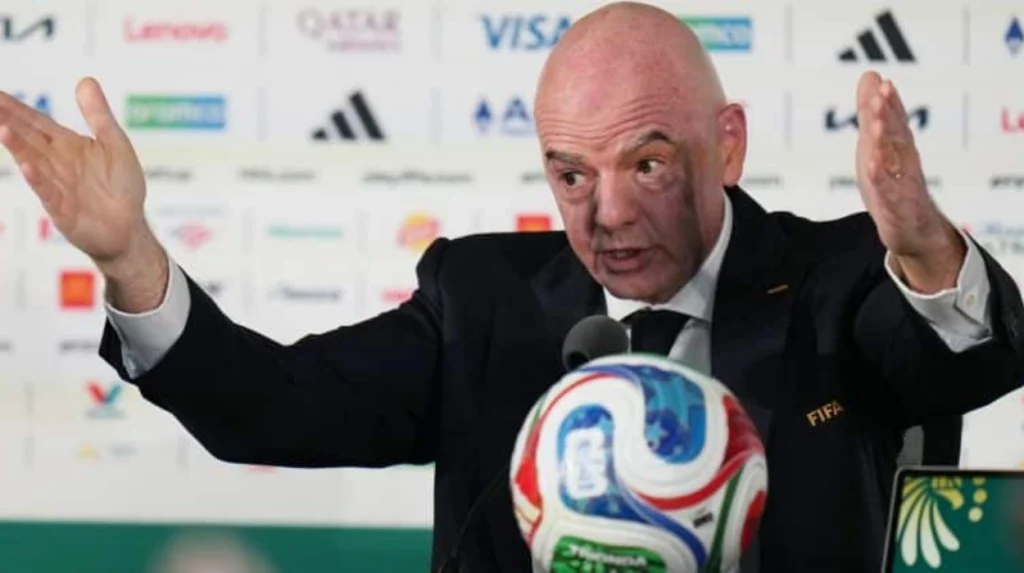
Members of the European Parliament have criticised FIFA President Gianni Infantino directly, arguing that the governing body is moving too quickly and too casually toward reintegration of Russian teams. Their objection is not simply that Russia might play again, but that FIFA appears to be normalising participation without a clear political or ethical benchmark. For lawmakers in Europe, where the war in Ukraine remains a defining security issue, that creates an obvious contradiction.
The criticism also reflects a broader institutional concern: if FIFA allows Russian youth teams back into competition while senior teams remain excluded, it risks creating a two-track policy that looks inconsistent and politically selective. European officials are effectively asking whether FIFA is still committed to the logic that justified suspension in the first place. In their view, a youth tournament cannot be treated as detached from the same conflict that shaped the original ban.
Gianni Infantino and FIFA’s governance under scrutiny
Infantino’s leadership style has long been defined by pragmatism, centralisation, and a belief that football can function as a bridge even in politically charged circumstances. That approach has supporters who argue that sport should preserve channels of contact when diplomacy hardens. But it also has critics who see a pattern of ad hoc decision-making, where FIFA reacts to political pressure without articulating a consistent governance principle.
This controversy highlights a recurring issue in Infantino’s presidency: FIFA often invokes neutrality, but its decisions repeatedly carry political effects. The Under-15 case is especially revealing because it suggests a willingness to separate youth football from the broader sanction regime without establishing a transparent pathway for how or why Russia would be readmitted. That raises questions about credibility, because FIFA’s legitimacy depends not only on what it decides, but on whether those decisions appear principled and coherent.
Russia’s return to youth football and global backlash
The prospect of Russian involvement in a FIFA youth tournament can be read as an early step toward gradual reintegration. That may be exactly what some advocates of sporting engagement want: a limited return through age-group football before any broader restoration of rights. But to critics, even a narrow return sends a powerful message that Russia is being reintroduced into the international football community before there has been any meaningful political resolution.
The backlash is therefore not only about football administration, but also about optics and precedent. Once FIFA opens one youth tournament to Russia, questions will immediately arise about whether other age categories will follow and whether the senior ban is becoming harder to justify. In geopolitical terms, small concessions often become politically loaded because they signal movement even when officials insist they are merely administrative.
Sports neutrality vs political reality in international football
FIFA’s public defence of youth participation usually rests on a familiar argument: football should remain neutral, and children should not be punished for state decisions made by adults. On a moral level, that position has appeal. Young athletes do not control foreign policy, and youth tournaments are meant to develop skills, not settle diplomatic disputes. But in practice, sport is never entirely separate from politics, especially when national teams compete under national flags and federations represent state-linked institutions.
That is the central contradiction in this case. FIFA wants to present the Under-15 World Cup as developmental and apolitical, yet the return of Russian teams would inevitably be interpreted through the lens of the Ukraine war. The stronger the political symbolism, the harder it becomes to sustain the claim that the competition is neutral. This is not just a communication problem for FIFA; it is a governance problem rooted in the structure of international sport itself.
UEFA and FIFA divisions over Russia participation policy
The Russia question has also exposed tensions within football’s global hierarchy. FIFA and UEFA have not always moved in lockstep, and the different pressures they face help explain why Russia’s status has remained unsettled. UEFA sits closer to the political centre of the conflict because it governs Europe’s national associations, many of which have been directly affected by the war and by public opinion in their own countries. FIFA, by contrast, often presents itself as a universal body above regional politics.
That distinction matters, but it also creates friction. If FIFA makes decisions that appear to soften restrictions while UEFA remains more cautious, the sport’s policy framework becomes fragmented. Such divergence weakens the sense that international football is being governed by a stable and shared standard. It also leaves room for accusations that FIFA is prioritising institutional flexibility over moral consistency.
How FIFA’s youth tournaments became politically sensitive
Youth football was once seen as one of the least controversial spaces in the sport, but that assumption no longer holds. As international politics has become more polarised, even junior competitions can become symbolic battlegrounds. A youth tournament involving a suspended or contested federation can be interpreted as rehabilitation, and that makes the event politically sensitive even if the football itself is low-stakes.
This is why FIFA’s developmental framing is under pressure. The organisation is not simply offering competition to teenagers; it is also creating a public signal about which federations are considered acceptable participants in the international football family. When the federation in question is Russia, that signal carries exceptional weight. The result is that a tournament designed to promote football development now sits inside a larger argument about legitimacy, sanction, and international order.
The most important question is whether this decision marks the beginning of a wider return for Russia or remains an isolated exception. If FIFA treats the Under-15 tournament as a one-off case, it may be trying to preserve the senior ban while testing the political temperature around youth reintegration. But if this becomes the first stage in a broader rollback, then the football world will need a much clearer explanation of the criteria being used.
For international sport governance, the stakes are significant. FIFA cannot credibly claim political neutrality while making decisions that clearly affect international diplomacy unless it is willing to explain the principles behind those decisions. The Russia case shows how quickly a technical tournament policy can become a referendum on leadership, consistency, and institutional trust. It also shows that in today’s football economy, even youth competitions can become instruments of geopolitical meaning.