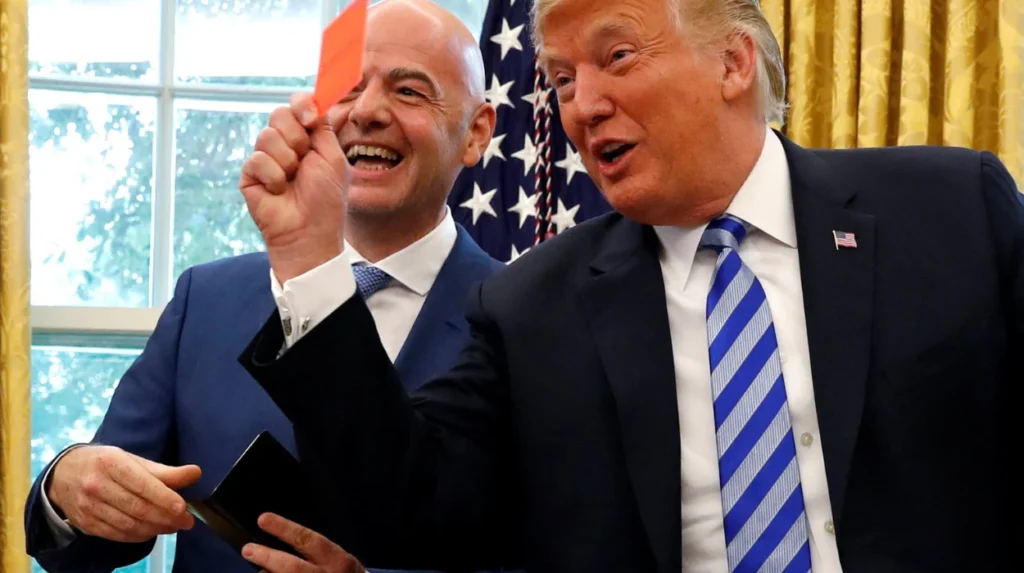
The FIFA Balogun suspension case has ignited a global debate over football governance, institutional independence, and the role of political influence in international sport. In an unprecedented move, FIFA suspended striker Folarin Balogun’s automatic one-match World Cup ban after U.S. President Donald Trump reportedly phoned FIFA President Gianni Infantino to request a review of the decision. Balogun had received a straight red card against Bosnia and Herzegovina in the round of 32, a disciplinary action that under normal FIFA regulations would have rendered him ineligible for the United States’ last-16 clash with Belgium. The reversal, justified by FIFA under Article 27 of its disciplinary code, has drawn sharp criticism from Belgium, UEFA, and football governance experts who argue it undermines the integrity of the World Cup’s disciplinary framework.
Why FIFA’s Decision Faces Heavy Criticism
Criticism of FIFA’s handling of the FIFA Balogun suspension centers on the perception of selective enforcement and the erosion of consistent disciplinary standards. Under established FIFA rules, a straight red card in a World Cup match triggers an automatic one-game suspension, a mechanism designed to ensure that disciplinary consequences are applied uniformly regardless of a player’s status or national affiliation. By intervening to suspend that ban, FIFA created the appearance that powerful stakeholders could influence outcomes that should remain insulated from external pressure. Belgium’s football federation has formally objected, arguing the decision distorts competitive fairness, while UEFA’s public criticism underscores concerns that the precedent could affect future tournaments hosted under FIFA’s authority. For governance analysts, the episode raises questions about whether FIFA’s disciplinary committee retains meaningful independence when high-profile political figures engage directly with football’s administration.
Did Politics Influence Football Justice?
The reported Trump FIFA call has become the focal point of inquiries into whether political influence should affect sporting disciplinary decisions. While FIFA has not provided a detailed public account of the conversation, multiple outlets confirm that President Trump contacted Infantino to advocate for Balogun’s eligibility, framing the issue as important for the United States’ World Cup campaign. 那 raises a fundamental question for football governance: should the head of state of a host nation—or any nation—be able to intervene in a disciplinary matter that, by design, is meant to be adjudicated by football’s own regulatory bodies? Critics argue that allowing political relationships to shape disciplinary outcomes politicizes sport and erodes the principle that on-field rules apply equally to all participants. Supporters of FIFA’s decision contend that Article 27 exists precisely to allow flexibility in exceptional circumstances, but skeptics note that the timing and context invite perceptions of preferential treatment.
Gianni Infantino Under Fresh Scrutiny
Gianni Infantino’s leadership is under fresh scrutiny following the FIFA Balogun suspension controversy, with observers questioning whether his administration has become too closely associated with political relationships rather than regulatory consistency. Infantino has long cultivated ties with world leaders, a strategy that FIFA argues helps secure the sport’s global footprint and commercial interests. Yet the Balogun incident highlights the risks of that approach: when a president’s phone call appears to precipitate a disciplinary reversal, it fuels perceptions that access and influence matter more than the rules themselves. For smaller football nations, the message is troubling—if exceptions appear to favor powerful stakeholders, confidence in the system’s fairness diminishes. Governance experts warn that repeated episodes of this nature could entrench the view that FIFA’s leadership prioritizes political capital over institutional credibility, a dynamic that could prove difficult to reverse.
FIFA Rules and the Question of Consistency
FIFA’s reliance on Article 27 of its disciplinary code to justify suspending Balogun’s ban has intensified concerns about selective enforcement and the consistency of football governance. Article 27 grants FIFA’s disciplinary bodies discretion to review and, in certain circumstances, modify sanctions, a provision intended to address genuine errors or extraordinary situations. However, the application of that discretion in the Balogun case invites scrutiny because it occurred after a direct intervention from a head of state rather than through a transparent appeal process initiated by the player’s federation or grounded in clear procedural error. Historical comparisons with other controversial FIFA disciplinary decisions show that consistency is essential for maintaining competitive fairness; when similar red-card incidents in past World Cups resulted in automatic suspensions without high-level intervention, the current exception appears anomalous. Transparency and consistency are not merely bureaucratic ideals—they are the foundations upon which teams, players, and fans place trust in the integrity of international competition.
UEFA Challenges FIFA’s Controversial Move
UEFA’s criticism of FIFA’s decision matters because it signals institutional unease within football’s own governance ecosystem. As the governing body for European football, UEFA has a vested interest in ensuring that disciplinary standards are applied uniformly across FIFA tournaments, particularly when European national teams are directly affected. Belgium’s objection, backed by UEFA’s public stance, underscores the competitive implications: a key opponent is allowed to field a player who would otherwise be suspended, altering the sporting balance in a knockout match. That UEFA would publicly challenge FIFA on this issue suggests that the governing bodies’ relationship is not immune to friction when governance norms appear compromised. For fans and stakeholders, the episode illustrates how governance disputes can spill into the tournament itself, distracting from the football and raising doubts about whether the rules are truly blind to politics and power.
What This Means for World Cup Integrity
The broader issue of politics, commercial interests, and global football governance comes into sharp focus when considering what the FIFA Balogun suspension means for World Cup integrity. The World Cup is marketed as the pinnacle of fair competition, a tournament where the best teams prevail under a shared set of rules. When disciplinary decisions appear susceptible to political influence, that narrative is undermined, and the tournament’s credibility suffers. For smaller football nations, the incident risks reinforcing the perception that the system bends for the powerful, a message that could dampen enthusiasm and trust in future editions. Moreover, the commercial stakes are high: sponsors, broadcasters, and host nations invest heavily in the World Cup’s brand, which depends on the belief that outcomes are determined on the pitch, not in back-channel negotiations. If exceptions become routine, the integrity that underpins the tournament’s global appeal could erode, with consequences that extend far beyond a single match.
Can FIFA Restore Public Trust?
Can FIFA restore public trust after the FIFA Balogun suspension controversy? The path forward requires more than a single statement; it demands demonstrable commitment to transparency, consistency, and institutional independence. FIFA must clarify the criteria under which Article 27 is invoked, ensuring that future reviews follow a transparent process insulated from political pressure. Without such safeguards, the perception that powerful stakeholders can secure favorable outcomes will persist, weakening confidence in the disciplinary framework. For Gianni Infantino’s administration, the challenge is to recalibrate the balance between political engagement and regulatory impartiality, signaling that access does not equate to influence over disciplinary matters. Ultimately, the long-term implications for FIFA’s credibility hinge on whether this episode is treated as an anomaly to be corrected or a precedent to be managed. If the latter, the governance of international football risks a slow erosion of trust that no marketing campaign can repair.
In conclusion, the FIFA Balogun suspension case has exposed vulnerabilities in football’s governance architecture, raising difficult questions about the independence of disciplinary processes and the role of political influence in sport. While FIFA’s reliance on Article 27 provides a technical justification, the timing and context of the decision have fueled perceptions of selective enforcement that threaten the integrity of the World Cup. For football governance to remain credible, transparency and consistency must be non-negotiable, ensuring that rules apply equally regardless of a player’s profile or a nation’s political clout. The long-term implications for FIFA’s credibility will depend on whether the organization can demonstrate that disciplinary decisions are insulated from political relationships and that exceptions are rare, justified, and transparent. Without such reforms, the trust of fans, federations, and commercial partners may prove difficult to restore.