
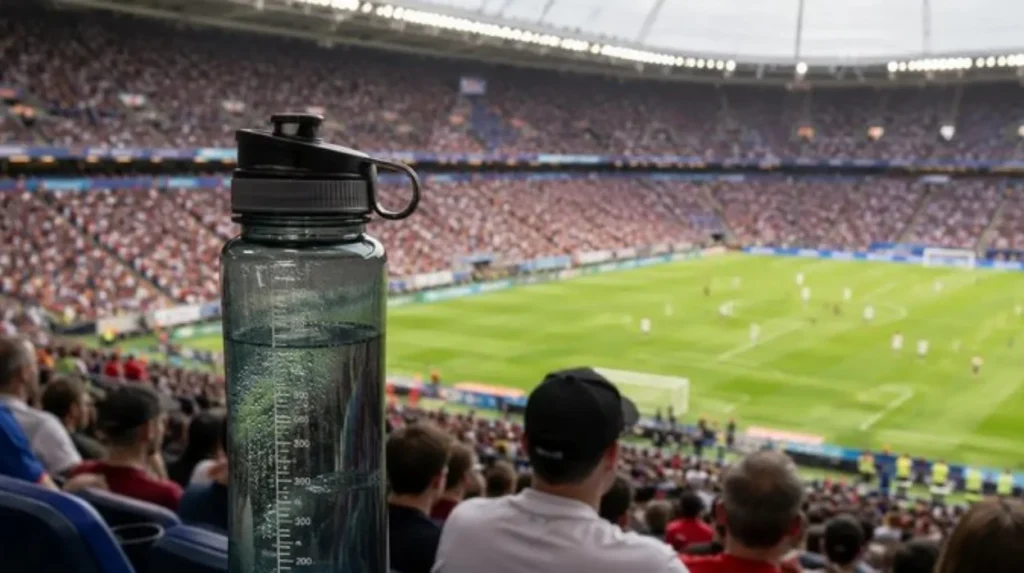
FIFA’s handling of stadium water bottle rules for the 2026 World Cup in the United States, Canada, and Mexico has already become one of the most contentious fan-experience issues before a ball has been kicked. What began as a relatively permissive approach, allowing empty, transparent reusable bottles of up to one liter into venues, was abruptly reversed in early June, with a revised Stadium Code of Conduct banning reusable water bottles across all 16 host stadiums. After fierce backlash from fan groups, health experts, and politicians, FIFA partially rowed back again, announcing that fans will be allowed to bring a single factory‑sealed, disposable 590ml bottle into matches in the United States and Canada. This sequence of decisions has raised substantive questions about policy consistency, public health risk, commercial incentives, and the governing body’s credibility in managing fan welfare during a summer tournament likely to be played in high heat.
The initial ban on reusable bottles was justified by FIFA on security grounds: bottles, the organization argued, could be used as projectiles and pose a risk of injury to players and spectators. At face value, such reasoning sits within a long‑standing global concern about objects thrown from stands, but the timing and scope of the change – implemented just weeks before kickoff and applied uniformly across diverse venues – have amplified criticism. Health specialists, fan organizations, and local authorities have countered that the policy significantly complicates access to hydration in potentially extreme conditions, especially in US stadiums where shade is limited and crowding is intense. The subsequent partial reversal permitting only sealed, disposable bottles has done little to quell concerns about affordability, environmental impact, and perceived commercial motives.
Stadium Hydration Policy Raises Fan Safety Concerns
Heat and hydration are at the heart of the backlash. Several host venues in the United States and Mexico are expected to experience high temperatures and strong sun exposure during summer matchdays, with some stadiums offering limited shade and airflow in the stands. Heat‑stress experts have warned that restricting fans’ ability to bring reusable bottles that can be refilled throughout the day increases the risk of dehydration, heat exhaustion, and even heatstroke, particularly for spectators arriving already hot and potentially dehydrated after travel, queues, and pre‑match gatherings. The World Cup’s own logistical design – long security lines, large perimeters, and heavy pedestrian flows – means that fans may spend hours in and around the stadium, not just the 90 minutes of match time.
Medical specialists quoted in recent coverage have described the bottle ban as “reckless” in the context of rising global temperatures and growing evidence that large sporting events face escalating heat‑related health risks. Their concern is not only the absolute temperature but the combination of humidity, crowd density, and limited airflow, which magnify physiological stress. Fan groups have echoed this perspective, arguing that any barrier to convenient, low‑cost hydration – be it by banning refillable bottles or by limiting the size and type of containers – runs counter to basic duty‑of‑care principles. FIFA, for its part, has emphasized planned cooling measures such as misting systems and shaded zones, but experts have questioned whether such interventions can adequately compensate for constrained water access over several hours.
The partial policy shift allowing one sealed disposable bottle per fan does not fully resolve these concerns. A single 590ml bottle is modest for a multi‑hour experience in hot conditions, especially for vulnerable groups such as children, older fans, or those with underlying health conditions. While stadium vendors will sell additional water, critics point out that reliance on in‑venue purchases, rather than enabling fans to manage their own hydration through refills, leaves a gap between public health guidance and practical realities on the ground.
Heat, Cost, and Comfort Issues in US World Cup Venues
The intersection of heat, stadium design, and spectator comfort is particularly acute in several US venues that double as NFL or college football stadiums. Many of these arenas were not built with an early‑summer global tournament in mind and have seats exposed to direct sun for large portions of the day. Concerns are not hypothetical: domestic US sporting events have already seen instances of fans suffering heat‑related illnesses in hot conditions. The World Cup, with its greater international travel and day‑long matchday routines, compounds this risk.
Comfort is more than a matter of convenience. From a public safety perspective, dehydrated, overheated crowds are more prone to medical incidents, slower to respond to instructions, and potentially more agitated – all of which increase operational risk for organizers and local authorities. Heat experts caution that small operational decisions, such as restricting personal water bottles, can have outsized downstream effects on medical services and stadium operations if they reduce baseline hydration levels among tens of thousands of spectators. Fan groups have also linked comfort and dignity, arguing that a modern mega‑event should not force supporters to choose between financial strain and adequate hydration.
FIFA’s commitment to standardized rules across all host stadiums is understandable from a tournament‑management perspective. The organization has argued that some venues already prohibited outside bottles under domestic policies, and that extending a uniform ban avoids confusion and simplifies security enforcement. However, critics counter that consistency should not come at the expense of adapting to local climate realities and best practices in crowd health management. For a tournament that has invested heavily in messaging around “fan experience,” the optics of narrowing fans’ ability to manage basic hydration are problematic.
Economic Implications and In‑Stadium Pricing Concerns
Beyond health, the bottle policy has clear economic dimensions. Studies and media analyses have highlighted how restrictions on bringing water into stadiums can significantly increase match‑day spending, particularly for international travelers who already face high costs for tickets, flights, and accommodation. Estimates cited in recent reporting suggest that, depending on stadium pricing and consumption patterns, a family or group could see their total hydration spend reach substantial sums over the course of a matchday and associated fan activities. While precise figures vary by venue, the underlying logic is straightforward: removing low‑cost, reusable options forces fans to rely on venue‑priced products.
FIFA has sought to reassure supporters by stating that water prices during the World Cup will be “consistent with other events” held at each stadium. However, “consistent” does not necessarily mean affordable, especially in US markets where concession prices for major sports events are already high. Fan advocates point out that a policy which channels all hydration through stadium vendors effectively creates a captive market, and even fair‑market prices can accumulate quickly when multiplied by multiple purchases per person.
This economic pressure is particularly sensitive given the broader cost profile of attending a World Cup in North America, where travel distances, accommodation rates, and ticket prices are significant. Any perception that basic necessities such as drinking water are being used to extract additional revenue risks deepening fan resentment. The fact that the policy reversal came late in the preparation cycle has also limited fans’ ability to plan and budget, further intensifying criticism.
Commercial Pressure and Stadium Revenue Debate
The most contentious question is whether commercial considerations have influenced the shape and timing of FIFA’s bottle policy. Officially, the governing body has framed the decision exclusively in terms of safety and security, citing the risk of bottles being thrown and the need for uniform rules across venues. Yet internal concerns reported by some media outlets suggest that even within FIFA there has been unease about the appearance – and possible reality – of revenue‑driven decision‑making, particularly in relation to concessions and sponsorship arrangements.
Critics note a key inconsistency: if the primary issue is the danger posed by bottles used as projectiles, then the distinction between a fan‑brought reusable bottle and a stadium‑purchased disposable bottle is not obvious. Both can be thrown, and both could cause injury depending on size and material. The partial reversal allowing one factory‑sealed disposable bottle from outside adds a further layer of complexity: some hard‑sided containers are deemed unsafe, while soft disposable ones are allowed – but once inside, multiple bottles purchased at kiosks are permitted. This patchwork approach has fueled suspicion that limiting refillable options nudges fans toward repeated purchases rather than enabling long‑term use of a single container.
The proximity of the policy reversal to the tournament start date, coupled with prior assurances to fan groups that reusable bottles would be allowed and water refill points provided, has deepened these doubts. Fan advocates have openly labeled the move a “money grab,” while some political leaders have criticized the optics of monetizing basic hydration at a time when global sporting bodies are under pressure to demonstrate social responsibility. Even if FIFA’s primary motivation was indeed safety, the failure to convincingly separate policy from commercial benefit has damaged perceptions of neutrality.
Environmental Concerns Over FIFA’s Bottle Policy Shift
The environmental implications of discouraging reusable bottles sit uneasily with FIFA’s broader sustainability rhetoric. Multiple host cities and environmental organizations have warned that a ban on reusable containers is likely to dramatically increase the number of single‑use plastic bottles consumed during the tournament. Estimates for one Canadian host city, Toronto, suggest that if each fan buys even a single bottle per match, hundreds of thousands of additional plastic units could be generated over a small number of games, with the total rising sharply if spectators purchase multiple drinks.
This projection runs counter to typical sustainability strategies, which generally encourage refillable containers and robust water‑refill infrastructure at major events. For an organization that has positioned climate and environmental responsibility as strategic priorities, the optics of a policy that pushes fans toward disposables are awkward. The partial allowance of one sealed disposable bottle from outside does nothing to address the core concern that the tournament will rely heavily on single‑use plastics. Environmental groups have argued that safety objectives could have been reconciled with sustainability by limiting bottle size, mandating soft materials, and focusing on behavior management rather than outright bans on reusables.
This tension between stated environmental goals and operational decisions feeds into a broader critique of mega‑event governance: ambitious sustainability narratives often collide with on‑the‑ground commercial and security priorities, leaving fans and local communities to manage the consequences. In the World Cup 2026 case, critics argue that the bottle policy demonstrates how quickly environmental considerations can be subordinated when they conflict with revenue streams or risk‑averse security models.
Trust and Transparency in FIFA Decision Making
The governance dimension of the water bottle controversy goes beyond the specifics of hydration. The sequence of policy announcements, reversals, and partial revisions has highlighted questions about transparency, stakeholder consultation, and internal decision‑making processes. Fan groups have reported that they received previous written assurances from FIFA that clear reusable bottles would be permitted and that free water refill points would be available. The subsequent policy change, communicated via an updated code of conduct shortly before the tournament, has been characterized by supporters’ organizations as a breach of trust.
Late changes are not uncommon in major tournament operations, but in this case the impact falls squarely on fans’ basic welfare rather than on marginal logistical tweaks. The apparent lack of meaningful consultation with supporter groups, health experts, and environmental stakeholders before implementing the ban has reinforced a longstanding perception that FIFA tends to prioritize top‑down control over participatory governance. While the partial reversal suggests the organization is responsive to public pressure, it also signals that the initial decision may not have been robustly tested against broader stakeholder input.
Comparisons with other global events sharpen these concerns. Many European leagues and international tournaments allow transparent, limited‑size reusable bottles or provide clear protocols for refills, combining safety checks with hydration and sustainability goals. The US World Cup policy, by contrast, appears more restrictive and commercially favorable, raising questions about why FIFA’s approach differs so sharply across contexts. For a governing body seeking to present itself as a modern, fan‑centric organization, inconsistencies of this kind are damaging.
Broader Implications for FIFA’s Fan Experience Credibility
In isolation, a dispute over water bottles may appear mundane. In context, however, it touches on broader themes that have defined FIFA’s contested relationship with fans and host societies: transparency, proportionality, commercial influence, and the balance between security and civil comfort. The 2026 World Cup is being marketed as a landmark event, expanding to 48 teams and hosted in one of the most commercially mature sports markets in the world. In such an environment, decisions that appear to put revenue ahead of basic fan welfare can have disproportionate reputational impact.
From a risk‑management perspective, FIFA faces a delicate equation. The organization is rightly concerned about stadium security and the need to mitigate potential projectile threats. Yet an overly restrictive approach that undermines hydration, generates plastic waste, and drives up costs for supporters risks creating different kinds of risks – medical, operational, and reputational. The partial policy correction suggests some recognition of this balance, but the underlying design still prioritizes controlled, commercialized hydration over flexible, fan‑managed solutions.
As the tournament approaches, the real test will be operational: whether water is genuinely abundant, easily accessible, and affordable inside and around stadiums; whether cooling measures function effectively; and whether FIFA can demonstrate responsiveness to real‑time feedback from fans, health services, and host cities. The bottle policy controversy has already become a case study in how small‑seeming logistical rules can become a barometer of institutional trust. For an organization still working to rebuild its credibility after years of governance scandals, how it manages something as simple – and fundamental – as access to water may prove more symbolically important than it first appears.