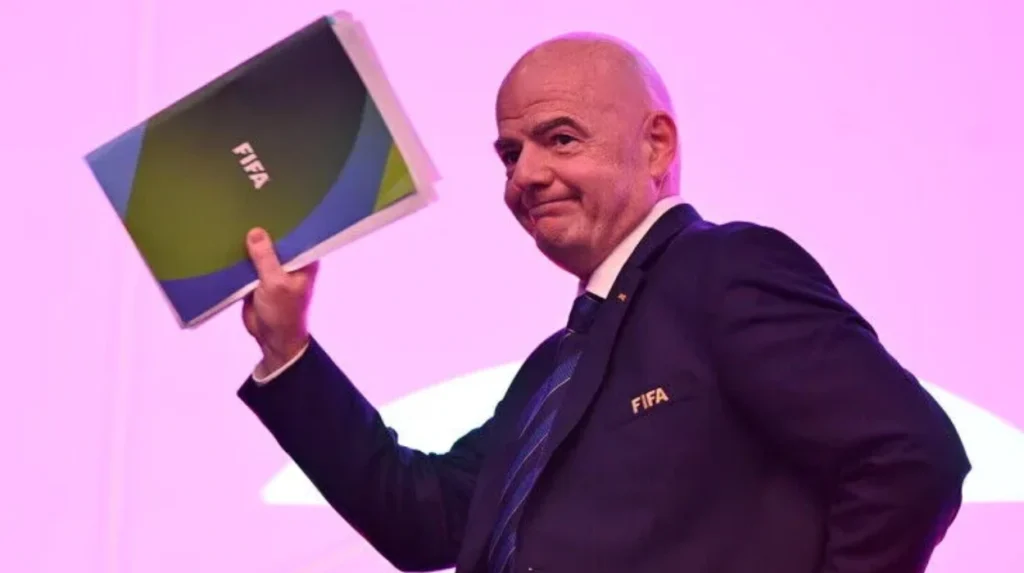
Europe’s leading football clubs threatened to boycott future Club World Cups just hours before FIFA president Gianni Infantino scrapped his private investment plan, a new report reveals, as New Zealand became the latest national federation to withdraw support for his re-election. With Infantino’s allies dismissing critics as jealous of a “high achiever,” the crisis shows no sign of resolving as FIFA’s confederations remain deeply split.
Europe’s leading football clubs threatened to boycott future editions of the Club World Cup unless FIFA president Gianni Infantino abandoned his FIFA Forward Enterprise investment scheme, issuing the warning in a letter sent hours before the plan was scrapped, according to a report by The Guardian carried by Anadolu Agency. The revelation came the same day New Zealand became the latest national federation to withdraw its support for Infantino’s re-election bid, according to Reuters, as the FIFA president continues to face open revolt from three confederations over the collapsed plan, even as allies including a senior Trump administration official rallied publicly to his defence.
European Clubs Threatened To Boycott The Club World Cup
Anadolu Agency reported that in a letter dated 31 July, sent to FIFA Secretary General Mattias Grafstrom, European Football Clubs, the body representing the continent’s leading clubs, said its support for future tournaments would depend on the creation of a joint FIFA-EFC venture before broadcasting rights for the 2028 Women’s Club World Cup are sold. EFC chief executive Charlie Marshall warned that FIFA’s actions could amount to a substantial breach of the organisations’ existing memorandum of understanding, and the group suggested it could challenge the international match calendar and player release rules if the dispute was not resolved.
A Broader Financial Transparency Dispute
Anadolu Agency reported that the EFC’s letter stated it would not support, and its member clubs would not participate in, any future edition of the men’s or women’s Club World Cup unless a fully operational FIFA-EFC joint venture, with exclusive authority over commercial and operational matters, was established well ahead of the 2028 rights cycle. The letter also criticised FIFA’s delay in distributing £185 million, around $250 million, in solidarity payments owed to clubs that did not participate in the tournament, and demanded FIFA share the final surplus revenue and a full profit and loss statement from the 2025 Club World Cup.
New Zealand Withdraws Support For Infantino
Reuters reported that New Zealand, the only Oceania Football Confederation nation to qualify for this year’s World Cup, withdrew its support for Infantino’s re-election bid on Friday, with New Zealand Football chief executive Andrew Pragnell saying the federation had lost confidence and trust in FIFA’s leadership. Pragnell said New Zealand had specifically called for an independent review of the collapsed investment plan because it did not want to see what he described as an in-house quick washover of the episode.
Oceania Confederation Takes A Softer Line
Reuters reported that the Oceania Football Confederation itself struck a markedly different tone from its own member, welcoming FIFA’s decision to withdraw the investment proposal and stating that football in the Oceania region had grown under Infantino’s leadership. New Caledonia’s football federation went further, publicly and unequivocally reaffirming its support for Infantino and praising his governance and funding reforms, illustrating the same pattern seen elsewhere in FIFA’s membership, where confederation-level statements do not always reflect the positions of individual national federations.
White House Ally Dismisses Critics As “Jealous”
Reuters reported that Andrew Giuliani, executive director of the White House Task Force for the 2026 World Cup, dismissed Infantino’s critics as jealous of high achievers, telling The Athletic that any confederation or federation failing to vote for Infantino in the next election would be making one of the most foolish decisions possible. Giuliani argued that Infantino had delivered the largest global sporting event ever without incident and generated more than four times the revenue of the previous World Cup, and said anyone voting against his re-election needed, in his words, to get their head examined.
The Numbers Behind The Vote
Reuters reported that UEFA, the Asian Football Confederation and CONCACAF, the three confederations calling for a review of Infantino’s leadership, together represent 136 of the 211 member associations that will vote in FIFA’s presidential election next March. Despite that numerical weight, Infantino retains significant support elsewhere: the proposal that triggered the crisis had come bundled with a $20 million grant for member associations for the next funding cycle, an amount that could have doubled had federations backed the deal.
Six Arab Federations And CAF Continue To Back Infantino
Reuters reported that six Arab national football associations, including Qatar and 2030 World Cup co-host Morocco, firmly backed Infantino on Thursday, saying they appreciated his sustained efforts to advance football globally. The Confederation of African Football’s executive committee separately confirmed its unanimous support for Infantino, though Reuters noted there was no guarantee that all 54 CAF members would ultimately vote as a single bloc when the election takes place.
Calls For An Independent Review Grow Louder
Pragnell told Reuters that any independent review of the scrapped FIFA Forward Enterprise proposal needed to shed light on FIFA’s decision-making and oversight, and should specifically identify who was involved in selecting Thrive Capital, a firm with close familial links to President Trump, to play a leading role in the venture. Reuters reported that Australia, an AFC member, has also called for an independent review alongside the wider Asian bloc, without publicly declaring a position on Infantino’s leadership itself, with Pragnell noting New Zealand remained strongly aligned with Australia’s position based on its commitment to the AFC’s own statement.
Why This Matters For Saudi Arabia’s 2034 World Cup
The revelation that Europe’s clubs were prepared to boycott FIFA’s own flagship club competition, combined with a growing list of national federations withdrawing support for Infantino’s re-election, illustrates a FIFA membership fractured at nearly every level, from confederations down to individual clubs. For Saudi Arabia, whose hosting of the 2034 World Cup depends on FIFA functioning as a stable, credible institution over the next eight years, a crisis this deep and this widely distributed across the organisation’s structure represents a more serious risk to long-term planning than any single leadership dispute might suggest on its own.
A Test Of Whether Numbers Or Alliances Decide The Outcome
With the three confederations opposing Infantino representing a majority of FIFA’s voting membership by association count, but Infantino retaining the backing of Africa, much of the Arab world and significant parts of South America, March’s election looks set to test whether raw numerical opposition or accumulated political alliance-building ultimately decides FIFA’s leadership. Saudi Arabia’s own position, still undeclared as its federation prepares to elect new leadership this month, remains one of the more consequential unknowns in that calculation, particularly given Andrew Giuliani’s framing of the dispute as a loyalty test that federations would be foolish to fail.
Broader Debate Over Accountability And Sportswashing
The scale of opposition now documented, spanning confederations, national federations and Europe’s own clubs, alongside vocal defences from figures directly tied to the Trump administration, illustrates how thoroughly FIFA’s leadership crisis has become entangled with wider political relationships. Neither FIFA nor Infantino has responded in detail to the EFC’s boycott threat or to calls for the independent review’s scope to specifically examine Thrive Capital’s role in the abandoned plan. For rights organisations, federations and fans already questioning the transparency of FIFA’s handling of Saudi Arabia’s 2034 hosting rights, the breadth of this month’s revolt, and the pointed calls for scrutiny of Infantino’s ties to Trump-linked investors, are likely to be read as further confirmation of exactly the governance concerns their campaigns have raised for years.