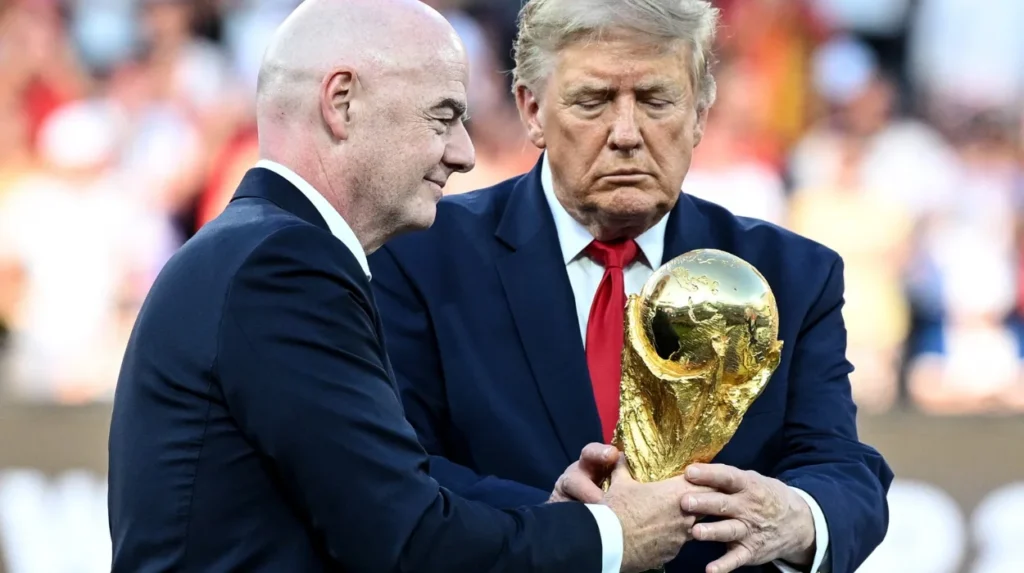
US President Donald Trump has publicly warned FIFA it would be making a “terrible mistake” if it replaced Gianni Infantino, hours after UEFA, CONCACAF and the AFC issued a joint letter accusing him of a “fundamental breach of trust.” Rather than demanding his immediate removal, the three confederations are understood to want Infantino to step down with dignity ahead of March’s election, a request now complicated by direct political backing from the White House.
US President Donald Trump warned on Tuesday that FIFA would be making a terrible mistake if it considered replacing Gianni Infantino as president, posting on his Truth Social platform that Infantino is fantastic and had presided over the most successful World Cup ever staged, and that the tournament would never be as successful or profitable again without him. The intervention came only hours after UEFA, CONCACAF and the Asian Football Confederation issued a joint open letter accusing Infantino of a fundamental breach of trust over his abandoned plan to sell a stake in the World Cup to private investors. According to reporting carried by the Irish Times, the three confederations are understood to want to give Infantino the chance to resign and leave his position with dignity, rather than seek re-election in March, a path now complicated by a sitting US president publicly urging FIFA’s membership to keep him in place.
Trump Intervenes Directly In FIFA’s Leadership Crisis
The Irish Times reported that Trump’s post came as UEFA, the AFC and CONCACAF, having accused Infantino of deception, indicated they wanted to insulate themselves from the unfolding crisis rather than continue operating under his leadership. Trump’s declaration that FIFA would be making a terrible mistake replacing him marks the most direct political intervention yet in a governance dispute that has, until now, been confined to football’s own institutional structures, and follows a pattern of public support Trump has extended to Infantino throughout his presidency, including at the World Cup final itself.
The Open Letter’s Core Accusation
The Associated Press, carried by 1News, reported that the joint letter, addressed to what the three confederations called the football family, said that when trust is broken through deception, and an individual places himself above the collective that entrusted him with authority, that duty has been abandoned. The letter, co-signed by UEFA president Aleksander Ceferin, AFC president Salman bin Ibrahim Al-Khalifa and CONCACAF president Victor Montagliani, said football belongs to no individual and no institution, but to the players, fans, clubs and member associations who safeguard its future.
Only One Elected Official Attended FIFA’s Crisis Meeting
The joint letter drew particular attention to how FIFA responded internally to the controversy. The Associated Press reported that the letter noted FIFA’s own account of a leadership meeting held in Morocco confirmed only one elected official was present, with no FIFA Council members or member associations invited to participate, and only FIFA’s own employed senior management in attendance. The letter argued that this meeting, at which FIFA said staff had reaffirmed their full support for Infantino’s presidency, amounted to the organisation investigating and vindicating itself rather than submitting to genuine external scrutiny.
A Failure Of Judgement, Not Communication
The joint letter rejected FIFA’s characterisation of the episode as a communications failure, stating plainly that what football witnessed was a failure of judgement. It said there remained no recognition from FIFA that attempting to sell an interest in the World Cup was a profound failure of judgement, not merely a procedural misstep, but a fundamental breach of trust with the institutions FIFA exists to serve. The letter closed by calling for unity to be honoured through leadership that serves football rather than seeks to command it.
FIFA Continues To Defend Infantino
FIFA’s own response, issued days earlier, accused critics of a concerted and ongoing effort to undermine the organisation and its president, warning that those without the backing of FIFA’s member associations should not seek through allegation or insinuation what they cannot achieve through FIFA’s democratic processes. That defensive posture, combined with Trump’s public intervention, suggests Infantino and his closest allies remain determined to contest March’s election rather than accept the graceful exit the three confederations are reportedly seeking to offer him.
Why This Matters For Saudi Arabia’s 2034 World Cup
A sitting US president publicly lobbying FIFA’s membership to retain a specific individual as its president is a striking illustration of how entangled FIFA’s institutional decisions have become with the political interests of powerful world leaders, a concern that sits at the centre of long-standing criticism of Saudi Arabia’s own 2034 hosting rights. Trump’s intervention did not address Saudi Arabia directly, but it reinforces a pattern already scrutinised by governance experts and rights organisations: FIFA’s major outcomes, from the awarding of hosting rights to the survival of its own president, appear increasingly shaped by relationships with heads of state rather than by FIFA’s stated commitment to institutional independence.
A Graceful Exit Now Politically Complicated
The three confederations’ reported willingness to let Infantino step down with dignity, rather than force a contested and divisive removal, represented a relatively conciliatory path out of the crisis. Trump’s public intervention makes that path considerably harder to walk, since any move by Infantino to step aside now risks being read as a capitulation to UEFA, the AFC and CONCACAF rather than a dignified exit, at the same moment the president of the United States has publicly staked his own credibility on Infantino remaining in office. For Saudi Arabia, which has stayed notably silent throughout the crisis and is not due to hold its own football federation elections until the end of August, the increasingly personal and political nature of the standoff adds further uncertainty to the leadership question hanging over the final eight years of 2034 preparations.
Broader Debate Over Accountability And Sportswashing
Trump’s willingness to publicly intervene in an internal FIFA leadership dispute, on behalf of a president whose signature investment plan was reportedly backed by a fund linked to the family of Trump’s own son-in-law, adds further weight to arguments that FIFA’s governance under Infantino has become difficult to separate from the personal political relationships surrounding it. Neither FIFA nor Infantino has responded directly to the confederations’ invitation to step down with dignity. For rights organisations, federations and fans who have spent years scrutinising the transparency of FIFA’s decision-making, including its handling of Saudi Arabia’s 2034 hosting rights, a US president’s public intervention in the question of who leads FIFA is likely to be read as further confirmation of exactly the concern their campaigns have raised.