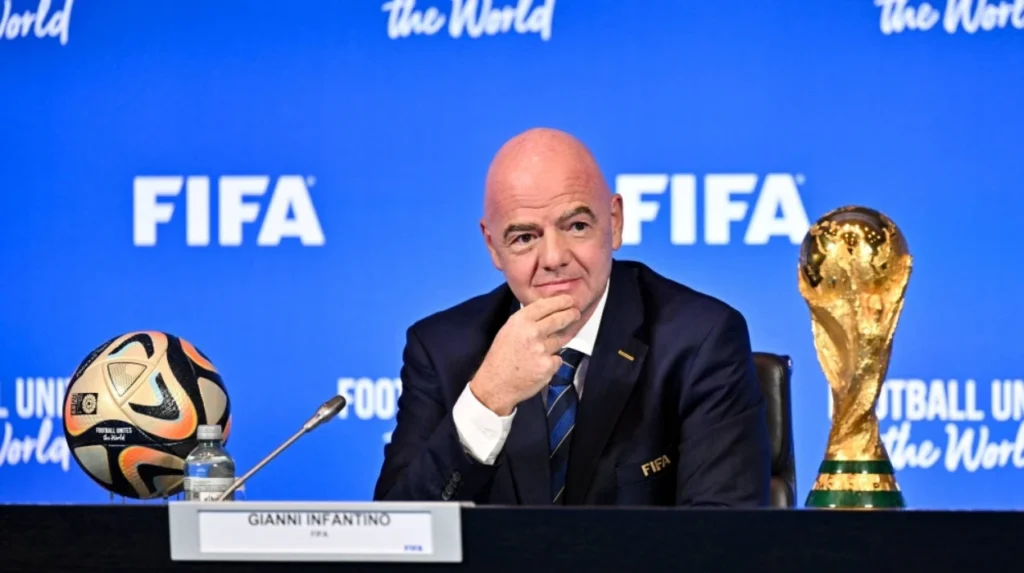
UEFA, CONCACAF and the Asian Football Confederation are reportedly coordinating an effort to force Gianni Infantino from the FIFA presidency, as internal defections and a wave of withdrawn re-election support leave him more isolated than at any point in his decade in charge. The crisis inside the body overseeing Saudi Arabia’s 2034 World Cup shows no sign of settling, even after Infantino publicly apologised and abandoned his investment plan.
Three of FIFA’s regional confederations, UEFA, CONCACAF and the Asian Football Confederation, are determined to force Gianni Infantino out of the FIFA presidency by paralysing the organisation, according to a report in The Times of London carried by Reuters on Tuesday. The move follows what Reuters described as three days of unprecedented civil war inside world football’s governing body, triggered by Infantino’s now-abandoned plan to sell a stake in the World Cup to private investors. Five European national associations, including England’s Football Association, have formally withdrawn their backing for Infantino’s re-election bid at FIFA’s Congress in Morocco next March, deepening a crisis inside the organisation that continues to oversee Saudi Arabia’s preparations to host the 2034 World Cup.
Infantino Apologises As His Grip On Power Weakens
Reuters reported that Infantino abandoned his plan to raise $4.2 billion through a new commercial rights body, FIFA Forward Enterprise, late on Friday night, apologising for how the proposal had divided the game for the first time in his decade running the organisation. The apology marked a notable departure from Infantino’s usual public posture toward criticism, which has more often involved dismissing detractors rather than conceding fault. Reuters described his once unassailable position at the top of world football as now shattered.
A Countable Tally Of Defections And Loyalists
Reuters reported that five European federations, including England’s FA, have formally withdrawn support for Infantino’s re-election, while Denmark’s federation said it had never intended to back him regardless of the investment plan dispute. By contrast, only five national federations, Morocco, Qatar, Kuwait, Lebanon and Sri Lanka, have so far publicly declared continued support for Infantino, who has led FIFA since 2016 and is seeking to remain in office until 2031. Reuters noted that while the number of federations with firm public positions on either side remains small relative to the 211 that will vote at Congress, the scale of confederation-level opposition has clearly cost Infantino significant support.
The Revolt Reaches Inside FIFA’s Own Leadership
ESPN reported that the resistance to Infantino’s plan was not confined to external federations. Carlos Cordeiro, a senior adviser to Infantino, a former Goldman Sachs partner and former president of US Soccer, resigned in protest on Friday, describing the proposal as a bad deal for football and urging other officials to speak out against it. Hours later, FIFA’s chief operating officer, Kevin Lamour, a long-time colleague of Infantino from both FIFA and UEFA, issued a statement saying staff had been deceived by the lack of openness in how the plan was developed, and that it was the project of one person rather than the organisation as a whole.
UEFA And CONCACAF Declared No Confidence Days Earlier
The current push to remove Infantino builds directly on statements issued by UEFA and CONCACAF on Saturday, in which both confederations said they had lost confidence in his leadership. UEFA’s 55 member associations had voted unanimously days earlier to boycott FIFA competitions, including the World Cup itself, if the investment plan proceeded, a threat significant enough to force its withdrawal. The Asian Football Confederation separately called for a full review of FIFA’s governance and decision-making processes.
What Removing Infantino Would Actually Require
Removing a sitting FIFA president before the end of his term is not a straightforward process under FIFA’s statutes, and requires either a resignation, disciplinary action through FIFA’s own ethics mechanisms, or a formal vote at Congress. With the next scheduled Congress and presidential election due in March in Rabat, Morocco, and candidates required to declare their intention to stand by 18 November, the confederations reportedly coordinating against Infantino may be working toward ensuring he faces a genuine contested election rather than pursuing his immediate removal.
Why This Matters For Saudi Arabia’s 2034 World Cup
Saudi Arabia’s hosting of the 2034 World Cup depends on a FIFA leadership capable of managing an eight-year preparation process with stability and institutional credibility. A sitting president facing coordinated opposition from three of FIFA’s six confederations, the resignation of a senior adviser, and public criticism from his own chief operating officer represents the most serious challenge to FIFA’s leadership since Infantino took office in the wake of the Sepp Blatter corruption scandal a decade ago. Whatever the outcome, the events of the past week raise legitimate questions for federations, rights organisations and fans about the stability of the institution Saudi Arabia is relying on to deliver its own tournament.
Gulf States Remain Among Infantino’s Firmest Backers
The list of federations publicly standing by Infantino, Morocco, Qatar, Kuwait, Lebanon and Sri Lanka, again shows a concentration of Gulf and Middle Eastern support at a moment when European federations are abandoning him in numbers. That pattern, consistent with Qatar’s earlier public backing during the investment plan dispute, adds further context to existing scrutiny of how closely FIFA’s institutional stability under Infantino has come to depend on continued support from Gulf states with direct commercial and hosting interests in his leadership, including Saudi Arabia’s own stake in the 2034 tournament.
Broader Debate Over Accountability And Sportswashing
The scale of the effort now reportedly under way to remove Infantino, coordinated across three confederations rather than confined to isolated criticism, suggests FIFA’s own membership regards the past week’s events as a genuine institutional crisis rather than a resolved dispute. Neither FIFA nor Infantino has responded in detail to reports of the coordinated removal effort. For rights organisations, federations and fans who have spent the past two years questioning the transparency of FIFA’s handling of Saudi Arabia’s 2034 hosting rights, the question of who leads FIFA into that tournament, and how they came to hold the position, is likely to remain central to the debate over accountability in world football for months to come.