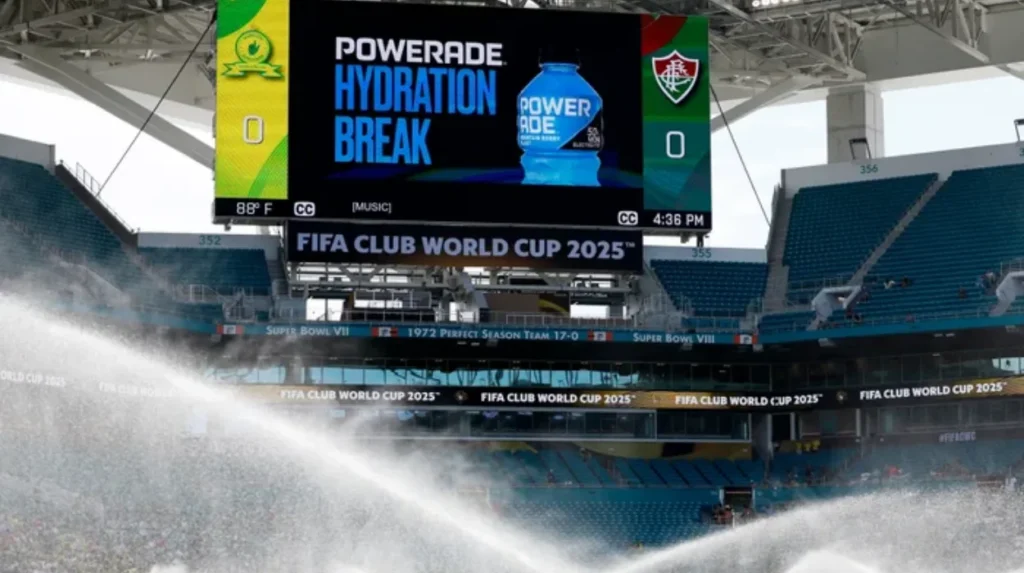
The governing body of world football, FIFA, is once again at the centre of controversy following reports that the 2026 World Cup will introduce structured in-game “hydration breaks” that will double as commercial advertising windows for broadcasters. While FIFA defends the move as a necessary step for player welfare in potentially extreme weather conditions, critics argue it represents another significant step in the gradual transformation of football into a heavily commercialized broadcast product.
At the heart of the debate is a growing question that has followed FIFA for years: where does sport end and entertainment commerce begin?
A Format Change That Alters the Flow of the Game
Under the proposed system, each half of a World Cup match will include mandatory three-minute hydration breaks. During these pauses, broadcasters will be allowed to air advertisements, creating structured commercial slots within live gameplay. The introduction of such breaks effectively reshapes football’s traditional continuous flow, aligning it more closely with segmented sports formats commonly seen in American leagues such as the NFL or NBA.
For many fans and analysts, this is not a minor operational adjustment. Football has long been defined by its uninterrupted rhythm, where momentum, pressure, and emotional intensity build continuously over 45-minute halves. Introducing planned stoppages designed around broadcast monetization raises concerns that the essence of the game is being altered to suit television economics rather than sporting tradition.
Critics argue that while hydration breaks may have a legitimate place in extreme weather conditions, their universal and structured implementation across matches suggests a broader purpose. The timing of their introduction alongside new commercial broadcasting opportunities has intensified scrutiny of FIFA’s motivations.
FIFA’s Justification: Player Welfare and Climate Conditions
FIFA has defended the decision by pointing to increasing global temperatures and the need to protect player health during major tournaments. With the 2026 World Cup set to be hosted across the United States, Canada, and Mexico—regions where summer heat can be intense in several venues—the governing body argues that hydration breaks are a necessary safeguard.
Player safety has become a more prominent issue in modern football, particularly in tournaments held in hot and humid environments. Previous competitions have already seen temporary cooling breaks introduced in response to extreme conditions.
However, the concern raised by critics is not necessarily the existence of hydration breaks themselves, but rather their standardization and integration into broadcasting schedules. The concern intensifies when these breaks are explicitly linked to advertising opportunities, creating a perception that welfare considerations may be intertwined with commercial planning.
The Commercial Expansion of FIFA Tournaments
FIFA has faced long-standing criticism over its approach to commercial partnerships and revenue generation. Each World Cup cycle has introduced new sponsorship categories, expanded media rights deals, and increased branding opportunities within stadium environments.
The organization generates billions in revenue from broadcasting and sponsorship agreements tied to the World Cup, making it one of the most lucrative sporting events in the world. As global viewership continues to grow, so too does the value of every minute of broadcast time.
From this perspective, the introduction of structured in-game advertising windows can be seen as part of a broader trend: the optimization of every possible moment within live sport for monetization. Rather than relying solely on halftime or pre-match advertising, FIFA appears to be enabling new commercial slots during active match broadcasts.
Critics argue that this represents a shift in philosophy—from organizing a sporting tournament that accommodates broadcasting, to designing a sporting format around broadcasting needs.
Concerns About “Americanization” of Football
One of the most common criticisms emerging from fans is the idea that football is being gradually reshaped to resemble American sports broadcasting models. In leagues such as the NFL, frequent stoppages are an integral part of the game structure, allowing for regular commercial breaks.
Football, by contrast, has historically resisted such segmentation. Its global appeal is often attributed to its simplicity and uninterrupted flow, where commercial influence is largely confined to natural breaks in play.
The introduction of mandatory stoppages designed for advertising has therefore been interpreted by some as a cultural shift. It raises questions about whether FIFA is adapting football to modern broadcast economics at the expense of its traditional identity.
While some argue that sport must evolve with media consumption habits, others believe there is a limit beyond which structural changes begin to erode what makes the game distinctive.
Fan Reaction and Cultural Pushback
The reaction from fans has been largely negative across social media and football communities. Many supporters express concern that the game is becoming increasingly “packaged” for television audiences rather than experienced as a live sporting contest.
A recurring theme in criticism is the feeling that football is being treated less as a sport and more as a content product. The introduction of predictable commercial breaks within matches is seen by some as disrupting emotional engagement, particularly during high-pressure moments where momentum can shift rapidly.
There is also skepticism about the necessity of making such breaks universal across all matches, regardless of weather conditions. Critics argue that flexibility would have been a more balanced approach, allowing referees or match officials to determine whether hydration breaks are required rather than embedding them as a fixed feature.
The Broader Governance Question
Beyond the specific issue of hydration breaks, the controversy feeds into a wider debate about FIFA’s governance model and priorities. The organization has frequently faced scrutiny over transparency, decision-making processes, and its relationship with commercial partners.
Each new commercial expansion tends to reignite concerns about whether football’s global governing body is sufficiently balancing its dual roles: steward of the sport and manager of one of the world’s most powerful entertainment properties.
The 2026 World Cup changes therefore become part of a larger narrative—one in which football is increasingly shaped by broadcast economics, sponsorship value, and global market expansion.
Balancing Modernization and Tradition
Defenders of FIFA’s approach argue that modernization is inevitable. Global sports operate in an increasingly competitive entertainment environment, where digital platforms, streaming services, and advertising models are constantly evolving. From this perspective, maximizing broadcast efficiency is not only logical but necessary for maintaining the financial sustainability of major tournaments.
They also point out that player welfare is a genuine concern, and structured breaks could provide consistent standards across all matches rather than leaving decisions to situational judgment.
However, the tension lies in how these objectives are balanced. Critics are not necessarily opposed to modernization or revenue generation, but question whether the current trajectory places too much emphasis on monetization at the expense of sporting integrity.
The controversy surrounding FIFA’s 2026 World Cup broadcast changes is not simply about a few minutes of stoppage time or additional advertising slots. It reflects a deeper and ongoing debate about the future identity of football.
As the sport continues to grow commercially, the boundaries between athletic competition and entertainment product become increasingly blurred. FIFA’s latest decision has therefore become symbolic of a broader transformation—one in which every aspect of the game is being reconsidered through the lens of global media value.
Whether this evolution is seen as necessary adaptation or excessive commercialization may depend on perspective. But what is clear is that football’s governing body is continuing to push the limits of how the sport is packaged, broadcast, and consumed in the modern era.