Saudi Arabia’s hosting of major sporting events like Formula 1 faces mounting scrutiny amid regional security threats, exemplified by potential cancellations of the Saudi Arabian Grand Prix. This situation serves as a critical lens for evaluating the kingdom’s capacity to manage the 2034 FIFA World Cup, testing the limits of its sports-driven global ambitions.
Escalating Security Threats
Recent escalations in the US-Israel-Iran conflict have placed the Jeddah Corniche Circuit under direct threat, with Iranian air strikes targeting nearby Gulf infrastructure, including Bahrain’s US naval base and Saudi military sites. Houthi forces, Iran’s proxies in Yemen, have repeatedly launched drones and missiles at Saudi oil facilities just 10-11 km from the track, as occurred in 2022 during F1 practice sessions, sparking driver boycott talks. Saudi Sports Minister Prince Abdulaziz bin Turki Al Faisal affirmed in past crises that races would be canceled if genuine threats emerged, a stance echoed in 2026 advisories.
While air defenses—bolstered by advanced US-supplied Patriot systems—have intercepted many projectiles, the proximity to Yemen’s border (under 400 km) heightens vulnerabilities to low-flying drones, which are harder to detect. This mirrors broader regional tensions spilling into Hajj pilgrimage logistics, where Saudi forces protect millions along a 450-km corridor annually.
Geopolitical Instability’s Logistical Toll
Hosting mega-events requires flawless coordination of air traffic, accommodations, and evacuations for thousands of international participants, yet Yemen’s conflict disrupts supply chains and heightens insurance premiums. The F1 circuit’s location near petrochemical refineries amplifies explosion risks from errant strikes, complicating emergency protocols compared to more isolated venues.
For the 2034 World Cup, spanning cities like Riyadh, Jeddah, and NEOM, these issues scale exponentially: FIFA anticipates 6.5 million visitors, straining expanded rail networks and airports despite $500 billion in Vision 2030 investments. Expo 2030 preparations in Riyadh highlight similar hurdles, including cyber threats and crowd control amid potential pilgrim overlaps.
Sportswashing Debates Intensify
Saudi Arabia’s $650 million F1 contract and uncontested 2034 World Cup bid form the core of Vision 2030’s sports diplomacy, aiming to diversify from oil and rebrand as a tourism hub. Detractors, including Human Rights Watch and Amnesty International, decry “sportswashing”—using glamour events to deflect from executions, women’s rights curbs, and migrant labor exploitation.
A GP cancellation would fuel these narratives, portraying the kingdom as unstable and eroding soft power gains from successes like the 2022 Jeddah race post-attack. Conversely, proponents note tangible progress: F1 has spurred local talent development and $2.7 billion in stadiums, including the ambitious 80,000-seat NEOM “Sky Stadium” with eco-friendly features.
Impact on International Confidence
Federations like the FIA and FIFA prioritize participant safety; an F1 pullout could prompt sponsor withdrawals (e.g., Aramco’s $400 million deals) and athlete refusals, rippling to World Cup qualifiers. Fans, deterred by travel advisories, might shun tickets, while insurers hike rates amid “force majeure” clauses.
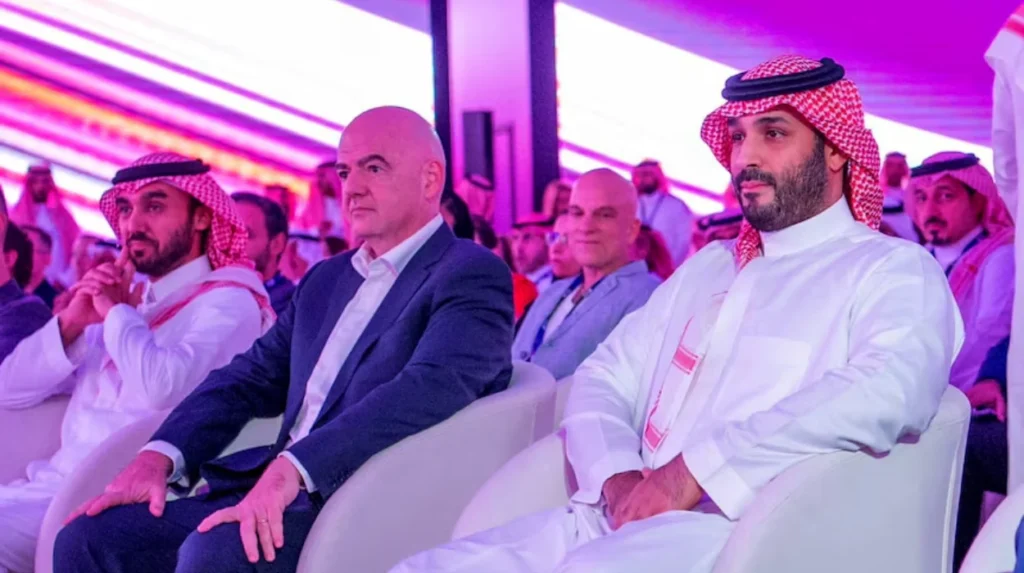
FIFA’s hasty 2034 approval, despite ignored human rights reports, amplifies stakes—groups warn of “reckless” risks to lives without binding safeguards. Athletes’ associations have voiced concerns over Qatar 2022 precedents, demanding transparency.
Saudi countermeasures include AI-driven surveillance, hyperloop trials for fan mobility, and joint military drills, positioning the World Cup as a security showcase. Yet, persistent incidents could solidify views of politically volatile hosts as high-risk.
Infrastructure and Development Counterpoints
Vision 2030’s $800 billion sports ecosystem features 15 World Cup-ready stadiums, high-speed rail linking 15 cities, and logistics hubs modeled on Singapore. Jeddah’s upgraded port and King Abdullah Economic City handle F1 freight, scalable for tournament volumes.
These assets rebut instability critiques, with officials touting a “multi-layered” defense integrating drones, satellites, and Gulf Cooperation Council pacts. Past resilience—running 2022 F1 amid attacks—bolsters claims of world-class hosting.
Broader Sports Diplomacy Challenges
In politically sensitive regions, events like Sochi 2014 or Beijing 2022 faced backlash but proceeded, suggesting Saudi can navigate scrutiny via economic leverage. However, Houthi threats differ, tied to active proxy wars rather than domestic issues.
Cancellations risk domino effects: eroded trust from federations, fan boycotts, and sponsor flight, potentially costing billions in World Cup prep. Balanced diplomacy—public risk disclosures and rights concessions—could mitigate this, turning challenges into credibility wins.
Saudi Arabia’s ambitions hinge on proving stability trumps geopolitics; F1’s fate will be a pivotal referendum.