The 2026 World Cup was sold as football’s great expansion: more teams, more hosts, more unity. Instead, it is becoming a live stress test of whether FIFA is still capable of political neutrality in an era when the US president, Donald Trump, openly treats the tournament as a tool of statecraft and personal power.
From the “FIFA Peace Prize” handed to Trump by Gianni Infantino, to travel bans, Greenland brinkmanship and the risk that teams like Iran may not even reach US soil, the line between global sport and geopolitical theatre is being deliberately blurred. The real question now is not just whether 2026 can be rescued, but whether FIFA’s choices today will poison the credibility of 2034 before a ball is even kicked.
FIFA’s Political Tightrope
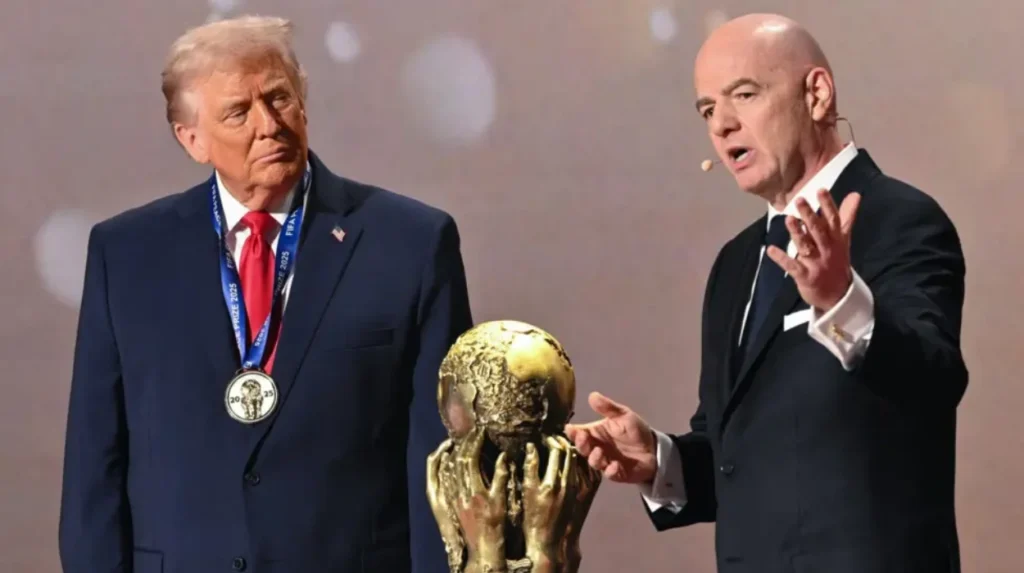
FIFA’s statutes formally require political neutrality, yet its leadership has moved ever closer to powerful heads of state, with Trump the most glaring example. Infantino’s decision to create and personally award a “FIFA Peace Prize” to Trump at the 2026 World Cup draw triggered a formal complaint from the NGO FairSquare, which accuses him of breaching Article 15 of the FIFA Code of Ethics by lobbying for Trump and endorsing his political agenda.
Critics argue that when the president of FIFA publicly suggests Trump “definitely deserves” a Nobel Peace Prize and then invents a FIFA award seemingly tailored to flatter him, FIFA ceases to be a neutral regulator and becomes an amplifier of US presidential politics.
This tightrope is not abstract; it has material consequences for how decisions are made and how dissent is handled. If the head of world football appears personally invested in Trump’s political fortunes, associations contemplating protest or boycott know they would be challenging not just a host government but FIFA’s own top leadership.
The power imbalance is stark: federations are bound by FIFA rules and financial dependence, while Infantino has shown he is willing to stretch governance norms to cultivate political patrons, from the Gulf monarchies to the White House. What emerges is not neutrality but a pattern: where political power is strongest, FIFA’s ethical red lines become negotiable.
The 2026 World Cup at Risk
The World Cup’s expansion to 48 teams and tri‑nation hosting in the US, Canada and Mexico was supposed to dilute political risk; instead, the American center of gravity has magnified it. Trump’s foreign policy has already raised doubts about whether all qualified teams’ players, staff and fans can even enter the country, as new travel and visa restrictions hit dozens of states, including major football nations.
Reports describe a broad halt or slowdown in visa processing for citizens from a long list of countries, forcing FIFA to confront the possibility that a host government’s immigration agenda may override its own commitment to equal participation.
On top of this structural tension sit sharper geopolitical flashpoints. Trump’s provocative push to claim Greenland has already sparked discussion among European politicians and football figures about the once‑unthinkable: boycotting a World Cup hosted by a NATO ally to protest expansionist ambitions. Experts in sports geopolitics note that a coordinated boycott, if it happened, would likely form part of a broader sanctions package, turning the World Cup into an explicit instrument of diplomatic pressure rather than an arena apart.
That such conversations are now mainstream underscores how fragile the 2026 tournament has become; the risk is not just logistical disruption but an event overshadowed by arguments about whether participating is itself complicity.
Iran and the Shadow of Exclusion
No team illustrates the collision of security narratives, US politics and FIFA’s responsibilities more clearly than Iran. On paper, Iran has earned its place at the expanded 2026 World Cup through Asian qualifying and remains one of the region’s most consistent performers.
In practice, its participation is already entangled in visa denials, security reviews and the broader architecture of Trump’s travel bans and sanctions. Iranian officials and media have reported instances where delegations were denied visas for key events such as the World Cup draw, raising the possibility that a qualified team could find itself locked out of crucial preparatory stages on political grounds.
More recently, FIFA has publicly confirmed that Iran’s participation is “under evaluation” amid escalating security concerns, a phrase that is both vague and ominous. While FIFA stresses safety for all teams, critics point out that similar language has often been used to justify selective harshness, as seen with the rapid exclusion of Russia from competition after the full‑scale invasion of Ukraine.
Iran, already subject to an expanded US travel ban and intense geopolitical demonization, may find that its fate is determined less by sporting merit and more by whether FIFA is willing to confront its main host over visas, security narratives and equal access. If a qualified side is effectively excluded through bureaucratic obstruction or security pretexts, the precedent for politically convenient disqualification will be set.
The FIFA Peace Prize Controversy
The “FIFA Peace Prize” awarded to Trump is a revealing case study in how symbolism can expose deeper governance failures. According to FairSquare, the prize itself appears to have been created and bestowed without proper authorization from the FIFA Council, contradicting the organization’s own statutes about how major initiatives and values‑based programs should be approved.
The NGO alleges at least four distinct breaches of the duty of neutrality, including Infantino’s public lobbying for Trump to receive the Nobel Peace Prize and his comments in Miami that could reasonably be interpreted as endorsing Trump’s political agenda.
For an institution that insists it is a guardian of apolitical global sport, honoring a sitting president with a “peace” award while that same administration tightens travel bans and slashes humanitarian funding looks less like naivety and more like calculated alignment.
The backlash has been swift and scathing. Human rights and governance watchdogs have derided the award as “vulgar,” arguing that it trivializes both peace and the suffering of communities targeted by Trump’s rhetoric and policies.
Within football circles, some officials may privately find the spectacle absurd, but they also see the implications: if Infantino can unilaterally instrumentalize FIFA’s moral authority to flatter a political ally, what prevents similar maneuvers in future bidding, disciplinary and broadcasting decisions? The peace prize controversy therefore becomes more than a public relations blunder; it is a litmus test of whether FIFA’s ethical machinery can restrain its own president when political access is at stake.
Sport or Political Theater?
Taken together, these trends raise a fundamental question: is global football still an independent cultural space, or has it been absorbed into the logic of power politics and image management? Trump’s approach to the 2026 World Cup—boasting about his role in securing the tournament, using the event to project strength, and reportedly seeing it as a vehicle for domestic political gain—suggests he understands its symbolic value better than many football administrators.
When that understanding meets a FIFA leadership eager for proximity to presidents and princes, the result is a tournament architecture where every visa decision, travel restriction, or diplomatic spat can become leverage.
The erosion of independence is not only about overt interference but about self‑censorship and selective outrage. FIFA moved quickly against Russia when European federations refused to play, yet appears far more cautious about confronting Washington over travel bans that could hinder multiple World Cup teams and thousands of supporters.
Such asymmetry signals that principles are applied according to political weight, not universal standards, encouraging governments to see football less as a neutral meeting ground and more as another front where influence can be bought, traded or coerced. In that environment, “the world’s game” risks becoming a stage on which ordinary players and fans are extras in someone else’s geopolitical script.
Lessons for FIFA 2034
The choices FIFA makes around 2026 will echo loudly as it moves toward awarding and organizing the 2034 World Cup. If the organization normalizes tailored awards for sitting leaders, silence on discriminatory travel regimes, and the quiet sidelining of inconvenient teams, potential hosts will draw their own lessons: cultivate personal ties with FIFA’s top brass, promise political loyalty, and you can expect indulgence even amid controversy.
That logic clearly favors states with concentrated political power and limited transparency, accelerating an already visible shift of mega‑tournaments toward authoritarian or semi‑authoritarian regimes.
Conversely, federations and civil society actors pushing for human rights‑based criteria, binding neutrality rules and independent ethics enforcement will need to treat 2026 as a hard boundary, not an exception. If Iran can be quietly squeezed out via security discourse today, another politically inconvenient nation can be discarded tomorrow; if a US travel ban can shape participation with limited resistance, a future host could do the same to silence critics or marginalize rivals.
The governance model settled now—on visas, sanctions, ethics oversight and the relationship between FIFA’s president and heads of state—will determine whether FIFA 2034 is perceived as a legitimate world championship or a branded spectacle curated to fit the interests of a narrow political club.
The World Cup has survived wars, dictatorships and corruption scandals, but it has rarely faced such open instrumentalization by a superpower host aligned with a compliant FIFA leadership. If 2026 proceeds as a tournament where access, recognition and even “peace” itself are contingent on proximity to the White House, then by 2034 the myth of football as a global commons may be impossible to recover.
The long‑term question is no longer whether FIFA can manage politics, but whether it has already surrendered the game’s soul in pursuit of power, leaving future World Cups as showpieces for those who can bend both sport and governance to their will.