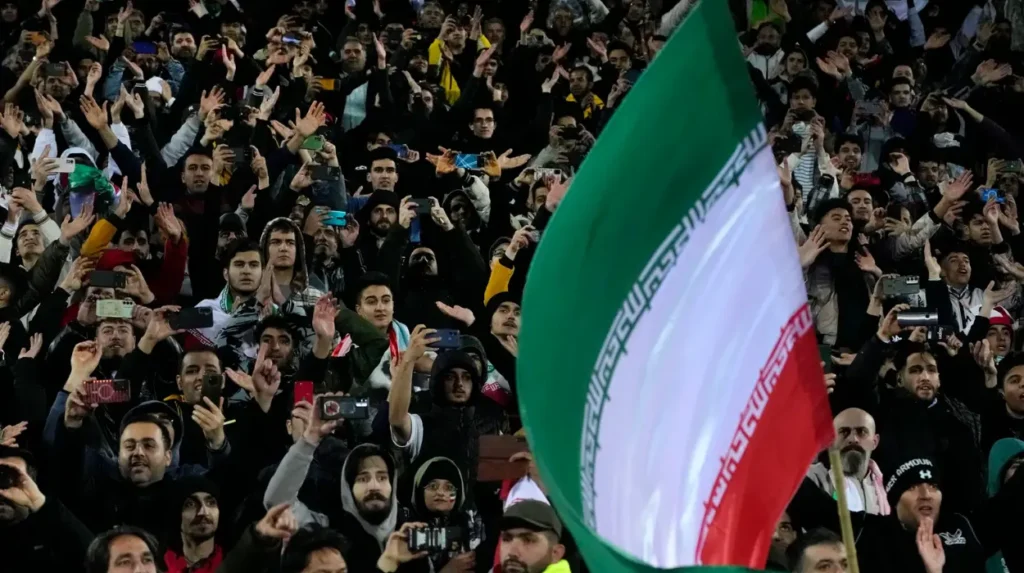
The 2026 FIFA World Cup, staged across the United States, Mexico, and Canada, was meant to showcase football as a unifying global spectacle. Instead, it has become a mirror of escalating geopolitical rupture. Following US–Israeli air strikes on Iran that killed Supreme Leader Ayatollah Ali Khamenei and triggered a wider regional conflict, Iran’s football authorities have publicly expressed deep pessimism about participating in the tournament. The national team, scheduled to face Belgium, Egypt, and New Zealand in American cities, now stands at the crossroads of mourning, nationalism, and diplomatic estrangement. This moment crystallizes a broader truth: in an age of permanent crisis, global sports cannot be cordoned off from politics, and the World Cup has become as much a diplomatic theatre as a sporting one.
The Myth of “Sports Above Politics”
The claim that “sports should be separate from politics” is one of the most enduring and convenient fictions in professional football. FIFA and host‑state actors routinely insist that the World Cup is a neutral celebration of unity, while simultaneously allowing the tournament to be staged in countries with contested human‑rights records or embedded in alliance structures that participate in military conflicts. In the case of Iran, the idea that the national team can simply “play football” while its supreme leader is assassinated and its cities are under bombardment is not merely naive—it is structurally impossible.
Iran’s football federation and sports minister have explicitly linked the team’s potential withdrawal to the strikes and the broader war, framing the question of participation as one of national dignity and security rather than athletic logistics. This refusal to compartmentalize sport from political reality exposes a deeper hypocrisy in how global sporting institutions treat conflict: wars waged by powerful states are treated as background noise, while the emotional and ethical responses of targeted nations are treated as “politicization” of sport.
Athletes Under Fire: Safety, Trauma, and Representation
For Iranian players, the question of whether to travel to US‑hosted matches is not an abstract debate about “sport and politics,” but a concrete calculus of safety, family, and national identity. With thousands of Iranian civilians reported killed in the strikes and the country in a prolonged period of mourning, players are expected to compete thousands of miles away in a nation that has just bombed their homeland. Such conditions impose acute psychological strain: representing the nation on the pitch becomes inseparable from representing a grieving population under siege.
Moreover, choosing to participate can be framed domestically as a betrayal, while choosing to withdraw can be weaponized internationally as a refusal to “separate sport from politics.” This double bind places athletes at the heart of a performative contradiction: the same institutions that celebrate national teams as symbols of unity rarely provide robust mechanisms to protect players from the moral and physical consequences of war. In this sense, the World Cup no longer functions as a neutral shield for athletes; it becomes a contested stage where the trauma of conflict is performed in the guise of entertainment.
FIFA’s Ambiguous Role: Neutrality or Complicity?
FIFA has repeatedly stated that it is “closely monitoring the situation,” yet it has not moved to relocate Iran’s matches or suspend the United States as a safe host for a country under direct aerial assault by Washington. This posture of observational neutrality effectively preserves the status quo: it allows the tournament to proceed as scheduled while shifting the burden of decision‑making onto the affected state. By framing Iran’s participation as a matter of “political and security considerations” rather than a foreseeable consequence of host‑state military action, FIFA subtly absolves the host of responsibility.
The federation’s historical pattern—of reluctantly adapting to boycotts, sanctions, or security threats only after intense political pressure—suggests that its neutrality is less a principle than a risk‑management strategy. In the shadow of a US–Israeli campaign that has killed Iran’s top leadership, FIFA’s failure to consider alternative venues, neutral‑territory fixtures, or even temporary suspension of Iran’s fixtures reveals a deeper institutional alignment with the geopolitical architecture of the host powers. Neutrality, in this context, functions as a form of complicity: the rules of sport are preserved while the consequences of war are displaced onto the very athletes and states that are least able to negotiate them.
Ethics of Hosting: Safety, Fairness, and Diplomacy
Hosting World Cup matches against Iran in the United States, shortly after that country has conducted deadly air strikes on Iranian territory, raises profound ethical questions about fairness and symbolism. The United States is not only a co‑host of the tournament but also a direct party to the conflict, blurring the line between “host” and “adversary” from Iran’s perspective. For Iranian fans, officials, and players, competing on American soil becomes an act of navigating a hostile environment where the distinction between sport and security is deeply compromised.
Security concerns are not limited to the battlefield; the threat of backlash, surveillance, or incidents against the Iranian team in a politically charged domestic climate cannot be dismissed. Yet the host’s discourse often treats “security” as a matter of crowd control and logistics, not as a structural consequence of a state’s own military actions. This gap between security rhetoric and geopolitical reality exposes the double standard by which powerful states host global events while simultaneously engaging in practices that make those events untenable for their rivals. Fairness, in such conditions, cannot be reduced to equal‑time rules; it must also account for the asymmetry of power, trauma, and representation that war imposes on the pitch.
Media Framing: Pessimism, Neutrality, and Geopolitical Lens
The ABC News report frames Iran’s response as one of “pessimism” and “uncertainty,” language that softens the political gravity of the situation. By foregrounding the opinions of Iranian officials while paying only passing attention to the scale of civilian casualties and the broader regional conflict, the narrative risks normalizing US–Israeli military action as a backdrop to sporting drama rather than its central cause. The piece juxtaposes Iran’s mourning and suspension of football with the host‑state narrative of “honouring freedom” and maintaining the World Cup calendar, thereby reinforcing a subtle hierarchy: the tournament’s continuity is treated as a default, while Iran’s withdrawal is presented as an exceptional, almost inconvenient, reaction.
This framing aligns with a broader Western media tendency to separate “legitimate” security concerns from “excessive” political responses by non‑Western states. When Iran signals a boycott or qualified withdrawal, it is rendered as a “political decision” rather than a rational response to targeted violence; when the host state insists on proceeding, it is celebrated as resilience or normalcy. Such asymmetry in narrative treatment reinforces the idea that the global South is “too political” while the Global North is merely “protecting its interests,” further entrenching the myth that sports can be neutral when the world system that produces war is treated as neutral background scenery.
Globalization Under Siege: War and Cultural Events
The Iran–World Cup crisis reveals how globalization is not an unbroken arc of integration, but a fragile and contested process constantly reshaped by military and diplomatic ruptures. Events like the World Cup, once imagined as spaces of cosmopolitan encounter, are now calculated within the same risk matrices as trade routes, diplomatic visits, and military deployments. The possibility that Iran may boycott the US‑hosted matches while still competing in the broader tournament in Mexico and Canada signals a new pattern: selective participation, geographically segmented competition, and the normalization of “sanctioned” or “partial” global engagement.
This dynamic challenges the orthodox notion that cultural globalization necessarily softens conflict. Instead, global events like the World Cup can become amplifiers of tension, where the visibility of national teams heightens the symbolic stakes of any withdrawal or refusal. At the same time, the crisis exposes the limits of soft power: the United States cannot simultaneously bomb Iran and expect unproblematic sporting hospitality from its citizens and athletes without producing profound cognitive and emotional dissonance.
Toward a Politics of Football
The 2026 World Cup may ultimately proceed in the United States, but the shadow of war has already altered its moral and political coordinates. Iran’s “pessimism” is not a technical scheduling issue; it is an indictment of a global order in which powerful states can weaponize their position as hosts while smaller, targeted nations are forced to choose between trauma and spectacle. The episode underscores that sports bodies, media, and states must abandon the pretense that global competitions can be insulated from the world’s conflicts.
If international football is to retain any claim to universality, it must confront the asymmetry of power that war introduces into the game. This means rethinking host selection in times of conflict, creating mechanisms for neutral‑venue fixtures, and recognizing that athletes from war‑affected nations are not merely performers but also political subjects navigating the same forces that shape the headlines. The Iran crisis, then, is not an exception to the World Cup; it is a preview of how global sport will increasingly be contested terrain—where the pitch becomes one of the last arenas in which the politics of survival can no longer be confined to the sidelines.