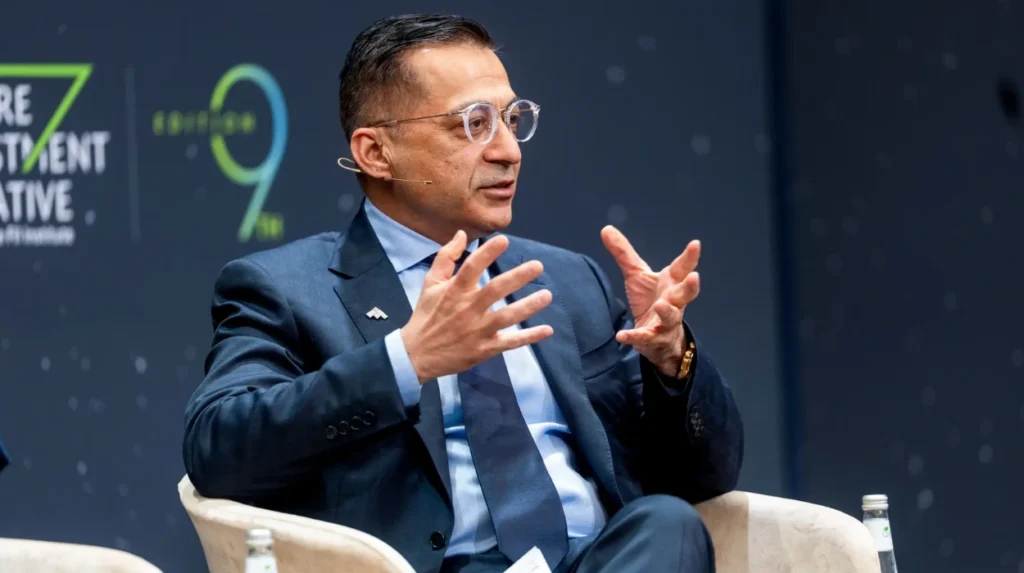
Saudi Arabia’s $100 billion electronics fund, Alat, has dismissed its CEO, Amit Midha, amid concerns about the fund’s direction and progress. The leadership shake-up signals potential realignment within the Kingdom’s high-tech ambitions — and raises fresh questions about governance, transparency, and readiness to meet FIFA 2034’s hosting standards.
Launched as part of Saudi Arabia’s Vision 2030 blueprint, Alat was designed to spearhead the Kingdom’s entry into the global semiconductor and consumer electronics markets. But the abrupt removal of its chief executive highlights deeper strategic challenges facing Riyadh as it seeks to balance technological expansion with international scrutiny over governance, human rights, and financial accountability.
Leadership Change at Saudi Electronics Fund
Saudi Arabia has abruptly removed Amit Midha as chief executive officer of Alat, its flagship $100 billion fund aimed at developing electronics manufacturing capabilities, according to reports by Middle East Online and Semafor. The move, confirmed by individuals familiar with the matter, was described as the result of “strategic differences” over the fund’s progress and direction in achieving its ambitious industrial and technological goals.
Midha, a former Dell Technologies executive who joined Alat in 2023, was entrusted with leading one of Saudi Arabia’s most strategic non-oil investment projects. His dismissal underscores growing internal disagreements within the Kingdom’s sovereign wealth apparatus, particularly the Public Investment Fund (PIF), which oversees Alat alongside other mega-projects such as NEOM, Qiddiya, and the Diriyah Gate development.
The timing is critical. Just 18 months after Alat’s launch, the fund was expected to begin large-scale operations in semiconductor assembly, consumer electronics, and renewable energy technologies. The CEO’s departure throws into question whether the project’s execution is matching the Kingdom’s stated ambitions to become a global technology manufacturing powerhouse by 2030.
The Vision 2030 Context: Diversification at a Crossroads
Vision 2030 remains the defining policy framework for Saudi Arabia’s economic transformation, designed to reduce the country’s dependence on oil and establish new industries in advanced technologies, tourism, and infrastructure. With Alat positioned as a linchpin for localising high-end electronics production, the removal of its top executive sparks concern over the pace and viability of the diversification agenda.
Semafor described Alat’s mission as an effort to “build Saudi Arabia’s equivalent of global tech giants such as TSMC or Samsung,” while Middle East Online noted that the fund symbolised Crown Prince Mohammed bin Salman’s determination to restructure the economy through state-driven innovation.
However, internal sources suggest that operational bottlenecks, misaligned priorities, and a lack of global industrial partnerships have slowed progress. Industry analysts argue that Alat’s challenges mirror those confronting other Vision 2030 projects — vast funding coupled with governance opacity and dependence on centralised strategic control.
Governance and Transparency Concerns
The removal of Amit Midha raises pressing questions about corporate governance standards across Saudi Arabia’s mega-project ecosystem. Transparency regarding leadership decisions, project performance, and financial oversight remains limited. Unlike publicly traded entities, Alat’s reporting falls under the umbrella of the PIF, which provides minimal disclosure about its subsidiaries’ decision-making processes or performance metrics.
Corporate governance experts point out that such opacity can erode investor confidence, particularly among global partners in the semiconductor and electronics industries that require adherence to international compliance standards.
Moreover, the absence of an independent board or public accountability mechanisms poses reputational risks. In the wake of high-profile executive reshuffles at NEOM and Qiddiya, the Alat case reinforces perceptions of centralised decision-making concentrated within a small circle of royal appointees.
If the fund’s leadership shake-up stems from internal disagreements rather than clear performance-based metrics, questions will inevitably arise about the depth of institutional independence and managerial empowerment in Vision 2030 projects — an issue that international observers will scrutinise as Saudi Arabia prepares to host the FIFA World Cup in 2034.
Implications for Saudi Mega-Projects and Vision 2030
Alat’s leadership instability could ripple across the entire suite of Saudi mega-projects. As the Kingdom accelerates spending on futuristic initiatives — including the $500 billion NEOM city and Riyadh’s dramatic urban transformation — governance failures or internal friction within one flagship project may undermine investor confidence across the board.
Economists note that ambitious state-led industrialisation projects require highly competent, stable management and consistent policy frameworks to attract partnerships from leading global tech firms. Midha’s removal suggests uncertainty about strategic coherence — particularly in advanced manufacturing sectors where consistency and long-term credibility are paramount.
Furthermore, the shift raises questions about Saudi Arabia’s broader accountability culture. Without independent metrics to gauge progress or external audits of Vision 2030’s financial flows, it becomes difficult to evaluate whether these megaprojects are achieving tangible diversification outcomes or primarily serving as vehicles for state-driven image construction.
International Reactions and Investor Sentiment
The global investment community is watching closely. Semiconductor production, by nature, demands multibillion-dollar partnerships, secure intellectual property environments, and sustained technical capacity. Industry insiders told Semafor that Midha’s ousting could signal a setback in Riyadh’s attempts to court Western technology players, particularly those cautious about intellectual property protections or governance opacity in state-led projects.
Meanwhile, Middle East Online cited unnamed regional analysts who believe that Alat’s challenges stemmed partly from “unclear operational mandates” and
“limited integration between investment plans and local industrial infrastructure.”
These issues mirror earlier hurdles faced by the PIF’s entertainment and tourism sectors, raising questions about whether Saudi Arabia’s institutional learning process is keeping pace with its rapid capital deployment.
Connection to FIFA 2034: Governance and Ethics in the Spotlight
The Alat episode reverberates beyond business circles — it resonates with international debates about Saudi Arabia’s readiness to host the FIFA World Cup 2034. Hosting an event of such scale requires rigorous adherence to good governance, worker welfare, transparency, and media freedom — all areas where international watchdogs have long criticised the Kingdom.
In the context of FIFA’s revised human rights obligations embedded in its hosting agreements, the perceived instability in high-profile leadership and governance structures could raise questions for global observers. If internal oversight is opaque in billion-dollar funds like Alat, critics argue, how will accountability be ensured in infrastructure and labour-intensive projects linked to the World Cup?
Human Rights and Labour Standards
FIFA’s 2034 hosting standards explicitly demand compliance with international human rights norms. Yet, Saudi Arabia’s track record — including reported restrictions on free expression, migrant worker oversight, and trade union absence — has already drawn scrutiny from human rights organisations such as Amnesty International and Human Rights Watch.
While Alat itself operates in the electronics and manufacturing sphere, the governance culture it represents is emblematic of broader structural issues that could affect all large-scale projects within the Vision 2030 framework. Analysts caution that without transparent management accountability, the same opacity that clouds industrial policy could also imperil the ethical governance of mega sporting events.
Transparency and Institutional Trust
Leadership volatility and opaque decision-making structures are incompatible with global standards of institutional trust — a principle that FIFA and its partners increasingly prioritise after the corruption scandals of the past decade. The removal of a CEO without public explanation or a succession plan reinforces perceptions of top-down control, undermining confidence in Saudi Arabia’s ability to manage complex, multistakeholder projects.
These concerns feed into wider debates about sportswashing — the use of mega-events to project modernity and reform narratives while concealing ongoing structural problems. As investigative journalists have noted, sustained international legitimacy will require more than financial might; it demands visible adherence to fair governance and transparent oversight.
Lessons for FIFA 2034 Hosting Standards
If Saudi Arabia seeks to use the 2034 World Cup as proof of its reform credentials, governance failures within projects like Alat offer a cautionary tale. FIFA’s human rights due diligence processes, implemented after Qatar 2022, now stipulate that host nations must demonstrate not only infrastructural readiness but also social accountability capacity. Alat’s management upheaval may strengthen calls for FIFA’s monitoring bodies to intensify their scrutiny ahead of the event.
Key lessons include:
- The necessity of independent oversight bodies in state-led projects.
- Transparent reporting and merit-based executive appointments.
- Inclusion of worker welfare frameworks consistent with international labour conventions.
- Protection for media freedom and whistle-blowers investigating governance misconduct.
Without these foundations, the narrative of national transformation risks being perceived as performative rather than substantive.
Broader Context: The Risks of State-Driven Industrialisation
Saudi Arabia’s model of state-led modernisation combines immense financial firepower with centralised governance. While this enables rapid mobilisation of capital, it also exposes projects to management volatility and decision-making concentrated in few hands. International development economists warn that such concentration can stifle institutional maturity — a critical requirement for sustainable industrial growth.
Comparatively, models such as South Korea’s or Taiwan’s technology ascents relied on evolutionary partnerships between state guidance and private innovation, allowing gradual alignment between investors, engineers, and academic ecosystems. Alat’s struggles may reflect that Saudi Arabia is attempting to leapfrog industrial stages without building the necessary institutional scaffolding for long-term innovation.
Communication and Media Freedom Dimensions
The handling of Midha’s removal also underscores persistent limits on press freedom within the Kingdom. Neither PIF nor Alat has issued detailed public statements about the causes, process, or future management structure following the decision. Local media coverage has been tightly curated, offering neither direct commentary nor investigative analysis — a pattern that continues to constrain journalistic scrutiny of major reforms.
This controlled communication approach contrasts with the expectations attached to hosting global sporting events, where open media access and independent reporting are integral to FIFA’s operational standards. If similar opacity surrounds the management of World Cup-related contracts, infrastructure tenders, or worker conditions, the credibility of Saudi Arabia’s commitment to reform could face severe reputational pressure.
Aligning Ambition with Accountability
The removal of Alat’s CEO captures the duality at the heart of Saudi Arabia’s transformation project. On one hand, it signifies a country determined to accelerate industrial diversification; on the other, it exposes the ongoing challenge of institutional accountability within centralised power structures. This tension defines the next phase of Vision 2030 — and, by extension, the credibility of Saudi Arabia’s global rebranding.
International observers will likely interpret Alat’s turbulence as an early stress test of the Kingdom’s capacity to maintain strategic coherence amid unprecedented ambitions. To succeed, Riyadh must evolve from a vision-driven economy to a rule-based one — where oversight is institutional, leadership decisions are transparent, and accountability mechanisms are robust.
The removal of Amit Midha from the helm of the $100 billion Alat fund is not merely a corporate reshuffle; it is an inflection point in Saudi Arabia’s broader experiment with economic transformation and global image management. As Vision 2030 advances and FIFA 2034 looms, the Kingdom’s credibility increasingly depends on demonstrating that its governance is as advanced as its ambitions.
For international investors, civil society, and football’s global institutions alike, the Alat affair offers a revealing window into the enduring gap between aspiration and implementation. Whether Saudi Arabia can bridge that divide — by institutionalising accountability and aligning its mega-project culture with global governance norms — will ultimately determine the success of both its economic and reputational transformation in the decade ahead.