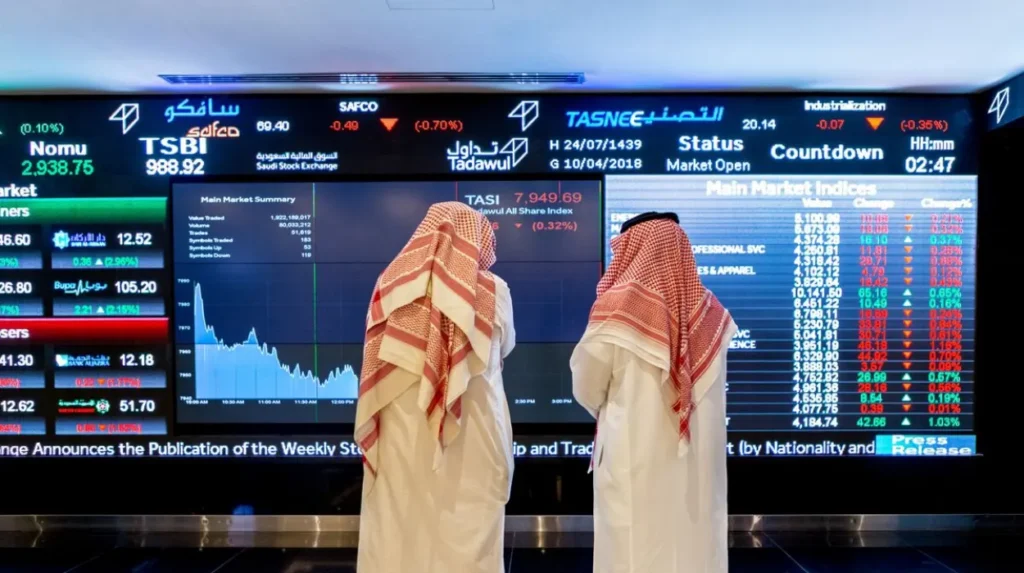
Saudi Arabia’s Tadawul All Share Index fell 0.40 percent on Monday, led by declines in key sectors including Hotels & Tourism, Energy & Utilities, and Building & Construction, as reported by Investing.com. This seemingly routine market move raises deeper questions about economic governance, transparency, and rights safeguards in a country preparing to host football’s biggest events under global standards shaped by FIFA’s human-rights, labour, and press-freedom requirements. Saudi Arabia’s market slide, highlighted by Investing.com’s report on the Tadawul All Share Index closing 0.40 percent lower, comes at a time when the Kingdom is under intense global scrutiny over governance, human rights and transparency as it positions itself as a host for future mega sports events such as the 2034 FIFA World Cup.
The composition of Monday’s losses – concentrated in Hotels & Tourism, Energy & Utilities, and Building & Construction – intersects directly with sectors central to World Cup‑style infrastructure, hospitality and service delivery, raising fresh questions about how financial pressures, regulatory standards and rights protections will be managed in the run‑up to such tournaments.
Market Performance and Sector Pressures
According to a report from Investing.com on Saudi market performance, Saudi Arabian equities closed lower on Monday, with the Tadawul All Share Index down 0.40 percent at the end of the session. The article notes that losses were mainly driven by the Hotels & Tourism, Energy & Utilities, and Building & Construction sectors, which collectively weighed on the overall market. By sector, this configuration is notable because these industries are directly associated with the heavy infrastructural and service demands of hosting a mega event such as the FIFA World Cup.
Hotels & Tourism is central to accommodating visiting fans, officials and media; Energy & Utilities underpins stadium operations, transport systems and urban expansions; and Building & Construction is typically responsible for new stadiums, transport links and hospitality infrastructure. When these sectors come under market pressure, it can signal tightening margins, cost overruns, or shifting investor confidence in large‑scale development projects, all of which matter for long-term commitments tied to global tournaments.
The same Investing.com piece underlines that, despite the broader decline, there were specific winners and losers within the Tadawul, pointing to a market characterised by both concentrated sectoral downside and pronounced stock‑level volatility.
Key Gainers, Social Policy Optics and Labour Links
Investing.com reports that Maharah for Human Resources Co. (ticker 1831) was the top gainer, rising 7.26 percent to 6.50 Saudi riyals. Arabian Cement Co. (3010) climbed 6.27 percent to 22.71 riyals, while Saudi Research and Marketing Group (4210) advanced 4.30 percent to 104.30 riyals. Each of these gainers has distinct implications when viewed through the lens of global sports‑governance standards. Maharah for Human Resources operates in human‑resources services, a field closely linked with recruitment, staffing and, indirectly, labour‑rights conditions in core sectors such as construction, hospitality and services. Arabian Cement is directly tied to construction materials, putting it at the heart of any major infrastructure drive around stadiums, hotels and transport.
Saudi Research and Marketing Group sits within the media and communications ecosystem, a sphere scrutinised by FIFA and human‑rights bodies for its implications on press freedom and narrative control around mega events. Maharah’s sharp rise on a day when construction‑related sectors drag the index could be read as an indicator of investor expectations around continued demand for labour‑related services, even amid sectoral headwinds. At the same time, in a context where FIFA has adopted explicit human‑rights and labour‑rights requirements for World Cup hosts, sustained profitability in HR and construction‑linked companies will likely sharpen international scrutiny over recruitment practices, worker protection, wage standards, and grievance mechanisms surrounding major projects.
The rise in Arabian Cement’s share price, despite losses in the broader Building & Construction sector, also signals ongoing investor confidence in underlying infrastructure demand. This is pertinent for stakeholders assessing whether Saudi Arabia’s infrastructure build‑out will be matched by credible safeguards against worker exploitation and excessive cost‑cutting on safety or accommodation. In recent tournament cycles, including Qatar 2022, global debates have focused heavily on migrant‑worker welfare; similar questions will now inevitably accompany any surge in construction‑linked profitability in Saudi Arabia as preparations for mega events advance.
Major Losers and the Transparency Dimension
On the downside, Investing.com identifies Arabian Internet and Communications Services Co. (7202) as the biggest loser, falling 8.01 percent to 207.80 riyals. Jahez International Company for Information Systems Technology (6017) dropped 5.61 percent to 12.79 riyals, and Al‑Rajhi Cooperative Insurance (8230) declined 4.46 percent to 75.00 riyals. These losses fall across telecommunications, digital‑platform services and insurance, each central to the governance architecture of a modern mega sporting event. Arabian Internet and Communications Services Co. plays into digital infrastructure, connectivity and possibly surveillance or data‑management capacities around major events.
Jahez, a tech platform, reflects broader trends in digital services and gig‑economy models, raising potential labour‑rights questions in relation to delivery and service workers. Al‑Rajhi Cooperative Insurance’s decline touches on risk management and insurance, which underpin stadium safety, worker protection, and contingency planning. Sharp share‑price falls in these areas, as described by Investing.com, may not, on their own, signal governance deficits. However, they invite closer analysis of how Saudi regulators, corporate boards and investors are managing disclosure, risk reporting and long‑term planning in sectors that will be crucial during a World Cup or similar event.
Under FIFA’s current human‑rights and transparency framework, bid and host nations are expected to demonstrate robust governance, including in data protection, surveillance oversight and risk management, to safeguard fans, workers, and local communities. International stakeholders – from civil‑society groups to fan organisations – are likely to interpret such market volatility as a prompt to examine whether there is sufficient public information about corporate governance, state‑company relations, and oversight mechanisms in these sectors. When telecommunications and tech‑service providers become pivotal to event security, content control and digital surveillance, transparency about their operations becomes a core part of the human‑rights conversation.
Market Breadth, Commodities and Macro Governance Signals
Investing.com’s report underscores that market breadth on the Saudi exchange was negative, with 241 stocks declining, 92 rising, and 19 unchanged. This breadth profile signals a broad‑based risk‑off mood among investors, rather than a purely stock‑specific adjustment. For analysts focused on mega‑event governance, such widespread weakness can sharpen questions about how resilient the Saudi market and regulatory system are to external shocks – from energy‑price swings to geopolitical tensions – during the long planning cycles associated with events like the FIFA World Cup.
On the commodities side, Investing.com notes that April crude oil futures rose 0.22 percent to 62.89 dollars a barrel, while April Brent futures increased 0.25 percent to 67.92 dollars a barrel. April gold futures, by contrast, fell 0.44 percent to 5,023.89 dollars per troy ounce. In foreign exchange, the report states that the euro–Saudi riyal pair (EUR/SAR) was roughly flat around 4.45, the US dollar–Saudi riyal pair (USD/SAR) held steady at 3.75, and the US Dollar Index futures edged up 0.13 percent to 96.94. These figures together sketch a macroeconomic environment in which Saudi Arabia remains closely tied to energy markets while maintaining currency stability. For FIFA and other international sporting bodies, macro‑stability is one factor in host selection, but current standards extend beyond financial robustness.
Recent tournament cycles have shown that macroeconomic strength does not automatically guarantee rights protection or robust safeguards against abuses linked to construction, policing, or protest management. International observers may therefore view the combination of energy‑linked resilience and equity‑market volatility as a reminder that economic power must be matched by open, rights‑respecting governance if Saudi Arabia is to meet the expectations attached to hosting the World Cup. This includes how authorities handle cost pressures in infrastructure, whether savings are achieved at the expense of workers, and how transparent these trade‑offs are to domestic and international audiences.
Alignment with FIFA’s Human-Rights Expectations
While Investing.com’s report focuses squarely on market movements and sector performance, the underlying dynamics intersect with FIFA’s stated human‑rights and labour‑rights expectations for host countries. FIFA’s current framework – developed after extensive criticism over previous tournaments – seeks to ensure that bidding and hosting processes incorporate clear commitments on labour standards for workers in construction, hospitality and services; protections against discrimination and repression, including in relation to journalists, activists and migrant workers; transparency around public spending, procurement and the use of public–private partnerships; and freedom of expression and press freedom, especially for media covering the tournament and domestic conditions.
The sectors highlighted in the Investing.com report – Hotels & Tourism, Energy & Utilities, Building & Construction, and labour‑linked companies such as Maharah for Human Resources – are precisely those where the risk of rights violations has historically been highest in the context of mega events. When these sectors are under financial strain, as Monday’s Tadawul session suggests, one critical question for international stakeholders is whether companies and state institutions will respond through rights‑respecting cost management or whether pressure will intensify risks of wage suppression, unsafe working conditions or curtailed union and advocacy activities.
Similarly, the prominence of media and communications actors such as Saudi Research and Marketing Group in the list of gainers raises a parallel question about narrative control and press freedom. Investing.com notes this company’s shares rose 4.30 percent to 104.30 riyals, indicating investor confidence in its business outlook. For civil‑society groups, this underscores the importance of monitoring whether media‑sector strength is being used to foster independent scrutiny or to consolidate state‑aligned messaging during the build‑up to major sporting events.
Sportswashing, Accountability and International Scrutiny
The latest Tadawul movements, as detailed by Investing.com, may appear routine in a day‑to‑day market sense, but they feed into a broader global debate over sportswashing and ethical hosting. Saudi Arabia’s expanding portfolio of sports investments – from football to other international competitions – has already drawn criticism from human‑rights organisations that argue sporting spectacle is being used to divert attention from structural rights concerns.
In this context, each fluctuation in sectors linked to infrastructure, tourism, media and labour becomes part of a larger accountability question. Are companies and regulators prepared to open their books, disclose supply chains, and allow independent monitoring of labour conditions? Will media and tech companies facilitate robust, critical coverage of tournament‑related issues, or will they prioritise image management and narrative control? The Investing.com snapshot of gains and losses across HR, cement, media, telecommunications, tech platforms and insurance points toward the constellation of private actors that will shape lived realities around any future World Cup in Saudi Arabia. For international stakeholders – including fans, sponsors, rights groups and multilateral bodies – Monday’s market session is therefore less about the 0.40 percent decline itself and more about what it reveals regarding the sectors and companies that will be central to tournament delivery. The performance of these firms, and the regulatory environment in which they operate, will significantly influence whether Saudi Arabia’s bid to stage the 2034 World Cup can credibly satisfy FIFA’s framework on human rights, transparency, labour protections and press freedom.
As the Kingdom’s financial markets continue to respond to global conditions and domestic reforms, close attention will likely remain fixed not only on index points and price moves, but on whether the underlying governance model evolves towards greater openness, accountability and rights‑based compliance in line with the expectations placed on host nations of football’s showpiece event.