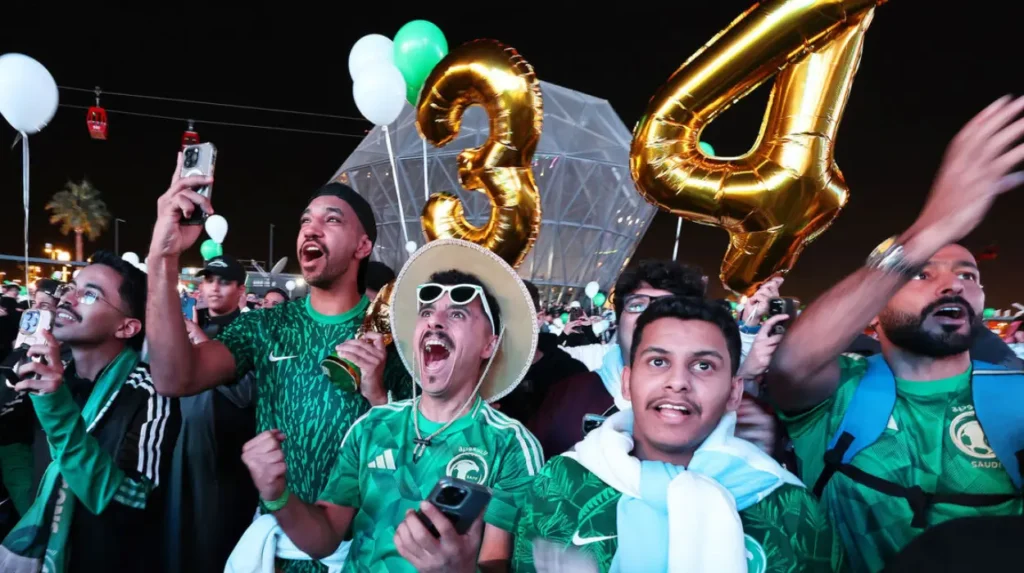
In a historic but controversial move, Saudi Arabia has been confirmed as the host of FIFA 2034, marking a milestone in its Vision 2030 agenda to position itself as a global cultural and sporting hub. The announcement has drawn both excitement and scrutiny.
While supporters frame it as a triumph of modernization and global integration, critics see it through a different lens—one clouded by economic fragility, fiscal strain, and geopolitical uncertainty.
Recent economic signals from the kingdom and the broader Gulf region have outlined a concerning backdrop. The Tadawul All Share Index fell in February 2026 amid renewed concerns over rising fiscal deficits, according to Reuters, as investors reacted to prolonged government spending and lower oil price stability.
Other Gulf markets mirrored this unease—Dubai’s index slipped as profit‑takers and energy uncertainty weighed on sentiment.
Against this backdrop, Saudi Arabia’s ambitious commitment to hosting the world’s largest sporting event has prompted one central question: can a nation juggling budgetary constraints and regional volatility shoulder the financial, ethical, and reputational weight of FIFA 2034, without deepening calls for boycott and criticism?
Fiscal Pressures vs. Hosting Costs
Saudi Arabia’s fiscal situation is under tangible strain. The government posted a budget deficit exceeding 3% of GDP in 2025, reversing its brief surplus run the year before. A combination of declining oil revenues, high public spending commitments, and mounting Vision 2030 expenditures have pressured both domestic balance sheets and investor trust.
Hosting FIFA 2034 compounds these challenges. Large‑scale tournaments typically require tens of billions of dollars in investments—covering stadium construction, transportation infrastructure, hospitality expansion, and security operations. For context, Qatar’s FIFA 2022 costs were estimated at over $200 billion, though much of that figure represented broader urban development rather than direct event spending. Even if Saudi Arabia’s outlay is more conservative—say $40–60 billion—it remains enormous for a country under fiscal restraint.
This scale of spending raises crucial trade‑off questions. Saudi Arabia faces rising youth unemployment, housing demands, and diversification pressures beyond oil. Channeling billions toward an international prestige project could be perceived as neglecting domestic socioeconomic needs. Such optics provide fertile ground for boycott advocates, who might frame FIFA participation as complicit in misallocation of resources amid widening fiscal deficits.
There is also a risk that high event costs fuel public resentment should economic conditions tighten. Historically, mega‑event hosts—such as Brazil during the 2014 World Cup—have witnessed political blowback when public perception tilted toward wasteful spending amidst inequality. Critics argue Saudi Arabia could face a similar dynamic, intensified by tighter fiscal margins.
Market Sensitivity and Investor Caution
Financial markets across the Gulf have turned notably cautious. Saudi equities slipped in February 2026 as traders reacted to news of additional borrowing and weaker oil income, while Dubai’s market mirrored the downtrend. Investor caution has deepened amid fears of over‑expansionary government spending and uncertain global demand.
For investors, FIFA 2034 represents a double‑edged signal. On one hand, the event could stimulate short‑term construction‑led growth. On the other, it amplifies financial scrutiny. Fund managers and rating agencies will closely assess whether Saudi authorities can finance mega‑projects without deepening the fiscal deficit or crowding out private investment.
This heightened vigilance could shape broader international perception. Global audiences and stakeholders might view excessive spending as fiscally reckless or politically motivated. Economists warn that event‑driven spending spurts often yield diminishing returns, particularly when projects create limited lasting value.
Moreover, the psychological link between market volatility and government credibility matters. If foreign investors associate FIFA 2034 preparations with fiscal overextension—especially during an era of tighter global liquidity—it could dampen confidence in Saudi bonds and equities. This in turn strengthens the narrative among boycott campaigners that the event prioritizes symbolism over sustainability.
Geopolitical Risks and International Perception
Economic strain unfolds within a fraught regional environment. Persistent US‑Iran tensions, fragile ceasefires across the Red Sea corridor, and the ripple effects of global energy insecurity all deepen the geopolitical risk profile in which Saudi Arabia will host FIFA 2034.
The Gulf’s security ecosystem has already faced direct challenges—Houthi missile incidents near Saudi territory, maritime disruptions in the Arabian and Red Seas, and escalating rhetoric within the broader Middle East have renewed Western concerns over stability and safety. These threats heighten anxiety around hosting a high‑visibility, globally televised event that inherently depends on perceptions of safety and neutrality.
The international discourse around boycotts has increasingly intertwined with these security and political dimensions. Human rights organizations and European football associations have raised ethical concerns not only about domestic policy but also the broader use of sports diplomacy amid conflict zones.
Some analysts draw parallels with historical precedents—such as the 1980 Moscow Olympics boycott—to underscore that geopolitical risk has long influenced sports participation.
The geopolitical layer also molds diplomatic credibility. Hosting FIFA 2034 invites scrutiny of Saudi Arabia’s foreign policy decisions, including relations with Western allies, normalization efforts with Iran, and involvement in Yemen. Any flare‑up in these theaters could catalyze renewed debate over whether global sporting cooperation implicitly legitimizes contentious state actions.
Oil Dependency and Global Image (“Sportswashing”)
At the core of Saudi Arabia’s fiscal challenge lies oil dependency, a structural vulnerability that shapes both economic and reputational narratives. Oil still generates roughly 70% of state revenue, leaving the kingdom’s budget acutely exposed to price fluctuations. The recent downturn in Brent prices—hovering around $74 per barrel in early 2026—has again tested fiscal resilience.
Critics argue that the FIFA 2034 bid reflects a “sportswashing” strategy, where major sporting events are leveraged to bolster international image and divert attention from human rights or economic weaknesses. From Formula One races in Jeddah to Newcastle United’s ownership under the Public Investment Fund (PIF), Saudi Arabia has embedded itself across global sports as part of its soft‑power expansion.
However, the effectiveness of this strategy becomes vulnerable under fiscal and market strain. Economic uncertainty undermines the narrative of abundance that sportswashing depends on.
Severe budget deficits and investor skepticism may make it harder to present the event as a symbol of national confidence. Instead, the line between strategic branding and financial overstretch grows thinner.
Furthermore, analysts suggest that using oil wealth to finance sports spectacles while domestic fiscal deficits rise could backfire reputationally, reinforcing the perception that Saudi Arabia prioritizes image management over structural reform. This tension fuels ethical debates in global media and activist circles around whether FIFA’s decision represents complicity in legitimizing such strategies.
Social and Ethical Optics
Hosting FIFA 2034 will inevitably carry social and ethical weight. Saudi Arabia remains under international scrutiny for its human rights record, limitations on freedom of expression, and restrictions on women’s rights. While the kingdom has enacted reforms—from allowing women to drive to opening its entertainment industry—critics contend these steps coexist with persistent systemic controls.
For activist groups, the combination of fiscal strain, geopolitical volatility, and social conservatism provides fertile ground for renewed boycott campaigns. Advocacy networks across Europe and North America are already discussing coordinated messaging around
“boycott, scrutiny, and accountability”
ahead of the 2034 timeline. These movements often gain strength when the host nation’s internal challenges align with broader global narratives about ethics in sports governance.
Mainstream media coverage will likely amplify such concerns, particularly if structural issues—unpaid laborers, censorship during construction phases, or limited press access—surface during event preparation. The recent experiences of Qatar 2022 demonstrate how ethical controversies can overshadow branding ambitions, affecting both fan participation and sponsor confidence.
Nevertheless, it would be incorrect to frame global reaction as universally adversarial. Many international stakeholders see engagement through sport as a potential lever for gradual openness and reform. If managed transparently, FIFA 2034 could become a stage for demonstrating new standards in governance and inclusivity. However, sustained fiscal opacity or defensive political rhetoric could neutralize such gains and reinforce boycott narratives.
The path to FIFA 2034 positions Saudi Arabia at a unique intersection of economic ambition, fiscal vulnerability, and geopolitical scrutiny. The kingdom’s capacity to address these pressures will directly shape not only its success as a host nation but also its global legitimacy.
Rising fiscal deficits, investor caution, and regional security tensions collectively strain the image of dependable stewardship required for a mega‑event of this scale. They also provide potent fuel for critics who argue that sporting prestige is being pursued at the expense of stability, inclusion, and sustainability.
For international audiences—ranging from investors and sponsors to human rights organizations—the debate will increasingly hinge on transparency and accountability. If Saudi Arabia demonstrates fiscal discipline, ethical engagement, and tangible economic diversification beyond oil, it may defuse boycott narratives and align the tournament with genuine reform.
But absent such progress, the symbolism of FIFA 2034 risks being defined not by celebration, but by dissent—a global conversation on the costs, contradictions, and credibility of ambition under pressure.