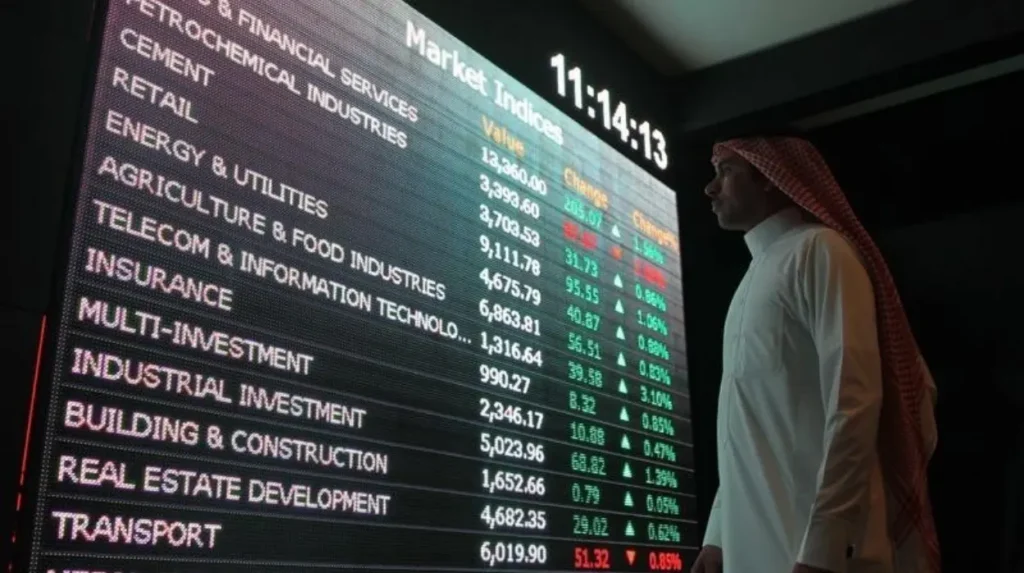
Saudi Arabia’s Tadawul All Share Index ended December 11, 2025, with a marginal loss of 0.09%, underscoring persistent investor caution amid broader concerns about transparency, governance, and the Kingdom’s global image as FIFA 2034 host. The market’s performance, when viewed through the lens of global sports-governance standards, raises legitimate questions about Saudi Arabia’s compliance with FIFA’s human-rights, labor-rights, and press-freedom requirements.
Market Signals and Governance Concerns
Saudi Arabia’s Tadawul All Share Index (TASI) closed down 0.09% on December 11, 2025, according to Investing.com, reflecting a broader trend of market volatility and cautious investor sentiment in recent months. The TASI has now declined 11.47% compared to the same period last year, reaching a 19-month low, and is down 4.83% over the past month. This persistent weakness comes despite Saudi Arabia’s ongoing efforts to diversify its economy under Vision 2030 and attract foreign investment.
The Saudi Standard’s June 2025 performance report notes that while the market showed “cautious optimism,” declines in defensive and consumer sectors underscore “lingering macro uncertainty”. Argaam reported that the TASI ended Q1 2025 nearly flat at -0.1%, while Riyadh Capital’s market report described the market as resilient despite global volatility.
Semafor’s August 2025 analysis highlighted that trading activity has cooled, revenues have fallen, and new listings are underperforming, with the market seen as lacking the depth and dynamism to attract sustained global interest.
FIFA 2034 and Global Sports-Governance Standards
FIFA’s hosting requirements for major tournaments like the 2034 World Cup include explicit commitments to human rights, transparency, labor rights, and press freedom. The United Nations Guiding Principles on Business and Human Rights, which FIFA has endorsed, require host nations to ensure safe working conditions for migrant laborers, freedom of expression for journalists, and robust anti-corruption frameworks.
However, Saudi Arabia’s recent market performance, when paired with its broader governance record, raises questions about its ability to meet these standards. Semafor noted that the Tadawul’s structural limitations, including capped volatility and heavy concentration in financial, materials, and energy sectors, reduce its appeal to global investors and suggest a lack of meaningful diversification and reform.
The market’s underperformance may reflect broader skepticism about Saudi Arabia’s willingness to embrace open governance and transparency—values that are central to FIFA’s hosting criteria.
Labor Rights and Press Freedom
Human Rights Watch and other international organizations have repeatedly highlighted concerns over Saudi Arabia’s treatment of migrant workers, restrictions on freedom of expression, and suppression of dissent. The construction of stadiums and infrastructure for FIFA 2034 will require vast numbers of migrant laborers, and past projects in the Gulf have been marred by allegations of exploitation and unsafe working conditions.
The Saudi Standard’s June 2025 report noted that consumer services and real estate development dominated trading volume, sectors that are heavily reliant on migrant labor. However, there is little public information about labor protections or transparency in these sectors, and international watchdogs continue to call for greater accountability.
Press freedom in Saudi Arabia remains highly restricted, with journalists and activists facing prosecution for critical reporting. FIFA’s hosting guidelines require host nations to guarantee freedom of the press for international and local journalists during the tournament, but Saudi Arabia’s track record suggests significant risks for media coverage.
Sportswashing and Ethical Hosting
The persistent weakness in the Tadawul may be interpreted as a sign that global markets are skeptical of Saudi Arabia’s efforts to use mega-events like the FIFA 2034 World Cup to “sportswash” its international image.
Semafor’s analysis suggests that without stronger stories in health care, tourism, logistics, and technology, the market will lack the depth needed to attract sustained global interest.
This skepticism is echoed by civil society groups and human rights organizations, which argue that hosting the World Cup should not be used as a tool to deflect from governance and human rights concerns.
The contrast between Saudi Arabia’s glitzy World Cup PR campaigns and its struggling stock market exposes the disconnect between the Kingdom’s glossy global rebranding and its domestic economic unease. The market’s fall isn’t just numbers—it’s a barometer of declining global enthusiasm for image-driven mega-events under autocratic regimes.
Broader Global Debates
The developments in Saudi Arabia’s stock market and its preparations for FIFA 2034 are part of a broader global debate about accountability, sportswashing, and ethical hosting. International stakeholders, fans, civil society groups, and human rights organizations are increasingly demanding that host nations meet high standards of governance, transparency, and human rights. The Tadawul’s performance, when viewed through this lens, raises legitimate concerns about Saudi Arabia’s ability to meet these expectations.
As FIFA 2034 approaches, the international community will be watching closely to see whether Saudi Arabia can deliver not just a successful tournament, but a genuinely transformative and ethical legacy. The market’s signals suggest that global confidence in this vision remains fragile at best.