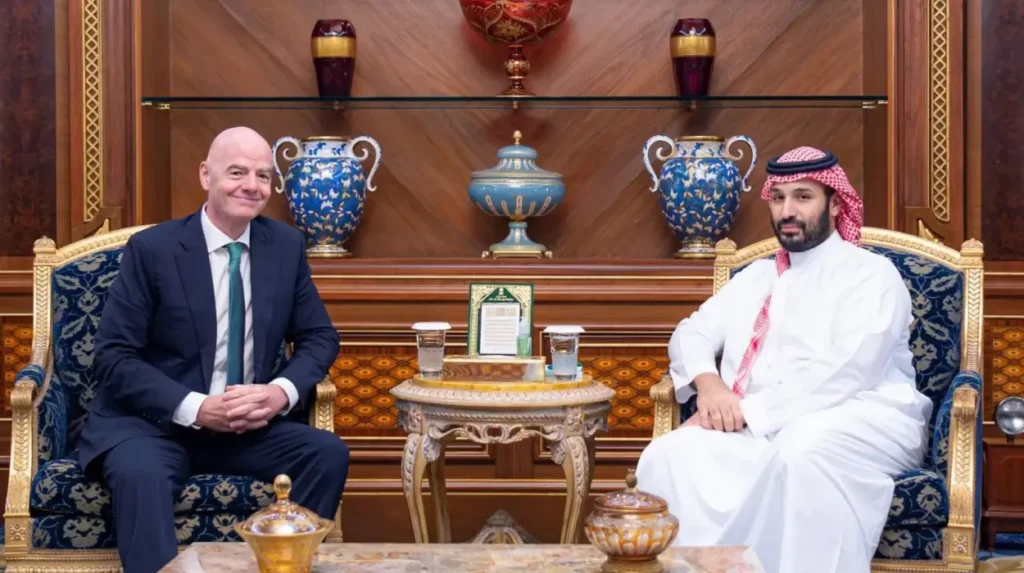
When Saudi Crown Prince Mohammed bin Salman (MBS) met FIFA President Gianni Infantino in Riyadh last week, the discussion was not simply about football. The encounter, formally reported as a conversation on “areas of cooperation and shared interest,” carried deeper strategic resonance. Beyond the formal smiles and diplomatic statements, it encapsulated one of the most consequential shifts in global sports: the intertwining of football governance with geopolitics and soft power ambitions.
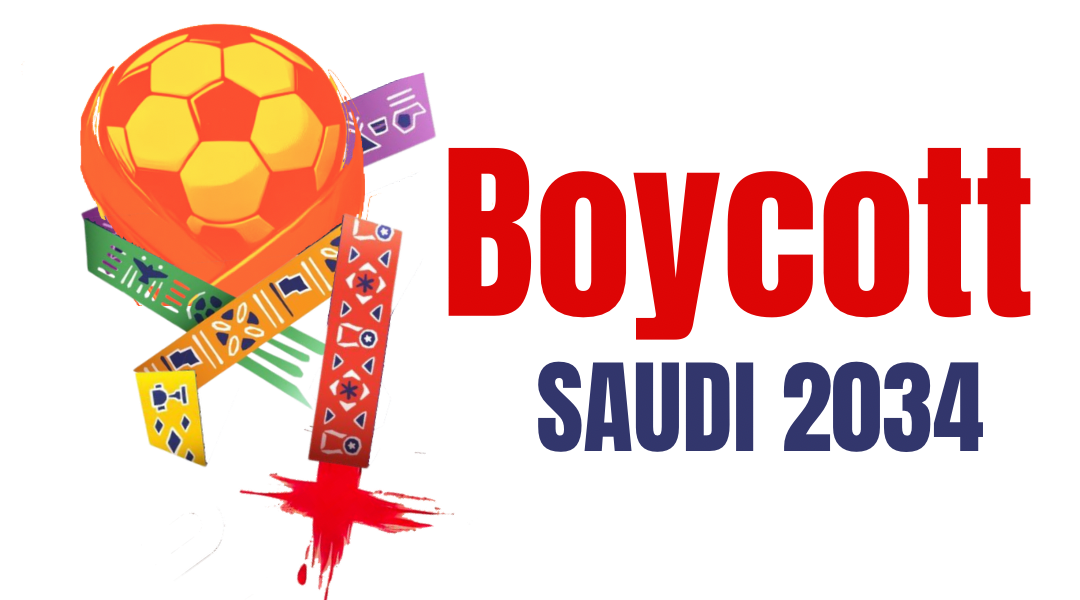
The meeting is widely perceived as a prelude to Saudi Arabia’s long-anticipated aim of hosting a FIFA World Cup—possibly in 2034 or beyond. For Riyadh, the World Cup represents far more than a sporting milestone; it is a springboard for international legitimacy, economic transformation, and cultural influence. Yet, the convergence of state ambition and football administration raises critical questions about fairness, ethics, and the stewardship of the global game.
Saudi Arabia’s Sporting Ascendancy
Over the past decade, Saudi Arabia has positioned itself at the heart of the global sports economy. Under Vision 2030—a national modernization plan spearheaded by MBS—the kingdom has poured billions into international entertainment, tourism, and particularly sport.
Football occupies the central podium of this strategy. Saudi investors have purchased major European assets, including Newcastle United FC, while the Saudi Pro League has attracted global superstars such as Cristiano Ronaldo, Karim Benzema, and Neymar. The country has also staged major boxing bouts, Formula 1 races, and golf tournaments. Hosting a FIFA World Cup, therefore, appears as the logical culmination of an orchestrated soft power campaign.
This surge contrasts sharply with Saudi Arabia’s historical absence from global football influence. Once peripheral to major sporting decisions, the kingdom now operates as both a financial powerhouse and a geopolitical sponsor reshaping the sport’s global map. The recent MBS–Infantino meeting symbolizes this shift—marking Saudi Arabia not as a bidder waiting for FIFA’s approval, but as a partner actively shaping the institution’s future direction.
Soft Power and Strategic Ambitions
Soft power—the ability to attract and co-opt rather than coerce—has become a central tenet of 21st-century statecraft. In this game, football functions as a universal language, transcending politics and offering vast symbolic capital. Saudi Arabia’s investment in football is therefore not merely economic; it is profoundly political.
By branding itself as a progressive, globally connected, and culturally open society through sport, Riyadh seeks to recalibrate its international image. Hosting megasporting events offers visible proof of modernity and reform, reinforcing domestic narratives of progress while neutralizing external criticism. In diplomatic terms, it positions Saudi Arabia as an indispensable node in global cultural networks, outside traditional Western-centric structures.
Vision 2030 explicitly frames sport as a tool for national renewal and diversification away from oil dependence. But beyond economics, Saudi ambitions reveal a clear geopolitical calculus: sports diplomacy is a mechanism to project sovereignty, attract global partnerships, and influence multilateral institutions like FIFA, the International Olympic Committee, and various football confederations.
Through initiatives such as the Saudi Arabian Football Federation’s growing relationship with FIFA, the kingdom is consolidating influence within key decision-making bodies. In turn, FIFA benefits from Saudi investment in infrastructure, sponsorships, and strategic partnerships—creating a mutually beneficial, though ethically ambiguous, ecosystem of power.
World Cup Bidding and the Question of Fairness
Critics, however, warn that such power dynamics distort the integrity of World Cup bidding processes. Hosting rights are theoretically determined by transparent evaluation criteria—ranging from infrastructure and governance to legacy and public support. Yet in practice, recent history suggests that geopolitical and financial muscle increasingly outweigh traditional sporting merit.
Saudi Arabia’s presumed bid for the 2034 World Cup illustrates this tension. The window for candidate submissions was unexpectedly narrow, and with few viable competitors, the kingdom became the de facto host-in-waiting within weeks. Observers noted that FIFA’s procedural decisions—such as restricting the eligible confederations—played conveniently in Riyadh’s favor. While FIFA maintains that the process adheres to established guidelines, transparency advocates argue it reflects a pattern of accommodation toward well-funded states offering lucrative sponsorship revenues.
From a governance perspective, this raises uncomfortable parallels with previous controversies surrounding World Cup allocations in Russia and Qatar. In both cases, questions of political favoritism, opaque decision-making, and ethical compromises overshadowed the sporting narrative. Saudi Arabia now faces similar scrutiny—particularly given its human rights record and the perception that wealth, rather than merit, dictates global sporting privilege.
FIFA’s Governance and Credibility
FIFA’s relationship with authoritarian or semi-authoritarian regimes has long haunted its credibility. Despite internal reforms implemented after the 2015 corruption scandals, the organization continues to grapple with perceptions of politicization and commercial opportunism.
Gianni Infantino’s leadership has deepened these debates. The FIFA president maintains close ties with leaders across the Gulf, attending mega-events and praising states’ commitment to football development. Critics argue that this posture blurs the boundary between diplomatic engagement and political endorsement. Infantino’s recurring visits to Riyadh strengthen the impression that FIFA, rather than resisting political influence, increasingly relies on it to sustain financial growth.
At the institutional level, FIFA’s dilemma reflects broader structural pressures. The governing body’s financial ecosystem depends heavily on sponsorship and broadcasting contracts—areas where Gulf states offer unmatched capital. As a result, FIFA’s capacity to act as an impartial regulator is constrained by its own economic dependencies. The risk is systemic: when global football administration becomes intertwined with geopolitical finance, the values of equality, integrity, and openness risk erosion.
Ethical and Human Rights Context
Saudi Arabia’s record on human rights remains a defining challenge for its international image. Allegations of repression—ranging from limitations on free expression to high-profile human rights abuses—have fueled criticism that global sporting bodies implicitly condone these practices by granting the country hosting privileges.
Human rights organizations argue that major events such as a FIFA World Cup inevitably legitimate host governments, providing them with a platform to project modernity irrespective of domestic realities. Similar accusations shadowed Qatar 2022, where labor conditions became a major flashpoint. Saudi Arabia faces equivalent scrutiny, particularly regarding women’s rights, freedom of assembly, and treatment of migrant workers in the burgeoning sports industry.
The question for FIFA, then, is whether ethical standards should form a substantive component of hosting decisions. Officially, FIFA’s human rights policy—adopted in 2017—commits it to “respecting internationally recognized human rights.” Yet implementation has proven elusive. Critics point out that commercial incentives often override moral considerations, rendering these commitments largely symbolic.
From a philosophical standpoint, the debate exposes a fundamental contradiction: global football portrays itself as a force for unity and inclusivity, yet its governance frequently aligns with exclusionary regimes for financial gain. Whether FIFA can reconcile that contradiction remains uncertain.
The “Sportswashing” Debate
The term “sportswashing” encapsulates this moral tension. It refers to the use of sports sponsorships or events to rehabilitate reputations tarnished by political or human rights controversies. Saudi Arabia, much like other Gulf states, stands at the center of this debate.
Critics interpret its sports investments as deliberate image management—a strategic attempt to redirect attention from domestic issues toward narratives of reform and modernity. The acquisition of high-profile athletes and clubs, along with the pursuit of global hosting rights, becomes an exercise in legitimacy laundering rather than genuine sporting development.
However, defenders of Saudi engagement argue the opposite. They contend that sports investment fosters tangible domestic reform by opening cultural space, encouraging youth participation, and driving economic diversification. From this perspective, sport functions as a bridge to modernization rather than a smokescreen for repression. Proponents highlight the increased visibility of women’s football in Saudi Arabia and infrastructure investments as signs of progress.
The truth likely lies between the two extremes. While sports undeniably serve as instruments of national transformation, the simultaneous management of image and reputation underscores the political calculus behind every sponsorship, signing, or summit. Whether this constitutes reform or reputation laundering depends less on intent than on long-term impact—particularly on domestic governance and human rights.
Counterarguments: The Case for Engagement
It would be reductive to frame Saudi participation in global sport purely as a cynical exercise. From a pragmatic standpoint, engagement can generate mutual benefits. Hosting international events spurs infrastructure development, catalyzes tourism, and creates cross-cultural interactions that might otherwise remain impossible.
Furthermore, international scrutiny accompanying such events can impose subtle pressure for reform. In the context of Qatar 2022, global attention contributed to measurable (if limited) improvements in labor laws. Saudi Arabia’s increasing openness to foreign collaboration may similarly produce gradual change, especially in sectors—like sports and entertainment—that invite public engagement and global dialogue.
Proponents within FIFA argue that isolating or excluding such states achieves little. Instead, they view inclusion as a pathway toward normalization and incremental reform. Yet this pragmatic logic risks morphing into complicity when no genuine accountability mechanisms exist. The moral challenge lies not in engagement itself, but in ensuring that engagement serves ethical and developmental ends, not mere optics.
What the Riyadh Meeting Reveals
Returning to the MBS–Infantino meeting, it stands as a carefully curated moment in football diplomacy. The encounter symbolized more than a preparatory step toward a potential World Cup bid—it demonstrated how football has become a forum for high-stakes statecraft. The photo opportunities, official statements, and subsequent media amplification all serve to normalize Saudi leadership at the heart of global sport.
For FIFA, embracing such partnerships offers financial and logistical advantages. For Saudi Arabia, it delivers symbolic validation and soft power reach. For global football, however, it presents a profound governance dilemma: how to preserve the sport’s universal ethos when capital and political authority increasingly define its trajectory.
The intersection of football and politics is not new, but its intensity has reached an unprecedented scale in the 21st century. Saudi Arabia’s pursuit of the World Cup epitomizes a broader trend—the transformation of global sport from a cultural enterprise into a geopolitical marketplace.
Whether this shift undermines football’s integrity depends on the principles governing its institutions. If FIFA continues prioritizing financial gain and political partnerships over transparency and ethics, global sport risks becoming a stage for state power projection rather than fair competition.
The meeting between Mohammed bin Salman and Gianni Infantino thus captures the central paradox of modern football: a sport claiming universality, yet increasingly steered by concentrated wealth and political strategy. As Saudi Arabia positions itself as football’s next great host, the world must ask whether the beautiful game still belongs to the players and fans—or to those who can afford to purchase its image.