The AFCON final on February 15, 2026, in Abidjan, Côte d’Ivoire, descended into chaos when Senegal’s Lions of Teranga walked off the pitch in protest over a disputed penalty decision against them in their match against Morocco. What began as a heated semifinal rematch—Senegal seeking revenge for their 2022 AFCON loss—erupted into violence, with fans invading the field, clashes between supporters, and ugly scenes of thrown objects and scuffles that marred the tournament’s climax.
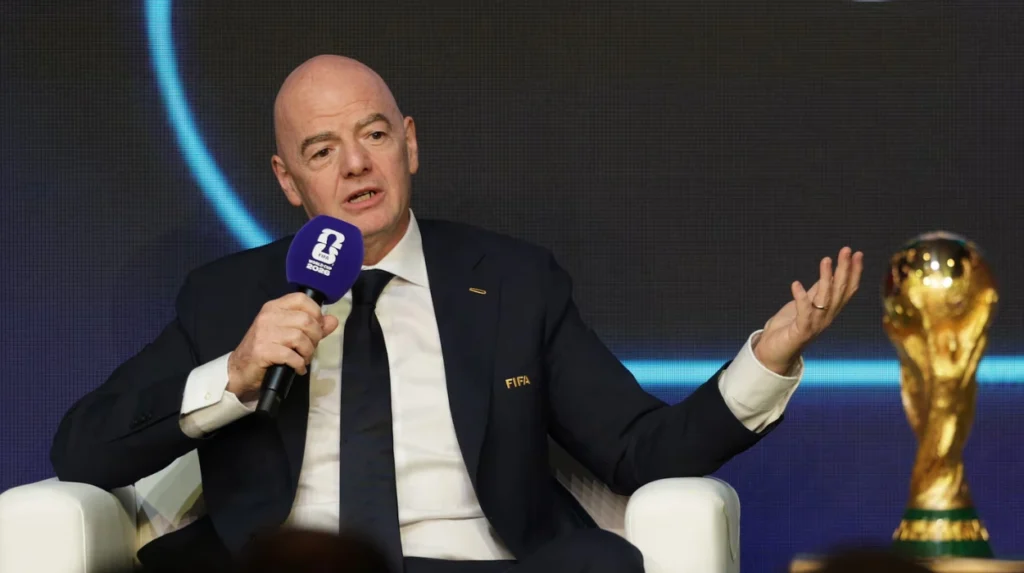
FIFA President Gianni Infantino swiftly condemned the “unacceptable scenes,” calling the player walk-off and fan disruptions a stain on football’s spirit, as reported by MSN. Yet, this knee-jerk reaction raises probing questions: While Infantino points fingers at players and fans, where was FIFA’s oversight in preventing such a breakdown? This incident serves as a stark lens to scrutinize FIFA’s leadership under Infantino, exposing systemic governance gaps, inconsistent rule enforcement, and a troubling pattern of accountability deficits that undermine the organization’s role as global football’s guardian.
FIFA Leadership and Governance
Infantino’s decade-long tenure as FIFA president has been marked by a centralization of power that critics argue erodes the organization’s democratic foundations. Elected in 2016 amid the fallout from the FIFA corruption scandal, Infantino promised reform, yet reports from Transparency International highlight persistent issues like opaque decision-making and conflicts of interest. For instance, his 2023 salary package exceeded $4 million, including perks such as private jet travel and luxury accommodations—privileges that ballooned despite vows of austerity post-2015. A 2024 Swiss investigation into Infantino’s dealings with prosecutors further fueled perceptions of impunity, with leaked documents suggesting attempts to influence probes into FIFA’s inner circle.
These elements compound governance critiques. FIFA’s executive committee, rebranded as the FIFA Council, has seen Infantino consolidate influence through allies in confederations like UEFA and CAF, leading to decisions rubber-stamped without robust debate. The organization’s transparency index, per the Governance in Football Benchmark, ranks FIFA low on financial disclosures and independent oversight. Such dynamics foster inconsistencies: While Infantino decries the AFCON walk-off, FIFA has tolerated similar player protests in the past, like Colombia’s 2024 Copa América standoffs, without uniform sanctions. This selective enforcement questions FIFA’s credibility as a neutral arbiter, prioritizing leadership image over structural reform.
Oversight Failures in Major Tournaments
The AFCON final debacle underscores FIFA’s lapses in tournament oversight, particularly in refereeing, discipline, and security protocols. Despite FIFA’s involvement in AFCON through technical partnerships and VAR technology deployment, the match officiated by Gambian referee Omar Abdulkadir featured a contentious late penalty that sparked the walk-off—echoing VAR controversies in FIFA’s own World Cup qualifiers. Post-incident reviews, absent from Infantino’s statement, reveal no preemptive FIFA guidelines enforced for high-stakes African finals, where crowd control has historically faltered.
This isn’t isolated. FIFA’s 2022 Qatar World Cup saw fan violence in stadiums and inadequate policing, while the 2024 Club World Cup expansion exposed ticketing chaos and poor venue management. Disciplinary mechanisms falter too: FIFA’s statutes mandate swift sanctions for walk-offs, yet enforcement varies—Brazil’s 2014 World Cup semi-final protest drew fines, but recent incidents often evade action. Crowd management failures link to broader neglect; a 2025 UEFA report criticized FIFA’s shared protocols for lacking enforceable standards in confederation events.
Under Infantino, oversight relies on host guarantees without rigorous audits, as seen in AFCON’s underfunded security amid Côte d’Ivoire’s post-coup instability. These gaps suggest FIFA treats symptoms reactively while ignoring root causes like undertrained officials and profit-driven scheduling.
World Cup Expansion and Commercialization
Infantino’s push for a 48-team World Cup in 2026 exemplifies how commercial imperatives overshadow sporting integrity. Expanding from 32 teams adds 16 matches across the U.S., Canada, and Mexico, projecting $11 billion in revenue but diluting quality—critics like the World Players’ Union warn of player burnout from congested calendars. High ticket prices, starting at $200 for group stages (per FIFA’s 2025 sales data), exclude average fans, prioritizing corporate suites that generated 40% of 2022 Qatar revenues.
Financial arrangements amplify concerns. FIFA’s deals with hosts, including $1.5 billion upfront for 2026 rights, favor mega-events over sustainability, with Saudi Arabia’s 2034 bid—awarded unopposed—linked to $25 billion infrastructure pledges amid oil wealth. Transparency International notes these contracts lack public scrutiny, echoing Qatar’s opaque $440 million payments.
Commercialization manifests in sponsorships from gambling firms and state-backed entities, clashing with FIFA’s integrity pledges. The AFCON fallout ties in: FIFA’s oversight extends thinly to affiliates, where revenue-chasing leads to packed stadiums without safety buffers. Infantino’s vision positions FIFA as a profit engine, but at the cost of fan alienation and governance erosion.
Human Rights and Ethical Concerns
FIFA’s ethical record under Infantino remains a flashpoint, with human rights rhetoric clashing against operational realities. The 2022 Qatar World Cup drew Amnesty International condemnation over 6,500 migrant worker deaths from exploitative labor, despite FIFA’s pre-tournament promises of reform—Infantino dismissed critics as “hypocritical.” Similar patterns emerge for 2026, hosted in North America with minimal labor scrutiny, and 2034 in Saudi Arabia, where the bid ignores the kingdom’s record on free speech and LGBTQ+ rights.
Political entanglements compound this. Infantino’s 2022 Qatar embrace, complete with a shirt emblazoned “respect,” sidelined dissidents while securing oil-state alliances. A 2025 Human Rights Watch report critiques FIFA’s host selection criteria as performative, lacking binding clauses—evident in Russia’s 2018 World Cup despite Crimea annexation.
Ethical tensions extend to labor: Players face grueling schedules without union leverage, mirroring AFCON’s fatigue-fueled tensions. FIFA’s 2023 human rights policy update promises audits, but implementation lags, with no penalties for violations. These choices prioritize geopolitical and financial gains over values, eroding trust and inviting accusations of complicity.
Global Reactions and Stakeholder Criticism
Global backlash to FIFA’s stewardship has intensified, with fans, media, and civil society amplifying calls for change. Post-AFCON, Senegalese outlets like WiFiAfrique labeled Infantino’s condemnation “tone-deaf,” while CAF president Patrice Motsepe defended players amid poor officiating claims. European media, including The Guardian’s February 2026 op-ed, linked it to FIFA’s “colonial oversight” of African football.
Fan groups like Football Supporters Europe decry commercialization, with #BoycottFIFA trending after 2026 ticket hikes. Civil society, via Transparency International’s 2025 scorecard (FIFA scored 58/100), urges independent audits. Player unions, including FIFPro, criticize expansions for health risks, threatening strikes. These reactions tarnish FIFA’s brand—2025 sponsorship dips by 5% per Nielsen data—and question its governance monopoly. Stakeholders demand reforms like term limits for Infantino, whose 2027 re-election looms amid diluted voting rules.
Infantino’s condemnation of the AFCON final rings hollow without FIFA addressing its oversight voids, governance lapses, and ethical compromises. Systemic failures—from reactive discipline to profit-driven expansions—reveal a leadership prioritizing revenue and alliances over accountability. If unheeded, these erode football’s global credibility, alienating fans and inviting regulatory scrutiny. True reform demands transparent audits, enforced standards, and leadership renewal; otherwise, FIFA risks becoming football’s biggest own goal.