
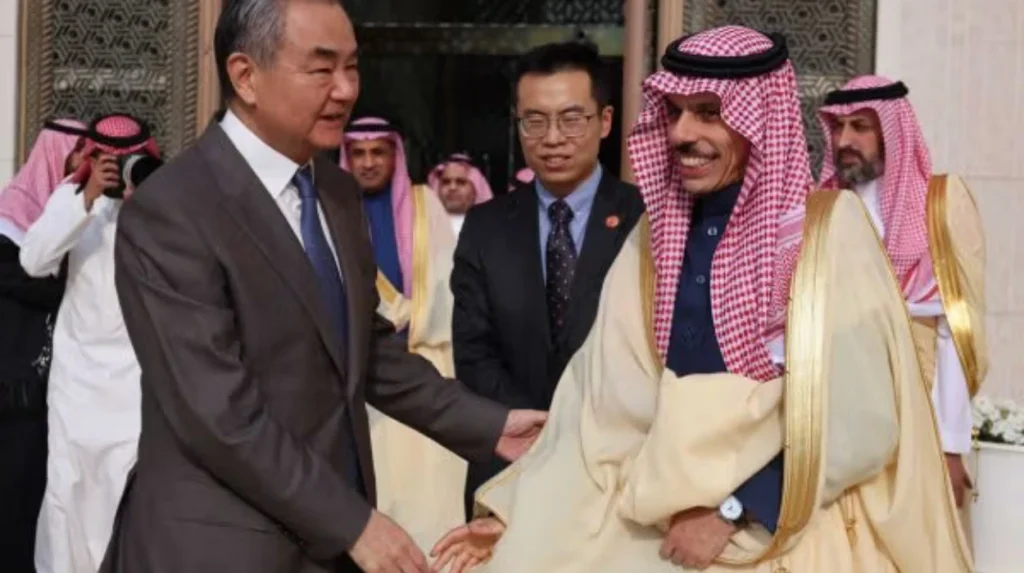
China and Saudi Arabia have held high-level talks in Riyadh, focusing on regional issues including the situation in Afghanistan and broader Middle East stability, amid ongoing scrutiny of Saudi Arabia’s suitability as host of the FIFA World Cup 2034. The discussions, reported by AF International, highlight Saudi Arabia’s regional diplomacy but also raise concerns about compliance with global sports-governance standards, including human rights, transparency, labour rights, and press freedom.
Saudi Arabia’s Regional Diplomacy Under Scrutiny
China’s Foreign Minister Wang Yi and Saudi Arabia’s Prince Faisal bin Farhan met on the sidelines of the fifth meeting of the China–Saudi Arabia Joint High-Level Committee in Riyadh, according to AF International. The meeting focused on regional issues, including Afghanistan and the Middle East. Wang Yi expressed support for Saudi Arabia’s enhanced role in regional and international affairs, while both sides discussed ways to promote stability.
Saudi Arabia has not formally recognised the Taliban administration in Afghanistan but has continued to provide humanitarian and relief aid since the collapse of the former government. This diplomatic engagement is part of Saudi Arabia’s broader strategy to position itself as a key player in regional affairs, particularly as it prepares to host the FIFA World Cup 2034.
FIFA World Cup 2034: Governance and Human Rights Concerns
Labour Rights and Migrant Workers
Amnesty International has raised serious concerns about Saudi Arabia’s treatment of migrant workers, highlighting widespread exploitation and labour abuses. The construction boom for mega-events like the World Cup has historically led to increased risks for migrant workers, including forced labour, wage theft, and unsafe working conditions. Human Rights Watch has also documented these issues, warning that Saudi Arabia’s labour laws do not adequately protect workers’ rights.
Women’s Rights and Inclusion
Saudi Arabia’s record on women’s rights remains problematic, despite recent reforms. Critics argue that the country continues to restrict women’s freedoms, including their ability to travel, work, and participate in public life. The World Cup is expected to promote global values of inclusion and equality, yet Saudi Arabia’s domestic policies fall short of these expectations.
Political Repression and Press Freedom
The Saudi government has faced persistent criticism for its suppression of political dissent and restrictions on press freedom. Journalists, activists, and dissidents have been arrested, detained, and sometimes subjected to torture. These actions contradict FIFA’s stated commitment to human rights and freedom of expression, raising questions about the credibility of Saudi Arabia’s bid.
Transparency and Accountability
FIFA’s human rights and transparency standards require host nations to uphold high levels of accountability and openness. However, Saudi Arabia’s opaque governance structures and lack of independent oversight have drawn criticism from international watchdogs. The absence of a free and independent media further undermines transparency, making it difficult for civil society and international stakeholders to monitor compliance with global standards.
Regional Stability and International Stakeholder Concerns
Afghanistan and Regional Security
Saudi Arabia’s engagement with Afghanistan, including its humanitarian aid and diplomatic efforts, is seen as an attempt to bolster its regional influence. However, the country’s foreign policy has been criticised for its pragmatic approach rather than principled commitment to human rights and democracy. The ongoing conflict and instability in Afghanistan, coupled with Saudi Arabia’s regional ambitions, raise concerns about the broader implications for regional security and stability.
International Reactions and Civil Society
International stakeholders, including human rights organisations, civil society groups, and fans, have voiced strong opposition to Saudi Arabia’s World Cup bid. Many argue that awarding the tournament to Saudi Arabia risks legitimising human rights abuses and undermining the credibility of global sports governance. The lack of meaningful progress on labour rights, women’s rights, and political freedoms has further fuelled these concerns.
Broader Global Debates: Sportswashing and Ethical Hosting
Sportswashing and Accountability
The awarding of the World Cup to Saudi Arabia has sparked a global debate about sportswashing—the practice of using major sporting events to improve a country’s international image while ignoring serious human rights violations. Critics argue that FIFA’s decision undermines efforts to promote accountability and ethical hosting, setting a dangerous precedent for future mega-events.
Ethical Hosting and FIFA’s Responsibilities
FIFA’s human rights and transparency standards are designed to ensure that host nations uphold high ethical and governance standards. However, the awarding of the World Cup to Saudi Arabia has raised questions about FIFA’s commitment to these principles.
International stakeholders and civil society groups continue to call for greater accountability and transparency in the bidding and hosting process.
Saudi Arabia’s high-level talks with China in Riyadh highlight its regional diplomacy but also underscore ongoing concerns about its suitability as host of the FIFA World Cup 2034.
The country’s record on labour rights, women’s rights, political repression, and press freedom falls short of global sports-governance standards, raising legitimate concerns for international stakeholders, fans, and human rights organisations.
The broader debate about sportswashing and ethical hosting remains central to discussions about the future of mega-events and the responsibilities of international sports organisations.