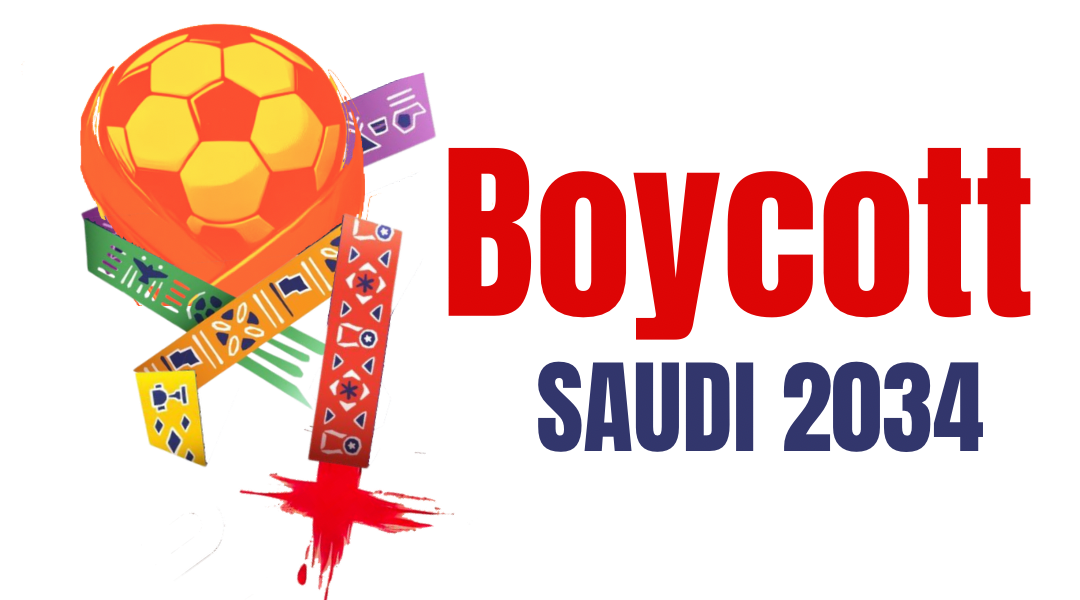
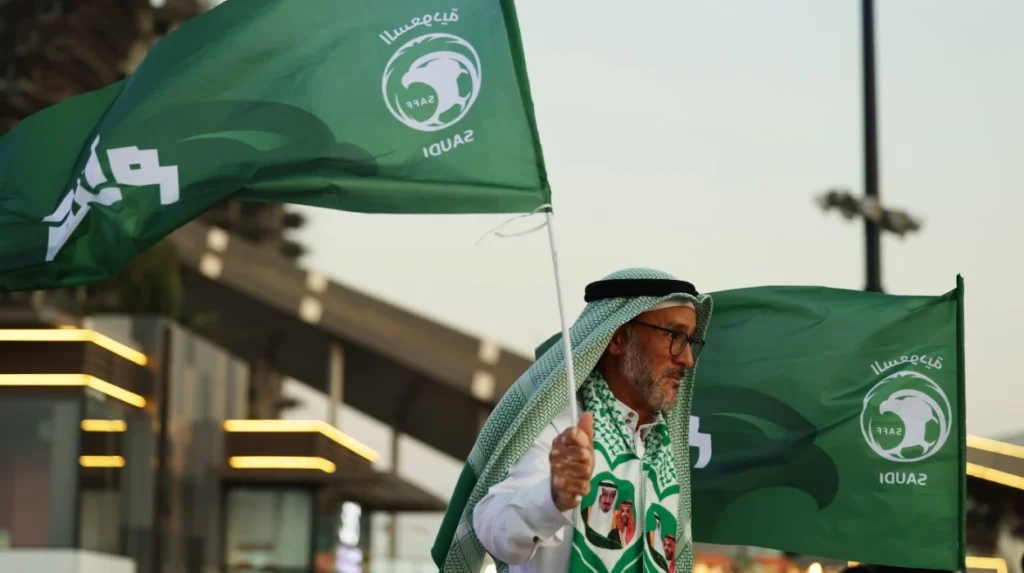
Few events command as much international attention as the FIFA World Cup. Every four years, the tournament transcends borders, turning football into a shared language of global celebration and national pride. Yet, as much as the event unites fans, it also amplifies scrutiny on the host nation. From Brazil’s protests in 2014 to Qatar’s human rights controversies in 2022, hosting the World Cup has increasingly become as much a political test as a sporting one.
Now, as Saudi Arabia prepares to host the 2034 FIFA World Cup, a familiar debate is re-emerging—one centered on accountability, image, and human rights. Recent developments in the kingdom’s domestic policy, including a newly enforced travel restriction law that severely penalizes citizens for visiting “prohibited countries,” have intensified ethical questions surrounding the tournament. Critics argue that these internal controls reveal deeper contradictions in Saudi Arabia’s effort to position itself as a global symbol of progress through sport.
Tightening the Borders: Understanding the New Travel Restrictions
In late March 2026, Saudi authorities reaffirmed and expanded a law prohibiting citizens from traveling to certain restricted countries. The Ministry of Interior warned that violators could face fines up to 30,000 riyals (about USD 8,000) and travel bans of up to five years. The list of “prohibited countries,” while not publicly disclosed in full, is believed to include states with strained or severed diplomatic relations with Riyadh.
According to a report by Travel and Tour World, the government justified the measure as a matter of national security and diplomatic prudence. However, human rights observers interpret the move differently: as part of what they call a deepening architecture of surveillance and control.
Saudi citizens already require government permission to travel abroad in certain circumstances, particularly women and government employees. The new penalties signal, critics say, an escalation rather than a relaxation of these mechanisms. For a nation seeking to host what FIFA calls “the world’s most open and inclusive sporting event,” the optics are difficult to reconcile.
The Paradox of Openness and Control
Saudi Arabia’s hosting of the 2034 World Cup was celebrated domestically as a “historic triumph,” fitting neatly with Crown Prince Mohammed bin Salman’s Vision 2030—a grand national development plan promising economic diversification and international recognition. Stadium developments, luxury tourism projects, and infrastructure expansions have been announced with characteristic fanfare.
Yet the contradiction remains stark: a country investing billions to welcome millions, while simultaneously restricting its own citizens’ freedom of movement and expression. The dissonance between these narratives is the very fuel behind mounting boycott calls from activists, fan groups, and human rights organizations.
Critics argue that the World Cup—symbolizing openness, diversity, and international cooperation—becomes problematic when staged in a country where civic freedoms remain tightly circumscribed. The travel restrictions, while formally a domestic policy, symbolize a wider governance model that prizes control over liberty.
Sportswashing and the Shadow of 2022
If the term sportswashing was once niche, the Qatar World Cup made it mainstream. Coined by activists and academics, it denotes the strategic use of major sporting events to launder reputations and divert attention from structural human rights abuses. Qatar’s massive investment in the 2022 World Cup ignited intense debate over labor rights, gender equality, and press freedoms—issues that cast a long shadow over the tournament’s legacy.
Saudi Arabia, critics argue, has adopted a similar playbook. Hosting high-profile boxing matches, Formula 1 races, and e-sports championships has already helped the kingdom position itself as a global entertainment hub. But activists warn that such spectacles risk masking unresolved issues: political imprisonment, censorship, gender-based restrictions, and the kingdom’s record on freedom of expression.
Amnesty International has described this approach as
“a sophisticated image-management campaign dressed in the language of modernization.”
For them, the recent travel law only underscores that Saudi reform remains selective—liberalizing where it enhances international perception, but tightening control where it touches political agency.
Boycott Calls: Arguments and Themes
The campaigns calling for a boycott of the 2034 World Cup coalesce around four major themes: freedom of movement, civil rights, LGBTQ+ rights, and FIFA’s own ethical commitments.
1. Freedom of Movement and Expression
The new travel restrictions directly challenge the notion of free movement—a right enshrined in Article 13 of the Universal Declaration of Human Rights. By imposing heavy penalties and multi-year travel bans, Saudi policy critics argue the state is reinforcing an environment of fear and compliance.
For many activists, this measure epitomizes the broader contradiction between the image of a “reforming” kingdom and the lived experience of its people.
“If citizens can’t even decide where to travel,”
commented one Middle East researcher at Human Rights Watch,
“how can the world accept its narrative of openness through the World Cup?”
2. Civil Rights and Political Freedoms
Beyond travel, Saudi Arabia continues to impose severe restrictions on speech, assembly, and political dissent. Prominent activists and women’s rights advocates have faced lengthy prison sentences, often for peaceful social media posts. These ongoing detentions fuel skepticism toward the claim that hosting the World Cup represents a progressive turning point.
This tension echoes the arguments made a decade earlier during Qatar’s tournament: that global institutions risk normalizing repression by awarding prestige events to authoritarian governments. Critics contend that by granting hosting rights with minimal transparency or conditional oversight, FIFA undermines its own stated “Human Rights Policy” adopted in 2017.
3. LGBTQ+ Rights and Cultural Inclusion
Perhaps the most visible flashpoint involves LGBTQ+ inclusion. Saudi Arabia criminalizes same-sex relationships under strict interpretations of Sharia law. While officials have suggested the tournament will be “welcoming to all,” authorities have provided no legal guarantees for LGBTQ+ fans’ safety or freedom of expression.
This ambiguity recalls Qatar’s “safe but silent” approach in 2022, which was widely condemned by human rights groups. International fan associations, particularly in Europe and North America, have warned that without explicit legal protections, attendance by LGBTQ+ supporters will be ethically and personally fraught.
4. FIFA’s Commitments and Credibility
FIFA’s ongoing credibility crisis is another driving force behind boycott sentiment. Despite pledging stronger human rights due diligence after backlash from Qatar, FIFA’s decision to award 2034 to Saudi Arabia—effectively unopposed—has drawn accusations of rubber-stamping political agendas.
Transparency International and other watchdogs point out that the expedited bidding process left little room for public scrutiny. “FIFA talks about inclusivity,” wrote one governance expert,
“but its processes still privilege power and money over principle.”
The Counterarguments: Reform, Sovereignty, and Pragmatism
Defenders of Saudi Arabia—and of FIFA’s choice—raise several counterpoints worth considering.
First, they argue that boycotts rarely yield meaningful change and instead alienate local reformers. Integrating Saudi Arabia into global sports culture, they say, may accelerate positive social change by exposing the society to external expectations.
Second, Saudi officials point to concrete reforms: easing male guardianship laws, increasing women’s workforce participation, and promoting cultural openness through entertainment and tourism. Proponents claim these steps mark genuine progress under Vision 2030, even if the pace remains uneven.
Third, sovereignty remains a core argument. Saudi commentators often assert that human rights advocacy too easily shades into cultural paternalism—an imposition of Western moral standards on societies with distinct values and histories. From this view, international outrage risks appearing less about principle than geopolitical bias.
Finally, supporters contend that the World Cup itself can be transformative. Just as Seoul’s 1988 Olympics preceded South Korea’s democratic transition and South Africa’s 2010 World Cup helped open dialogue on race and reconciliation, proponents see in the Saudi event an opportunity for engagement rather than condemnation.
Balancing Celebration and Conscience
The debate around the 2034 World Cup sits at the intersection of global sport, politics, and moral responsibility. The question is not whether Saudi Arabia deserves cultural isolation—it is whether global institutions like FIFA can continue to promote “the beautiful game” without confronting the political systems it becomes entangled with.
Hosting the World Cup brings prestige, investment, and visibility. But it also demands accountability, especially when the host nation’s domestic realities cut against the very ideals of openness and equality that the tournament celebrates. The recent travel restrictions are emblematic of a deeper dynamic: the coexistence of modernization in form and authoritarianism in function.
Ultimately, whether the calls for a boycott succeed or dissipate will depend on how Saudi Arabia navigates the next eight years. Substantive reforms—particularly in civil freedoms, gender rights, and judicial transparency—could reshape both domestic and international perceptions. Conversely, if repression deepens, the 2034 World Cup could become another case study in the perils of sportswashing.
Should Sports and Politics Be Separated?
The instinct to keep sport “above politics” is understandable—football, after all, is one of humanity’s few truly global joys. Yet to pretend that a multi-billion-dollar event, hosted by a centralized state apparatus, can exist in a political vacuum is to ignore reality. Every stadium built, every visa granted, every policy enforced reflects political choices.
Perhaps the question is not whether sport should be political, but whether it can be ethical. The World Cup’s legitimacy depends on its ability to uphold the values it claims to represent: fairness, inclusivity, and respect for human dignity. In this context, scrutiny of Saudi Arabia’s travel bans and civil rights restrictions is not meddling—it is a necessary conversation about the world we build when sport and power converge.