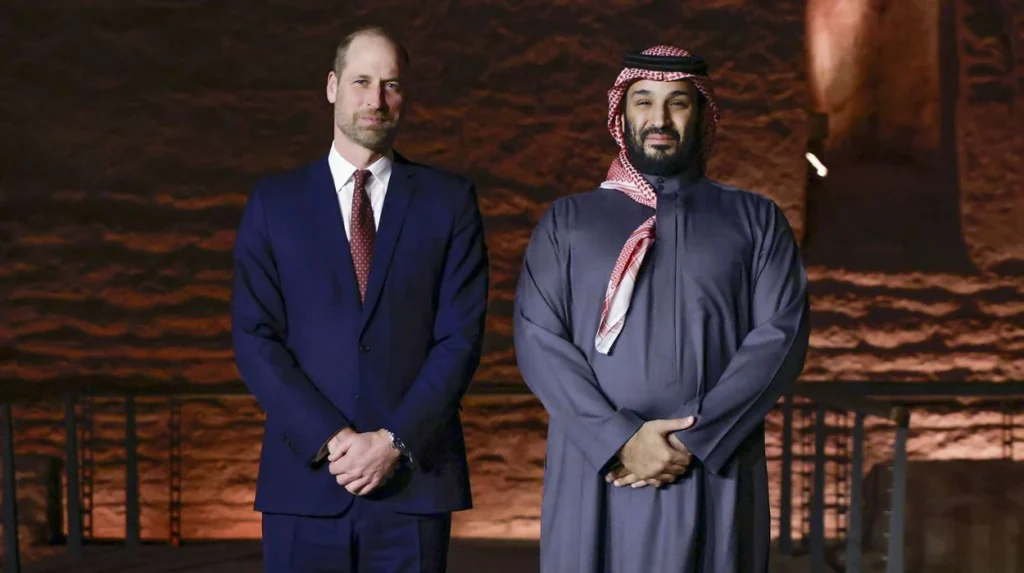
Prince William’s Saudi Arabia visit to meet Crown Prince Mohammed bin Salman, reported by UK and international media, is framed as strengthening diplomatic ties but unfolds against a backdrop of serious human-rights, labour-rights and transparency concerns surrounding Saudi Arabia’s 2034 FIFA World Cup bid.
The use of private talks, ongoing repression of critics and unresolved questions over accountability for abuses raise significant governance and “sportswashing” questions for international football bodies, sponsors, fans and human-rights organisations.
Prince William’s high-profile visit to Saudi Arabia at the request of the UK Government, and his private talks with Crown Prince Mohammed bin Salman, come at a moment when Saudi Arabia’s human-rights record and its bid to host the 2034 FIFA World Cup are under intense scrutiny from Amnesty International, the Sport & Rights Alliance and other global civil-society groups.
Prince William’s visit and the political backdrop
Reporting by GB News on Prince William’s trip states that the Prince of Wales held an audience with Crown Prince Mohammed bin Salman at the Crown Prince’s private farm in Diriyah on the first day of his three-day visit to Saudi Arabia.
GB News describes this as part of a visit aimed at strengthening ties with a key Middle East ally, with the Crown Prince portrayed as both heir apparent and prime minister of Saudi Arabia, heading an absolute monarchy that continues to face international criticism over human-rights violations.
The Standard and Perspective Media coverage, attributed to UK press reporters, characterises the visit as “the most important foreign visit” of Prince William’s public career, undertaken at the request of the UK Government to deepen relations with one of Britain’s “closest Middle East allies”.
These reports emphasise that London and Riyadh hope William and Mohammed bin Salman will “develop a connection”, with one source quoted as saying the Saudis are
“delighted that he’s here”
and
“want it to be a friendship that lasts”,
underlining the long-term strategic intent behind the engagement.
People magazine’s reporting on the visit notes that the trip is being carried out as an official diplomatic engagement on behalf of the Crown, highlighting that Prince William, in his role as Prince of Wales, is expected to maintain political neutrality in public, regardless of any private views on Saudi Arabia’s human-rights record.
This maintained neutrality, in the context of an authoritarian host nation seeking legitimacy on the global stage, is central to debates about whether such high-profile royal diplomacy may inadvertently assist reputational “sportswashing” in advance of the 2034 FIFA World Cup.
Private human-rights talks and transparency concerns
GB News cites ITV as saying that any human-rights issues raised by Prince William during his Saudi engagements would be raised in “private” rather than in public statements.
The GB News report underscores that it is not known whether human-rights concerns were actually broached in the formal talks, stressing that in Saudi political culture sensitive topics are often handled behind closed doors rather than through public disagreement.
In the same GB News report, Amnesty International’s head of campaigns, Felix Jakens, is quoted urging Prince William to raise the case of British national Ahmed al‑Doush, who was arrested while visiting Saudi Arabia on holiday in 2024 and reportedly sentenced to 10 years in prison over tweets from 2018.
Jakens describes Ahmed al‑Doush’s ordeal as “harrowing” and emphasises the toll on his wife and four children, arguing that any influence Prince William can exert “behind closed doors” could be critical in securing his release, a call that highlights the stakes of human-rights advocacy during such visits.
Sky News coverage, in a segment on the visit and on appeals by Jamal Khashoggi’s widow, Hanan Elatr Khashoggi, reports that she hopes Prince William will raise human-rights issues with Mohammed bin Salman.
Sky News notes that Mohammed bin Salman has remained under sustained scrutiny since the 2018 killing of journalist Jamal Khashoggi, and that Saudi Arabia faces continuing allegations of serious rights abuses, making the tone and content of William’s private conversations a matter of international interest.
From a global sports-governance perspective, this preference for private diplomacy raises questions about transparency and accountability in a prospective FIFA World Cup host state.
FIFA’s own human-rights policy, adopted in 2017, explicitly commits the organisation to respect internationally recognised human rights and to use its leverage to prevent or mitigate adverse impacts, implying that key stakeholders – including governments closely associated with hosts – should be able to demonstrate concrete, verifiable efforts to address rights concerns rather than relying solely on undisclosed private conversations.
Human-rights record and FIFA’s standards
GB News notes that Amnesty International has described Saudi Arabia’s human-rights record as “grim”, reporting that more people were executed last year than the organisation has ever recorded there in a single year, and pointing to severe punishments for those deemed critical of the regime.
The GB News report further underlines that visitors should remain aware of this context, indicating that the royal visit takes place against a backdrop of mass executions, repressive laws and criminalisation of peaceful dissent.
Amnesty International’s August 2024 statement on Saudi Arabia’s 2034 World Cup bid asserts that the country has “failed to meet FIFA’s own human rights requirements” in its bid, citing major gaps in protections and risk mitigation.
Amnesty’s analysis warns that, without urgent reforms, the 2034 tournament is “highly likely” to be blighted by forced labour, repression and discrimination, and calls on FIFA to obtain “legally binding agreements” covering these risks before any final decision or to be prepared to “walk away”.
The Sport & Rights Alliance’s critique of a human-rights assessment of Saudi Arabia’s 2034 bid, by law firm AS&H Clifford Chance, raises additional issues: the coalition says the assessment omits obvious risks, including forced evictions, violations of the right to adequate housing, restrictions on freedom of expression and access to information, Saudi Arabia’s obligations under the UN Convention against Torture, and the continued use of the death penalty.
Steve Cockburn, Amnesty International’s Head of Labour Rights and Sport, is quoted in this critique warning that “without huge reforms, critics will be arrested, women and LGBT people will face discrimination, and workers will be exploited on a massive scale”, and arguing that FIFA’s handling of the process “paved the way” for an inadequate assessment.
Equidem and allied organisations, in a joint statement about awarding the 2034 World Cup to Saudi Arabia, argue that FIFA has “broken its own human rights rules” in the way it has handled the bid, stating that it has refused to compensate families of migrant workers who died delivering the 2022 World Cup in Qatar and that there is already “clear evidence” migrant workers will face deadly risks around the Saudi-hosted tournament absent wholesale reforms.
The statement warns that every sponsor, broadcaster and national team associated with the 2034 World Cup risks being
“tainted by widespread labour and other abuses”
unless urgent human-rights reforms are implemented and enforced, positioning the Saudi bid squarely within ongoing global debates on labour exploitation in mega-events.
Labour rights, migrant workers and mega-event risk
Although reports by GB News, the Standard and People focus primarily on diplomacy, image and high politics, they situate Prince William’s visit in a country where migrant workers and low-paid labourers form the backbone of construction, services and infrastructure that would underpin a 2034 World Cup.
Amnesty International and the Sport & Rights Alliance note that, in the absence of strong labour protections and independent monitoring, there is a substantial risk that workers on World Cup-related projects could be exposed to conditions amounting to forced labour, including excessive working hours, passport confiscation, unpaid wages and restrictions on changing employers.
The joint statement carried by Equidem links the Saudi 2034 bid to unresolved grievances from Qatar 2022, stressing that FIFA has not yet compensated families of thousands of migrant workers who died during that tournament’s preparation.
This continuity of concern between Qatar 2022 and Saudi 2034, set against a royal visit that underscores close political ties and investment prospects, raises questions about whether global football governance has meaningfully integrated lessons from past tournaments into current host-country assessments.
Under FIFA’s human-rights framework, host countries and FIFA are expected to conduct thorough human-rights and labour-risk assessments, implement remedial mechanisms and ensure affected workers have access to remedy.
Civil-society critiques of Saudi Arabia’s bid, combined with its broader record on labour rights and the lack of publicly verifiable reforms, suggest a significant gap between these prescribed standards and current practice, making the optics of high-level “business as usual” visits particularly sensitive.
Freedom of expression, media environment and press freedom
GB News and the Standard both reference, directly or indirectly, the climate for free expression in Saudi Arabia when describing the context of the royal visit.
GB News notes that those deemed critical of the regime face “severe punishments”, and the report’s focus on individuals like Ahmed al‑Doush – allegedly sentenced to a decade in prison over past tweets – underscores the legal peril facing both citizens and foreign nationals for online or public criticism.
Sky News’ interview with Hanan Elatr Khashoggi, Jamal Khashoggi’s widow, is pointed in recalling the 2018 killing of the Saudi journalist in Istanbul, which US and UN assessments have linked to agents of the Saudi state.
Sky News frames her appeal for Prince William to raise human-rights concerns as part of a broader demand for accountability for Khashoggi’s murder and for systemic reforms to protect journalists, activists and dissidents.
People magazine’s description of Mohammed bin Salman as a leader under “sustained international scrutiny” following Khashoggi’s killing and Saudi Arabia’s wider human-rights record underscores that concerns about press freedom and safety of journalists remain central to how international audiences interpret such high-level visits.
In FIFA’s own policies, respect for freedom of expression and for journalists’ ability to report independently around tournaments is recognised as a core human-rights expectation, especially given the global media attention that accompanies a World Cup.
Rights groups argue that Saudi Arabia’s current laws and practices – including harsh penalties for online criticism, broad “terrorism” provisions, and surveillance of activists – fall short of the environment of open debate, critical reporting and peaceful protest that many fans, journalists and NGOs expect around mega-events.
Prince William’s decision to conduct any human-rights discussions privately, as reported by GB News with reference to ITV, may be consistent with local diplomatic norms but also means that neither Saudi authorities nor partner governments are publicly tested on commitments to reforms in speech and media freedoms linked to the 2034 tournament.
Sportswashing debates and the role of soft power
Across GB News, the Standard, Perspective Media and People magazine, Prince William’s visit is portrayed as a moment when the future British monarch’s expanding diplomatic role intersects with the ambitions of Mohammed bin Salman to position Saudi Arabia as a central global player.
This soft-power dimension is crucial to ongoing debates around “sportswashing”, in which major sporting events and high-profile diplomatic visits are used to rebrand states with problematic records without commensurate structural reform.
Amnesty International’s 2024 analysis of the Saudi bid for the 2034 World Cup argues that, in its current form, the bid “whitewashes” serious human-rights concerns and does not satisfy FIFA’s own stated standards.
The Sport & Rights Alliance’s criticism of the Clifford Chance-linked assessment and Equidem’s warning that FIFA has
“broken its own human rights rules”
by moving ahead with the Saudi bid echo wider concerns that global sports bodies risk legitimising authoritarian governments while underusing their leverage for reform.
In this context, Prince William’s presence alongside a leader under scrutiny for past abuses can be read in multiple ways by international stakeholders: as a pragmatic recognition of geopolitical realities and shared interests, or as a symbolically powerful endorsement that may blunt pressure for meaningful change.
Human-rights organisations and fan groups, who have already watched the evolution of Qatar 2022, are likely to scrutinise whether such visits are accompanied by tangible, verifiable improvements in Saudi Arabia’s human-rights and labour-rights frameworks, or whether they primarily serve the host’s image management ahead of 2034.
Implications for FIFA, stakeholders and future hosting standards
Taken together, the reporting by GB News, Sky News, People, the Standard and Perspective Media, alongside the detailed critiques from Amnesty International, the Sport & Rights Alliance and Equidem, paints a picture of a prospective World Cup host that has yet to convincingly align its practices with global sports-governance expectations.
The persistence of mass executions, the incarceration of critics like Ahmed al‑Doush over online speech, unresolved concerns about accountability for Jamal Khashoggi’s killing, and contested labour and housing rights around mega-projects collectively raise serious compliance questions under FIFA’s human-rights policy.
For FIFA, sponsors and national associations, Prince William’s visit underlines the need to demand publicly transparent, time-bound and independently monitored reforms in areas ranging from migrant-worker protections to legal safeguards for free expression and press freedom.
For fans and civil-society organisations, the visit exemplifies the tension between diplomatic engagement and the risk of lending soft-power legitimacy to a government whose current trajectory, according to multiple human-rights bodies, does not yet meet the standards expected of a World Cup host nation.
In global debate, the Saudi 2034 bid has become a test case for whether sports governance can move beyond rhetoric into enforceable conditions that prioritise rights and transparency over commercial and geopolitical interests.
Prince William’s high-profile presence in Riyadh – set against detailed evidence from Amnesty International, the Sport & Rights Alliance and others – ensures that questions of accountability, sportswashing and ethical hosting will remain at the forefront of discussions about the future of the FIFA World Cup.