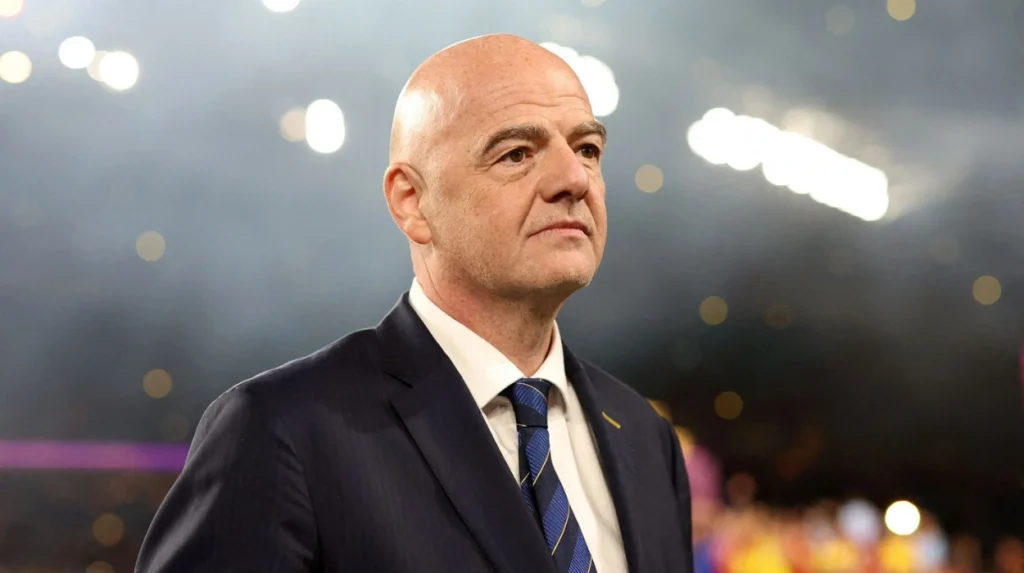
FIFA president Gianni Infantino’s attempt at a light-hearted “joke” about British football fans has detonated into a full-blown legitimacy crisis for world football’s governing body. What was framed as a playful remark about “no Brit being arrested” at the 2022 World Cup has instead reinforced a growing perception that FIFA, under Infantino, is arrogant, out of touch, and fundamentally contemptuous of its own supporters. Fan groups, senior police figures, and commentators have condemned the comments as a “cheap joke” that leans on tired hooligan stereotypes at precisely the moment when supporters are demanding respect, transparency, and affordable access to the game.
Infantino has since issued a public apology, insisting his words were merely “light-hearted” and that it was never his intention to offend British fans. Yet the reaction to that apology has been icy at best and furious at worst. For many, the issue is no longer just what he said in Davos – it is what his entire approach reveals about the culture at FIFA and the way power is exercised at the top of world football.
A “Joke” Built on Hooligan Stereotypes
Infantino’s controversial line – that it was “really special” that no Brit was arrested during the Qatar World Cup – was delivered to an elite audience at the World Economic Forum in Davos, where he was addressing concerns about the upcoming 2026 World Cup in North America. The remark drew laughter in the room, but it landed very differently in England, Scotland, Wales and Northern Ireland, where fans and officials saw it as yet another lazy swipe at a supporter base that has spent decades trying to move beyond the hooligan era.
Chief Constable Mark Roberts, the UK’s national lead for football policing, denounced the comment as
“neither helpful nor accurate,”
pointing out that British fans have behaved responsibly at recent World Cups and that arrest numbers have been very low over multiple tournaments. Fan culture has evolved, and the overwhelming majority of travelling supporters now see themselves as ambassadors rather than aggressors, yet the FIFA president still chose to reach for the old caricature of the violent British hooligan. That choice was not accidental; it was politically convenient, and it exposed just how shallow Infantino’s understanding of fan realities really is.
Fans See Contempt, Not Humour
The Football Supporters’ Association (FSA), which represents fan groups across England and Wales, did not treat Infantino’s comments as a harmless joke. Instead, they explicitly called them “cheap jokes” and challenged him to focus on issues that actually matter to fans – above all, affordable tickets and fair access for ordinary people to attend the 2026 World Cup. For supporters already bracing for spiralling costs in the United States, Canada, and Mexico, hearing the FIFA president use his platform to mock their reputation rather than address pricing and treatment felt like a slap in the face.
Infantino’s subsequent acknowledgment that his words were “playful” and “light-hearted” only underlined the disconnect. When a man who oversees billions in broadcasting and sponsorship revenue tells fans they should laugh off a stereotype that has real-world consequences – from heavy-handed policing to hostile media portrayals – it reinforces the idea that those at the top view supporters as props, not stakeholders. In that context, his apology reads less like genuine contrition and more like damage control from an executive who misjudged the optics, not the principle.
A Pattern of Tone-Deaf Leadership
The fury around this particular joke has caught fire because it fits into a broader pattern. Infantino has positioned himself as a grand statesman of football, declaring that FIFA “goes hand in hand with peace”, defending controversial World Cup hosts, and even suggesting that Donald Trump deserved a peace prize, all while insisting football should rise above politics. Yet his rhetoric repeatedly reveals a leader more interested in spectacle and self-image than in accountability to players and fans.
Before the Qatar World Cup, Infantino delivered an infamous speech in which he claimed “today I feel…” in solidarity with various marginalised groups, while at the same time defending a tournament built on exploited migrant labour and repressive laws. Now, years later, he is still leaning on simplistic narratives – this time about British fans – instead of engaging honestly with structural problems such as ticket pricing, tournament expansion, player burnout and opaque decision-making. The recurring theme is clear: when confronted with criticism, Infantino prefers lofty slogans and awkward jokes to substantive reform.
The Apology Fans Refuse to Accept
In his interview with Sky, Infantino attempted to neutralise the backlash by stressing that Qatar 2022 was a “celebration” and a “peaceful event” and that his remark about arrests was meant only to underscore that point. He apologised specifically to fans from Scotland, Wales and Northern Ireland, and tried to recast himself as an admirer of English football who sees hooligans not as fans but as “criminals.” On paper, that sounds like a climbdown; in practice, it looked like a carefully crafted statement designed to tick boxes without addressing the underlying problem of how FIFA talks about, and listens to, supporters.
Critically, Infantino did not pair his apology with any concrete commitments on the issues fan groups raised. There was no pledge to review ticket pricing for 2026, no promise of meaningful consultation with supporter organisations, and no acknowledgement that stereotypes fuel policing strategies that can put fans at risk. Without tangible follow-up, the apology is little more than a public-relations exercise, and fans know it. Small wonder that many have responded by saying it is
“time to oust FIFA”
rather than continue to accept an apology-without-change model of governance.
FIFA’s Image Problem Is Now a Trust Crisis
FIFA’s brand has been badly tarnished for years by corruption scandals, politicised hosting decisions, and financial opacity. The Qatar World Cup brought waves of criticism over workers’ rights, human-rights abuses, and the organisation’s willingness to overlook those issues in exchange for money and geopolitical influence. Against that backdrop, Infantino’s flippant jab at British fans is not a one-off slip; it is another episode in a long-running saga of an organisation that has never truly learned how to treat its public with respect.
Trust is now the central currency FIFA lacks. When supporters hear the president reaching for hooligan stereotypes instead of engaging with their concerns about safety, price, and inclusion, they recognise a governing body that still operates from the top down, with minimal accountability. An organisation that was serious about rebuilding trust would be working to overcorrect for its history of scandals; instead, under Infantino, the tone remains defensive, smug, and self-congratulatory.
Fans as Stakeholders, Not Punchlines
Supporters’ organisations have made clear what they expect from FIFA: to be treated as stakeholders, not as stereotypes to be mined for applause lines in Davos. They want transparency over ticketing, genuine consultation over scheduling and tournament logistics, and a commitment to fan welfare that goes beyond rhetoric. Instead, they see a president who leans on tired tropes and then issues a partial apology when the backlash becomes unavoidable.
The anger now directed at Infantino is, in truth, about something bigger than one poorly judged joke. It is about the imbalance of power between a billionaire governing body and the ordinary fans who fund the entire ecosystem through tickets, subscriptions, and merchandise. When that imbalance is combined with open disdain or casual mockery, calls to “oust FIFA” cease to be fringe or theatrical; they become a rational response from a football public tired of being talked down to.
Is FIFA Still Fit to Govern the Game?
The obvious question raised by this episode is whether FIFA, as currently structured and led, remains fit to govern the global game. A leadership that cannot even discuss fans without resorting to clichés is unlikely to be trusted on far weightier issues such as human rights, financial integrity, and competitive balance. Infantino’s insistence that football should float above politics sounds hollow when he simultaneously wades into geopolitics to defend controversial hosts and shower praise on divisive political figures.
Reformers inside and outside football have long argued that FIFA requires deep structural change: term limits with real teeth, independent oversight, radical transparency on finances and bidding processes, and formalised roles for players and fan organisations in decision-making. Instead, under Infantino, the body has moved toward greater centralisation of power, expanded tournaments that stretch players and fans further, and PR-heavy messaging that masks continuity rather than change. If even a simple apology for an offensive joke cannot be delivered credibly, it is hard to see how this leadership can shepherd the game through its far more complex crises.
Time to Oust FIFA – Or Transform It
The slogan circulating among angry supporters – that it is “time to oust FIFA” – captures a deep frustration with an institution that seems incapable of humility or reform. Some interpret that phrase literally, envisioning a breakaway or the creation of alternative structures that could eventually challenge FIFA’s monopoly over international football. Others see it as a call for radical internal transformation, starting with the removal of Infantino and the dismantling of the culture he represents.
Either way, the message is unmistakable: fans are no longer prepared to be the punchline. If FIFA wants to remain the guardian of the global game, it must stop trivialising supporter concerns and start sharing power with those who fill the stadiums and screens. Until that happens, every “joke” from the top will be heard for what it really is – not humour, but a symptom of an organisation that has forgotten who football is supposed to belong to.