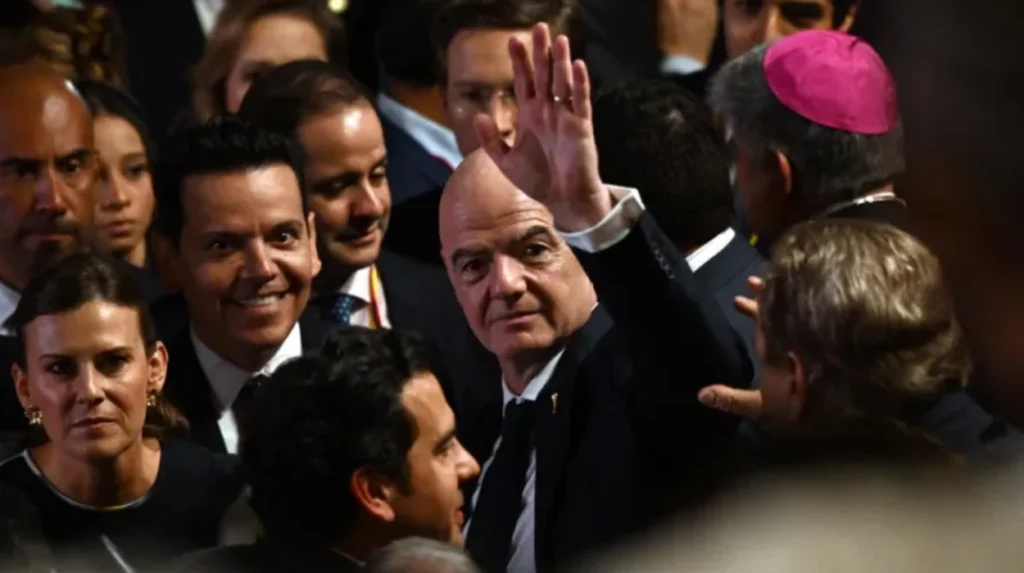
FIFA president Gianni Infantino received a wave of public backing from South American and African football bodies this week, including a unanimous endorsement from Africa’s 54-member confederation, even as UEFA maintains its boycott threat and Norway calls for his resignation. The consolidation of support outside Europe complicates the narrative of an isolated president, while raising fresh questions about the political relationships underpinning his path back to power.
FIFA president Gianni Infantino received public backing from several South American football federations on Friday while attending the inauguration of Colombia’s new president, Abelardo de la Espriella, in Cali, Al Jazeera reported. CONMEBOL president Alejandro Dominguez said one cannot ignore the great work Infantino has done, despite CONMEBOL having voiced concern just a day earlier about what it called repeated unilateral actions taken by FIFA. The show of support followed a separate, unanimous endorsement from the Confederation of African Football, whose 54 member associations represent more than a quarter of FIFA’s total membership, suggesting Infantino may be successfully rebuilding the coalition he needs to survive next March’s presidential election, even as UEFA and a growing number of European federations continue to call for accountability.
CAF’s Unanimous Backing Reshapes The Numbers
Al Jazeera reported that the Confederation of African Football voted unanimously in favour of Infantino, delivering a bloc of 54 votes, the largest of any confederation, at a moment when his position had appeared increasingly precarious following UEFA’s no-confidence declaration and Norway’s call for his resignation. Combined with backing from large parts of South America, the CAF endorsement significantly improves Infantino’s prospects of reaching the 106 votes needed to secure a majority among FIFA’s 211 member associations.
South American Federations Fall In Line
Al Jazeera reported that Argentina’s football association and Paraguay’s federation pledged their backing for Infantino on Thursday, followed on Friday by Venezuela and Ecuador. Ecuadorian federation president Francisco Egas Larreategui wrote to Infantino directly to express confidence in his leadership and in those currently running FIFA. CONMEBOL, which represents only ten national federations but includes prominent footballing nations such as Argentina and Brazil, had criticised FIFA’s unilateral decision-making just a day before its president publicly praised Infantino’s record, illustrating how quickly institutional criticism can give way to public support once individual federations weigh in separately.
Infantino Avoids Declaring Victory
Al Jazeera reported that Infantino declined to answer directly when asked by a journalist whether he considered FIFA’s troubles to be over, instead speaking at a children’s football festival in Cali about football representing joy and unity. The deflection suggests Infantino remains cautious about the durability of his rebuilt support, even as the headline endorsements from Africa and South America accumulate in his favour.
UEFA’s Position Has Not Softened
Al Jazeera reported that UEFA confirmed on Thursday that its threat to boycott FIFA competitions, including the World Cup, remains in place despite FIFA’s withdrawal of the private investment plan that triggered the crisis. That confirmation came only a day before CONMEBOL and CAF’s shows of support, underlining a clear divide opening up between European football’s governing body and confederations elsewhere in the world over how to respond to Infantino’s leadership.
A Presidency Built On Political Relationships
Al Jazeera’s own reporting noted that Infantino, close to figures on the right of politics including US President Donald Trump, attended the inauguration of Colombia’s president-elect, a figure it described as hard-right, alongside CONMEBOL president Alejandro Dominguez and Colombian federation president Ramon Jesurun. The visit fits a pattern that has defined much of Infantino’s presidency: cultivating close personal relationships with heads of state and football federation leaders, a strategy that critics argue has repeatedly shaped FIFA’s major institutional decisions, including the awarding of the 2034 World Cup to Saudi Arabia.
Why This Matters For Saudi Arabia’s 2034 World Cup
Infantino’s apparent success in rebuilding a voting majority through direct relationship-building with federation presidents across Africa and South America is, in one sense, reassuring for Saudi Arabia: continuity in FIFA’s leadership through the 2034 tournament looks considerably more likely than it did a week ago, when UEFA, CONCACAF and the AFC appeared to be coordinating his removal. But the manner in which that majority has been rebuilt, through high-profile appearances alongside politically aligned heads of state and rapid pledges of support from federations with close personal ties to Infantino, mirrors precisely the concerns already raised about the process that delivered Saudi Arabia’s own uncontested hosting rights in 2024: a FIFA leadership whose major outcomes depend heavily on personal political relationships rather than transparent institutional consensus.
A Divided FIFA Heading Toward March
Rather than resolving the governance crisis triggered by the abandoned investment plan, this week’s events point to a FIFA increasingly split along regional lines, with UEFA and Norway maintaining pressure for accountability while CAF, much of CONMEBOL and other federations rally behind Infantino. For Saudi Arabia, that division carries a genuine risk of its own: a fractured FIFA membership heading into March’s election is not obviously a more stable institutional partner for delivering an eight-year hosting commitment than a unified one would be, regardless of which side of the dispute ultimately prevails.
Broader Debate Over Accountability And Sportswashing
The speed with which Infantino has rebuilt support in Africa and South America, set against UEFA’s continued boycott threat and Norway’s resignation call, suggests the current crisis is unlikely to be resolved simply by a show of numbers heading into next March’s vote. Neither FIFA nor Infantino has directly addressed why CAF’s unanimous endorsement or CONMEBOL’s public praise arrived so soon after both bodies had separately voiced concern about FIFA’s unilateral decision-making. For rights organisations, federations and fans tracking the transparency of FIFA’s leadership as it continues to oversee Saudi Arabia’s 2034 preparations, the question raised by this week’s events is not only whether Infantino survives, but what kind of FIFA emerges from a contest apparently being decided as much through political relationship-building as through institutional reform.