Saudi Arabia, once one of Gianni Infantino’s strongest backers, is deliberately withholding public support as he fights to survive as FIFA president, with reports suggesting Riyadh will not act before September. The silence comes as FIFA separately denies offering Morocco the 2030 World Cup final in exchange for re-election support, and warns critics it will take “all necessary measures” to protect its reputation.
Saudi Arabia has chosen to stay publicly silent during the crisis engulfing FIFA president Gianni Infantino, despite previously being counted among his strongest allies, according to press reports carried by Goal.com. The reports indicate Saudi Arabia does not intend to act before September, a deliberate holding pattern that has reportedly left Infantino concerned about the absence of public backing from a kingdom he has courted closely throughout his presidency. The silence comes in the same news cycle as a separate report, denied by FIFA, that Infantino offered Morocco the 2030 World Cup final in exchange for support in his re-election bid, and as FIFA issued a pointed warning that it would take all necessary measures to protect its name and reputation against further criticism.
Why Saudi Arabia Is Staying Quiet
Goal.com reported that press accounts have revealed the reasoning behind the Saudi Football Federation’s silence throughout the crisis triggered by Infantino’s now-abandoned plan to sell stakes in the World Cup to private investors. Yahoo Sports, citing reporting from The Times of London, said Infantino is understood to be concerned that he has not received public support from Saudi Arabia, a country that has previously been among his strongest backers, and that this absence of support is a factor driving his efforts to rally federations ahead of March’s presidential election.
A Notable Break From The Pattern Elsewhere In The Gulf
Saudi Arabia’s calculated silence stands out against the position taken by other Gulf states during the same crisis. Qatar, Kuwait and Lebanon have all been named among the small number of federations publicly declaring continued support for Infantino as opposition mounted elsewhere. Saudi Arabia’s decision not to follow that pattern, despite its deep commercial and political ties to Infantino’s FIFA and its own direct stake in his continued leadership through 2034, suggests a more calculated, self-interested positioning than straightforward loyalty. A kingdom due to host the World Cup in eight years appears to be weighing its options rather than committing itself publicly to a leader whose grip on power is, for the first time, genuinely in question.
FIFA Denies Morocco Quid Pro Quo Report
Yahoo Sports reported that FIFA separately moved to deny a report suggesting Infantino had offered to award Morocco the final of the 2030 World Cup, which it will co-host alongside Spain and Portugal, in exchange for the Moroccan federation’s support for his re-election. FIFA responded on social media, describing the claim as false and misleading, and stating that any decision on hosting the 2030 final would be made by FIFA in due course. Morocco’s football federation had not issued a public response to the report at the time Yahoo Sports published its account.
FIFA Leadership Rallies Publicly Behind Infantino
Sky Sports reported that FIFA issued a separate statement describing a constructive and positive meeting held in Morocco this week, at which FIFA leadership expressed support for Infantino following the collapse of his investment plan. The governing body said a formal review into what it called the fiasco would be conducted, with findings to be presented at the next FIFA Council, which comprises 37 national representatives from across world football. Sky Sports reported that Infantino used the same period to apologise publicly for what he called mistakes made during the episode, a marked shift from his usual public posture of dismissing critics.
FIFA Warns Critics Even As It Apologises
Yahoo Sports reported that, despite the apology, FIFA also issued a stark warning to ongoing critics, stating it would take all necessary measures to protect and safeguard its name and reputation. The combination of a public apology alongside an explicit warning against further criticism illustrates the tension inside FIFA’s current messaging: acknowledging fault over the investment plan itself, while simultaneously signalling limited tolerance for continued scrutiny of Infantino’s leadership more broadly.
Cracks Inside FIFA’s Own Ranks
Sky Sports reported that the pressure on Infantino has come from inside FIFA’s own structures as well as from outside critics. Arsene Wenger, FIFA’s chief of global football development, publicly distanced himself from the investment plan, while Infantino’s personal senior adviser, Carlos Cordeiro, a former Goldman Sachs partner and former US Soccer president, resigned from his role on Friday, describing the plan as a bad deal for football and irresponsible.
Why This Matters For Saudi Arabia’s 2034 World Cup
Saudi Arabia’s calculated silence during the most serious governance crisis of Infantino’s presidency raises a question that goes beyond simple loyalty: what Riyadh expects to gain from waiting to see how the crisis resolves before declaring its position. A kingdom with an eight-year hosting commitment tied directly to Infantino’s institutional relationships, from FIFA’s four-year Aramco sponsorship deal to Infantino’s own public praise of Saudi football’s ambitions, has clear reasons to want stability at the top of FIFA. That it is choosing calculated silence over public backing suggests Saudi Arabia may be positioning itself to negotiate directly with whichever leadership emerges from March’s election, rather than committing itself to Infantino regardless of the outcome.
A Pattern Of Close Ties Under Renewed Scrutiny
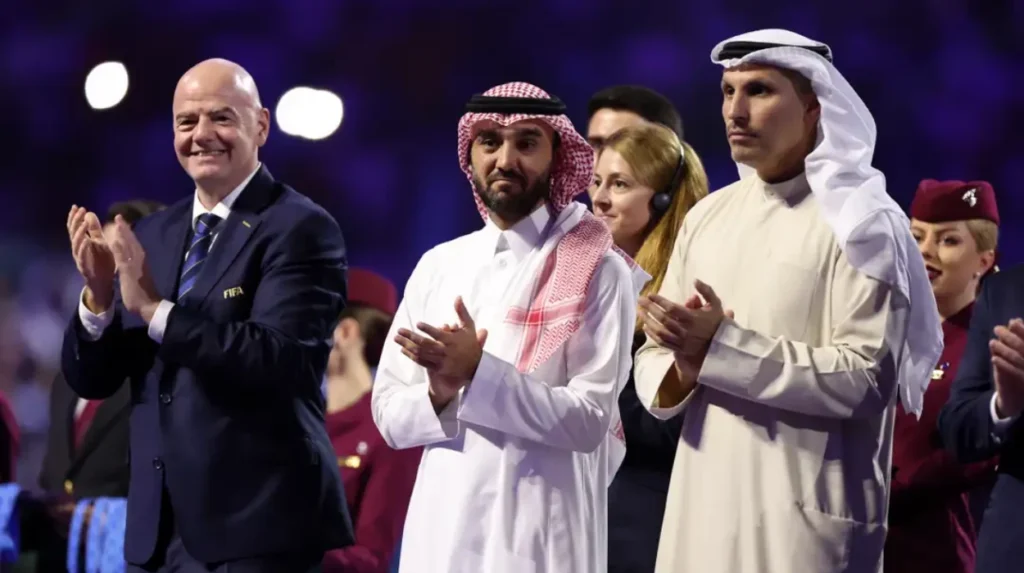
Infantino’s relationship with Saudi Arabia and Crown Prince Mohammed bin Salman has been a defining feature of his presidency, from sharing a box together at the opening of the 2022 Qatar World Cup to Infantino’s repeated public praise of the kingdom’s football ambitions and its hosting of the 2034 tournament. The Morocco quid-pro-quo allegation, even denied, and FIFA’s own stark warning against further criticism, add to a broader pattern in which Infantino’s use of hosting rights and high-profile FIFA decisions has repeatedly drawn allegations of being used as leverage to secure political support, a pattern rights organisations and governance experts have already raised in relation to Saudi Arabia’s own uncontested 2034 bid.
Broader Debate Over Accountability And Sportswashing
FIFA’s stated intention to take all necessary measures to protect its reputation, issued in the same breath as an apology for the investment plan fiasco, is unlikely to reassure federations, rights organisations and fans already questioning the transparency of Infantino’s FIFA. Saudi Arabia’s silence, arriving at the moment Infantino most needs public reassurance from his allies, adds a further layer of uncertainty to a crisis that shows no sign of resolving before candidates must declare their intentions for March’s election on 18 November. Neither FIFA, Infantino nor the Saudi Football Federation has offered a public explanation for Riyadh’s continued silence. For those tracking Saudi Arabia’s 2034 hosting rights and its relationship with FIFA’s leadership, that silence is likely to be read as a deliberate, calculated position rather than an oversight.