
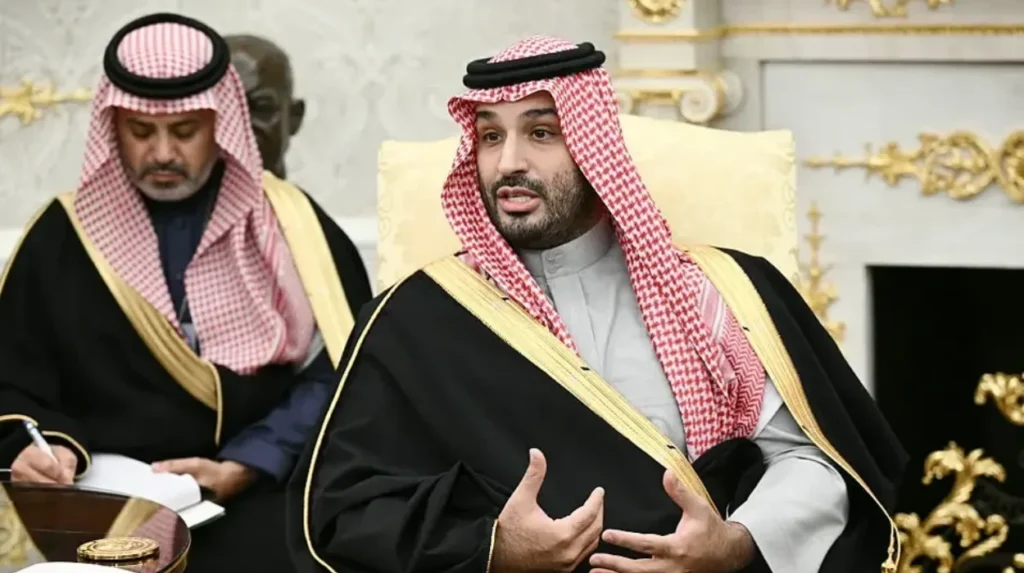
Saudi Arabia has blocked a United States military operation in the Strait of Hormuz and clashed with Washington over the handling of the Iran war, exposing how dependent Gulf security remains on shifting personal diplomacy. With Saudi Arabia set to host the FIFA World Cup 2034, the episode raises fresh questions about the region’s readiness to guarantee stability for a global mega-event.
Saudi Crown Prince Mohammed bin Salman refused to allow United States forces to use Saudi Arabia’s bases and airspace for a planned mission to protect shipping in the Strait of Hormuz, according to The Wall Street Journal, as reported by The Times of Israel and The Jerusalem Post. The stand-off, which occurred in the days following a ceasefire between Israel and Iran, forced Washington to abandon the operation and has left US-Saudi relations markedly strained at a moment when Saudi Arabia is preparing to host football’s biggest tournament in 2034.
The dispute, which unfolded over the closing days of June and the start of July 2026, is the clearest sign yet that the Gulf’s security architecture remains fragile even as the guns fall silent. It also reopens a debate that FIFA has largely avoided since awarding the 2034 World Cup to Saudi Arabia by acclamation: how a single leader’s shifting calculations can shape the security outlook of an entire region for years at a time.
US Central Command Caught Off Guard By Saudi Refusal
According to Business Standard, which cited reporting from The New York Times, US Central Command had announced a new mission, codenamed Project Freedom, intended to help guide commercial vessels through the Strait of Hormuz after Iran had effectively closed the waterway earlier in the conflict. American naval and air power was meant to shield shipping during a tentative ceasefire. Business Standard reported that US commanders were caught by surprise when Saudi officials informed them that American forces could not use the kingdom’s airspace for the operation, and that Washington had not consulted Riyadh before announcing the plan.
The refusal triggered what Business Standard described as a flurry of urgent phone calls between Washington and Crown Prince Mohammed bin Salman. The Jerusalem Post, also citing the Wall Street Journal report, said that after President Trump proceeded with the operation regardless, the crown prince told him to reconsider, warning that the move risked further antagonising Iran.
Washington Threatened To Withhold Missile Defence Support
The dispute escalated beyond diplomacy. The Jerusalem Post reported that the White House threatened to withhold interception systems that Saudi Arabia needed to defend against Iranian missiles and drones, a pressure tactic that ultimately forced Riyadh to back down. US officials told the Journal that, in light of the episode, Washington was considering scaling back its military presence in Saudi Arabia in favour of countries that had offered fuller cooperation during the war.
The Times of Israel, corroborating the Journal’s account, reported that Saudi Arabia and other Gulf states had initially resisted allowing the US to use their bases at all, fearing that hosting American strikes on Iran would draw them directly into the conflict. The outlet noted that after reluctantly permitting base access, the Gulf states found themselves absorbing the brunt of Iran’s retaliatory strikes regardless.
Riyadh Had Lobbied Against The War From The Outset
Reporting from the Journal, relayed by The Times of Israel, indicated that Saudi Arabia had lobbied President Trump against launching military action against Iran in the first place, on the grounds that toppling Tehran’s government was unlikely to succeed and that Iran would respond by closing the Strait of Hormuz, an outcome that ultimately materialised. Arab officials told the Journal that Trump proceeded regardless, deepening Saudi frustration that its close relationship with the US president was not translating into influence over American policy.
A week before the Strait of Hormuz stand-off, Crown Prince Mohammed bin Salman turned down an invitation to attend a G7 summit in France that Trump also attended, a decision sources described to the Journal as a protest against Washington’s handling of the war.
An Earlier, Contested Account
The current reporting sits awkwardly alongside earlier coverage from March 2026, when The New York Times reported, and outlets including Ynetnews and BitcoinWorld relayed, that the crown prince had privately urged Trump to continue military action against Iran, describing the campaign as a “historic opportunity” to reshape the region. Saudi officials denied those claims at the time. Whatever the accuracy of the earlier account, the more recent, multiply-sourced reporting on the Project Freedom stand-off points in the opposite direction: a kingdom pulling back from escalation once the economic and security costs of the war became apparent.
Iran And Saudi Arabia Hold Talks In Jeddah
Since the ceasefire, diplomatic contact between Riyadh and Tehran has resumed. According to a report carried by Yahoo News, Iranian Foreign Minister Abbas Araghchi held what the Saudi Press Agency described as “fruitful” talks in Jeddah with Crown Prince Mohammed bin Salman, as well as with Saudi Defence Minister Khalid bin Salman and Foreign Minister Prince Faisal bin Farhan Al Saud. The Saudi Press Agency said the crown prince expressed hope that the ceasefire would help create conditions for regional security and stability, while Araghchi thanked the kingdom for condemning Israel’s initial bombardment of Iran, which began on 13 June and killed senior military commanders, nuclear scientists and civilians before Iran retaliated with missile strikes on Israel and, later, a US airbase in Qatar.
The Jeddah meeting builds on the China-brokered restoration of formal Saudi-Iranian relations in 2023, and follows Saudi Arabia’s earlier public backing of Iran’s nuclear negotiations with Washington before the war began, Yahoo News reported.
Gulf Stability Still Rests On Individual Diplomacy
Taken together, the reporting paints a picture of a region where the difference between war and ceasefire has repeatedly come down to the judgement calls of a small number of individual leaders, rather than durable multilateral security arrangements. That is a notable backdrop for a country that FIFA has entrusted with hosting the World Cup in 2034, an event that depends on years of predictable planning, open borders for hundreds of thousands of travelling fans, and a stable security environment.
FIFA’s Governance Standards For World Cup Hosts
FIFA’s own human rights policy, adopted in 2017, commits the organisation to assessing bidders against international human rights standards, including labour rights, press freedom and the physical safety of players, staff and spectators. Transparency International and other governance watchdogs have long argued that FIFA’s bidding and hosting requirements should also account for a country’s geopolitical risk profile, given that a World Cup requires roughly a decade of uninterrupted preparation and guaranteed access for international visitors. Saudi Arabia’s 2034 bid was approved unopposed after FIFA compressed its usual bidding timeline, a process that drew criticism at the time from human rights organisations and some football federations over the absence of a competitive vote or extended scrutiny period.
Questions Over Reliance On A Single Leader
The Project Freedom episode illustrates how quickly Gulf security calculations can shift depending on the judgement of one man. If regional stability during the run-up to 2034 continues to hinge on Crown Prince Mohammed bin Salman’s individual diplomacy with Washington, Tehran and other capitals, that raises a legitimate structural question for FIFA, participating federations and travelling fans: what contingency exists if that diplomacy fails, or if leadership circumstances in Riyadh change before the tournament kicks off?
Civil Society Groups Have Already Raised Similar Concerns
Human rights organisations that have long scrutinised Saudi Arabia’s hosting of the 2034 tournament, including Amnesty International and the Building and Wood Workers’ International, have previously focused their criticism on labour conditions, press freedom and the treatment of migrant workers. The latest reporting on US-Saudi tensions adds a distinct dimension to that critique: regional security risk that lies largely outside Saudi Arabia’s own control, shaped by decisions in Washington, Tehran and Tel Aviv as much as in Riyadh.
A Broader Debate About Sportswashing And Accountability
Critics of Saudi Arabia’s sporting investments, from the LIV Golf breakaway tour to its Formula One and boxing events, have long argued that Riyadh uses high-profile sport to project an image of stability and modernisation that sits apart from the kingdom’s foreign policy entanglements. The events of the past month complicate that narrative further. A kingdom navigating threats to withhold missile defence systems from its principal security guarantor, weeks before it must also reassure FIFA, broadcasters and travelling fans of the region’s stability, illustrates the tension between sportswashing as image management and the underlying geopolitical reality it is meant to obscure.
Neither FIFA, the Saudi government nor the White House has issued a public statement directly connecting the Project Freedom dispute to the 2034 World Cup. For international stakeholders, including national football federations that will need to send teams and supporters to Saudi Arabia, the absence of any public reassurance on this specific point leaves an open question that is likely to resurface as the tournament draws closer.